
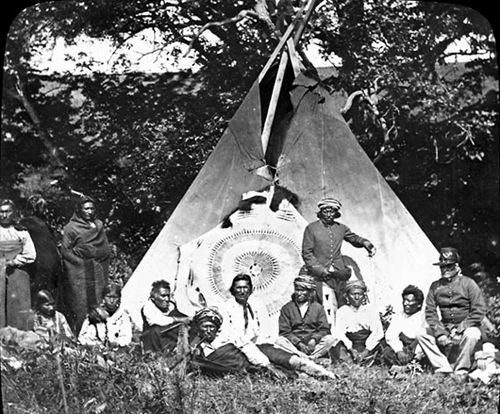
Omaha Scouts in 1865.
The Omaha tribe began as a larger woodland tribe comprising both the Omaha and the Quapaw. The original tribe inhabited the area near the Ohio and Wabash Rivers, near present-day Cincinnati, Ohio.
As the tribe migrated west, it split into the Omaha and Quapaw tribes. The Quapaw settled in what is now Arkansas, and the Omaha tribe, known as “those going against the wind or current,” settled near the Missouri River in what is now northwestern Iowa. Conflict with the Sioux and the splitting off of part of the tribe into the Ponca forced the Omaha tribe to retreat to an area around Bow Creek, Nebraska.
Their territory extended from near Yankton, South Dakota, south to Rulo, Nebraska, and westward up to 150 miles, an area of 35,600,000 acres. They had villages at Homer and Bellevue, Nebraska, and probably several other locations along the river.
They moved their village of 50-100 lodges every 8 to 15 years to clear the ground and create new hunting areas. Initially, it was their custom to build bark lodges; however, this was replaced with the idea of teepees borrowed from the Sioux and earthen lodges borrowed from their allies, the Pawnee.

Omaha Indian.
The tribe usually wore breechcloths, buckskin dresses, and moccasins. The men wore their hair in a scalp lock, with the rest of their hair braided and hanging down on each side of their heads. Polygamy was practiced, but the maximum number of wives that any one man could have was three. They are also the originators of the picturesque Omaha dance, which soon became common among most Plains tribes.
When the Omaha first encountered white fur traders around 1750 in the Bellevue area, they thrived as hunters and farmers. Buffalo served as their primary provision, providing food, clothing, blankets, rope, moccasins, fuel, shelter, and utensils. To supplement their diet, the Omaha also planted gardens containing corn, beans, squash, and melons.
In 1780, the Omaha tribe had almost 3,000 members, but by 1802, they had declined to a mere 300 due to sickness and warfare. The Omaha were settled in what is now Dakota County, Nebraska, when Lewis and Clark encountered them in 1804.
The Omaha lived under the protection of the powerful Pawnee, who claimed the whole Platte region. Since they occupied a subordinate position, the Omaha have never been as prominent in tribal history.
As the buffalo disappeared from the plains, the Omaha had to rely increasingly upon the U.S. government and its new culture. They joined with other tribes in treaties with the U.S. Government in 1830 and 1836. The March 16, 1854, treaty ceded all their lands west of the Missouri River and south of a line running due west from the point where the Iowa River leaves the bluffs, retaining their lands north of this line for a reservation. More than ten years later, in another treaty on March 6, 1865, they sold part of their reservation to the United States for the use of the Winnebago Indians.
The last full-blooded Omaha Chief was Big Elk, who died in 1846 and is buried in Bellevue Cemetery in Bellevue, Nebraska. Today, the tribe has about 5,000 members, with approximately 3,000 residing on the Omaha Reservation at Macy, Nebraska.
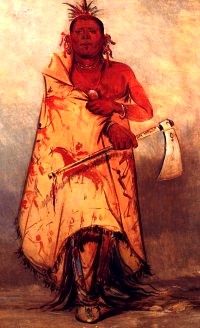
Omaha Chief Big Elk.
For more information, see the Omaha Tribe Website.
©Kathy Alexander/Legends of America, updated January 2026.
Also See:
Native Americans (main page)
Susan La Flesche Picotte – First Native Physician
Nebraska (main page)
Native American Photo Galleries (available for prints)