
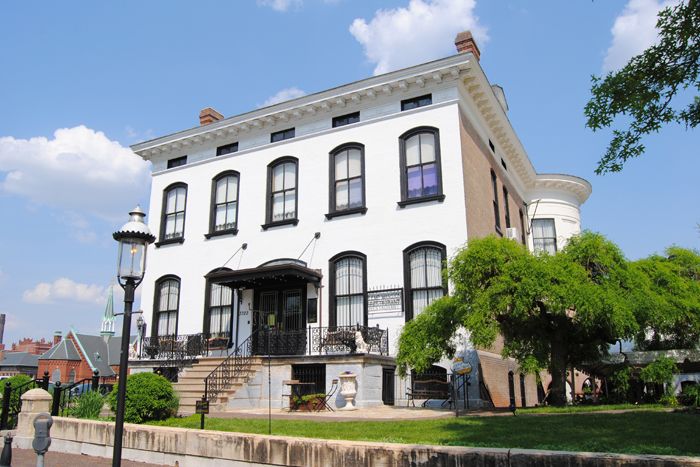
The Lemp Mansion in St. Louis, Missouri, by Kathy Alexander.
A house is never silent in darkness to those who listen intently; there is a whispering in distant chambers, an unearthly hand presses the snib of the window, and the latch rises. Ghosts were created when the first man woke in the night.
— James Matthew Barrie, “The Little Minister”
Said to be one of the ten most haunted places in America, the Lemp Mansion in St. Louis, Missouri, continues to play host to the tragic Lemp family. Over the years, the mansion was transformed from the stately home of millionaires to office space, decaying into a run-down boarding house. It was finally restored to its current state as a fine dinner theatre, restaurant, and bed-and-breakfast.
The Lemp Family began with Johann Adam Lemp, who arrived in St Louis from Eschwege, Germany, in 1838. Building a small grocery store at what is now Delmar and 6th Streets, he sold everyday household items, groceries, and homemade beer. The light golden lager was a welcome change from the darker beers that were sold at the time. The recipe, handed down by his father, was so popular that just two years later, he gave up the grocery store and built a small brewery in 1840, near where the Gateway Arch stands today.

Lemp Beer Label, 1892
Lemp first sold his beer in a pub attached to the brewery, introducing St. Louis to its first lager. Before long, Lemp found that the brewery was too small to handle production and storage, and found a limestone cave south of the city limits. The cave, located at the present-day corner of Cherokee and De Menil Place, could be kept cool by chopping ice from the nearby Mississippi River and depositing it inside, providing perfect conditions for the lagering process to run its course. Lemp’s Western Brewing Co. continued to prosper and, by the 1850s, was one of the largest in the city. In 1858, the beer captured first place at the annual St. Louis fair.
A millionaire by the time of his death, Adam Lemp died on August 25, 1862, and his son, William, began a significant expansion of the brewery. He purchased a five-block area around the storage house on Cherokee, above the lagering caves. In 1864, a new plant was completed at Cherokee Street and Carondolet Avenue. The brewery eventually covered five city blocks by continually expanding to meet the product demand.
By the 1870s, the Lemp family symbolized wealth and power, as the Lemp Brewery controlled the St. Louis beer market, a position it maintained until prohibition.
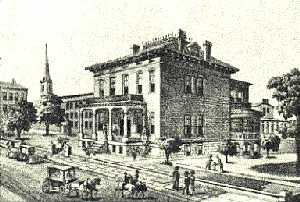
Lemp Mansion 1892.
In 1868, Jacob Feickert, William Lemp’s father-in-law, built a house a short distance from the Lemp Brewery. In 1876, William Lemp purchased it for his family, utilizing it as a residence and an auxiliary office. While the home was impressive, Lemp immediately began renovating and expanding the 33-room house into a Victorian showplace.
From the mansion, a tunnel was built from the basement through the caves to the brewery. When mechanical refrigeration became available, parts of the cave were converted for other purposes, including a natural auditorium and a theatre. This underground oasis would later be converted into a large concrete swimming pool, with hot water piped in from the brewery’s boiling house and a bowling alley. At one time, the theatre was accessible through a spiral staircase from Cherokee Street.
By the middle 1890s, the Lemp Brewery gained a national presence after introducing the popular “Falstaff” beer, which another company still brews today. The Lemp Western Brewery was the first brewer to establish coast-to-coast distribution of its beer. At the same time, he was building his own business empire; William Sr. also helped Pabst, Anheuser, and Busch get started.
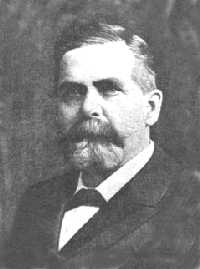
William Lemp
Amid this success, the Lemp family experienced the first of many tragedies when Frederick Lemp, William Sr’s favorite son and heir apparent, died in 1901 at the age of 28. Frederick, who had never been in excellent health, died of heart failure. The devastated William Lemp was never the same, beginning a slow withdrawal; he was rarely seen publicly after his son’s death. On January 1, 1904, William’s closest friend, Frederick Pabst, also died, leaving William indifferent to the details of running the brewery. Though he arrived at the office daily, he was nervous and unsettled. His physical and mental health began to decline, and on February 13, 1904, he shot himself in the head with a .38 caliber Smith & Wesson.
In November 1904, William Lemp Jr. took over as the new president of the William J. Lemp Brewing Company. Inheriting the family business and a vast fortune, he and his wife, Lillian, began to spend the inheritance. Filling the house with servants, the pair spent vast amounts on carriages, clothing, and art.
Lillian was a beautiful woman who came from a wealthy family herself. She and William Lemp, Jr. had married in 1899, and William J. Lemp, III was born on September 26, 1900. Before long, Lillian became known as the “Lavender Lady” because of her fondness for the color. In addition to her lavender attire and accessories, she went so far as to have her carriage horse harnesses dyed lavender. Initially, Will enjoyed showing off his “trophy wife,” but Will was a “player.” Born with a “silver spoon in his mouth,” he was used to doing and acting as he pleased.
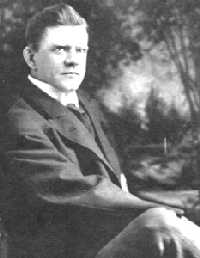
William Lemp II
When William began to tire of his beautiful wife, he demanded that she spend her time shopping. Allotting her $1,000 a day, he gave her an ultimatum that she would get no more if she didn’t spend it.
In the meantime, Will was busy running the brewery by day and pursuing all manner of decadent activities by night. Holding lavish parties in the caves below the mansion, he would bring in numerous prostitutes for the “entertainment” of his friends. Enjoying the swimming pool, the bowling alley, and the free-flowing beer, his friends who attended these lavish events were known to enjoy a high time on earth below.
Will’s shenanigans caught up with him when he sired a son with a woman other than his wife. Today, there is no official documentation of this boy’s existence. However, rumors that this boy was hidden in the attic of the mansion for his entire life have been prevalent over the years. According to St. Louis historian Joe Gibbons, when he interviewed a former nanny and a chauffeur who worked at the mansion long ago, they confirmed that the boy existed and was housed in the attic quarters that also served as the servants’ rooms. Spawned from Will’s philandering with either one of the many prostitutes or a mansion servant, the boy was born with Down’s Syndrome. A total embarrassment to the family, the boy was hidden away from the world to cloak the Lemp’s “shame.” Known today as the “Monkey Face Boy,” this unfortunate soul continues to show his presence at the Lemp Mansion.
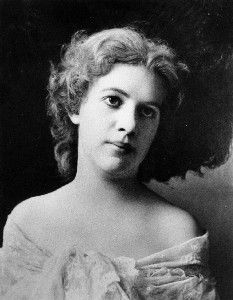
Lillian Handlen Lemp
Finally, William Jr. tired of his “trophy wife” and filed for divorce in 1908. Why she didn’t take this step with all of his goings-on could be nothing more than a sign of the times. The court proceedings surrounding the divorce became a major St. Louis scandal, with all four St. Louis newspapers devoting extensive front-page coverage to the messy affair. The trial opened in February 1909 to crowds that flocked to the courthouse each day to witness the drama of tales of violence, drunkenness, atheism, and cruelty.
Virtually ignoring William’s decadent activities, Lillian almost lost custody of William Lemp, III, because of a photograph presented at the trial that showed her smoking a cigarette. Ultimately, she retained custody of their son but soon retired from the public eye. The only time she was ever seen wearing anything other than lavender was on the final day of her divorce proceedings, when she appeared entirely in black before the judge.
With the divorce, Will’s troubles had only just begun. In 1906, nine large breweries in the St. Louis area combined to form the Independent Breweries Company, creating fierce competition that the Lemp Brewery had never faced. In the same year, Will’s mother died of cancer on April 16.
Though the brewery’s fortunes were continually declining, the Lemp Mansion was entirely remodeled in 1911 and partially converted into offices for the brewery. At the same time, William allowed the company’s equipment to deteriorate without keeping abreast of industry innovations. By World War I, the brewery was barely limping along.
William soon built a country home on the Meramec River, to which he increasingly retreated. In 1915, he married for a second time to Ellie Limberg, the widowed daughter of the late St. Louis brewer Casper Koehler.
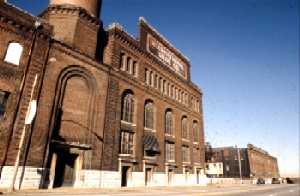
Lemp Brewery in St. Louis
Then Prohibition came along in 1919. The individual family members were already wealthy, so there was little incentive to keep the brewery afloat. For a time, Will hoped that Congress would repeal Prohibition, but finally gave up and closed the Lemp plant down without notice. When they came to work one day, the workers learned of the closing and found the doors shut and the gates locked.
On March 20, 1920, Elsa Lemp Wright, William’s sister, the wealthiest heiress in St Louis, shot herself just like her father had years before. Elsa was said to have been despondent over her rocky marriage.
In 1922, William Jr. sold the famous Lemp “Falstaff” logo to brewer Joseph Griesedieck for $25,000. The brewery buildings were sold to the International Shoe Co. for $588,000, a fraction of their estimated worth of $7 million in the years before Prohibition.
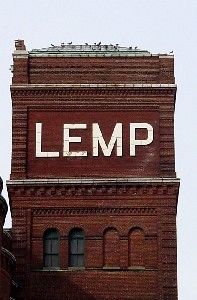
Lemp Brewery Tower
After the end of the Lemp’s brewing dynasty, William Jr. slipped into a depression. Acting much like his father, he became increasingly nervous and erratic, shunning public life and often complaining of ill health. On December 29, 1922, William shot himself in the heart with a .38 caliber revolver in the very same building where his father had died 18 years before. William II took his life on the main level of the mansion, just inside the entrance to the left. At the time of his death, this room served as his office. He was interred in the family mausoleum at Bellefontaine Cemetery, in the crypt just above his sister Elsa.
William’s brothers, Charles and Edwin, had long ago left the family business, so with William Jr. gone, it seemed that the Lemp empire had finally ended. Edwin had entered into a life of seclusion at his estate in Kirkwood, Missouri, in 1911. Charles had never been involved in the brewery and had chosen to work in the banking and real estate fields instead.
In 1943, yet another tragedy occurred when William Lemp III died of a heart attack at the age of 42.
Brother Charles eventually remodeled the mansion into a residence and lived there with two servants and the illegitimate child of his brother William. Charles, too, became an odd figure as he grew older. Developing a morbid fear of germs, he exhibited obsessive-compulsive behavior, including always wearing gloves to avoid bacteria and constantly washing his hands. During this time, William’s illegitimate child, now in his 30s, died at the mansion. He was buried on the Lemp Cemetery plot with only a small flat marker with the word “Lemp.”
Shortly after the “Monkey Face Boy’s” death, Charles became the fourth member of the Lemp family to commit suicide. First, he shot his beloved Doberman Pinscher in the mansion’s basement. Then, climbing the staircase to his room on the second floor, he shot himself. Charles was discovered on May 10, 1949, by one of his staff, still holding a .38 caliber Army Colt revolver in his right hand. Though the dog was shot in the basement, he was found halfway up the stairs.
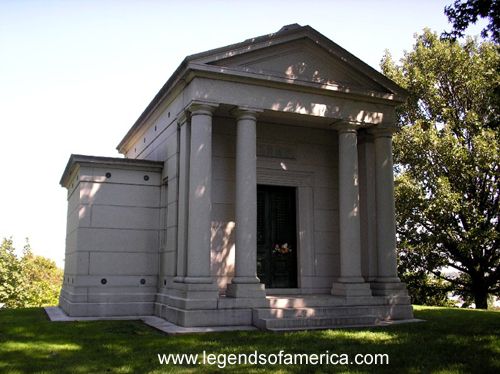
Lemp Family Burial Site, Bellefontaine Cemetery, St. Louis, Missouri, by Amy Stark.
Of the Lemps, only Edwin Lemp, who had long avoided the life that had turned so tragic for the rest of his family, remained. He was known as a quiet, reclusive man who had walked away from the Lemp Brewery in 1913 to live peacefully on a secluded estate in Kirkwood, Missouri. Edwin passed away quietly from natural causes at age 90 in 1970. According to Edwin’s last wishes, his butler burned all the paintings the Lemps had collected throughout his life, along with the priceless Lemp family documents and artifacts. These irreplaceable pieces of history vanished in the smoke of a blazing bonfire.
The Lemp family line died out with him, and the family’s resting place can now be found in beautiful Bellefontaine Cemetery.
After the death of Charles Lemp, the mansion was sold and turned into a boarding house. The building began to deteriorate along with the nearby neighborhood, and the haunting tales began. Residents reported hearing ghostly knocks and phantom footsteps throughout the house. As these stories spread, tenants were hard to find for the boarding house, and it continued to decline to a near-flophouse status.
However, in 1975, the old mansion was saved when Dick Pointer and his family purchased it. Immediately, they renovated the building, turning it into a restaurant and inn. Workers in the house often reported apparitions, strange sounds, vanishing tools, and a feeling of being watched. Frightened by the hauntings, many would leave the job site never to return.
Lemp Family Burial Site, Bellefontaine Cemetery, St. Louis, Missouri. Amy Stark,
Since the restaurant opened, staff members have reported several strange experiences. Again, apparitions appear and then quickly vanish, voices and sounds come from nowhere, and glasses often lift off the bar and fly through the air on their own. On other occasions, doors are said to lock and unlock on their own, lights turn on and off of their own accord, and the piano bar often plays when no one is near.
Said to be haunted by several members of the Lemp family, the old mansion has three areas with the most activity: the stairway, the attic, and what the staff calls the “Gates of Hell” in the basement. This area of the basement used to be the entrance to the caves running below the mansion and the brewery.
The attic is said to be haunted by William Jr.’s illegitimate son, referred to only as the “Monkey Face Boy.” This poor soul, born with Down’s Syndrome, spent his entire life locked in the attic of the Lemp Mansion. Strange occurrences are often witnessed on this third-floor level of the mansion. The boy’s face has regularly been seen from the street, peeking through the small windows of the mansion. Ghost investigators have often left toys in the middle of his room, drawing a circle around them to see if the objects have been moved. When they return the next day, the toys are consistently found in another location.
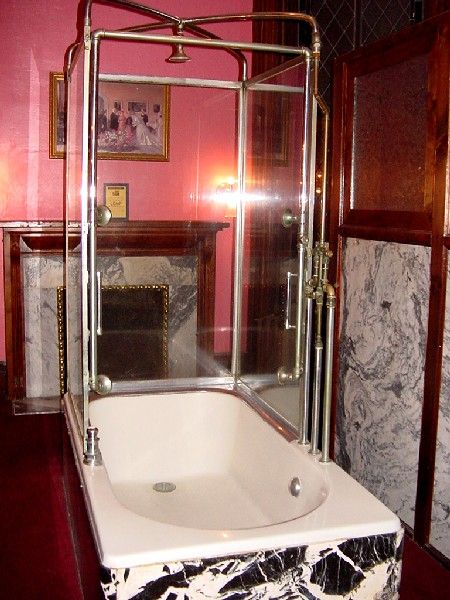
The Women’s Restroom on the main floor of the Lemp Mansion was once the personal domain of
William Lemp, Jr. By Kathy Alexander.
Many women have reported a man peeking over the stall in the downstairs women’s bathroom, which was once William Jr.’s personal domain and held the first free-standing shower in St. Louis. On one such occasion, a woman emerged from the bathroom, returned to the bar, and told the two men she was there with: “I hope you got an eyeful!” However, the two men quickly denied ever leaving the bar, and the bartender confirmed it. This ghost is said to be that of William Jr., the womanizer.
In William Lemp, Sr’s room, guests have often reported hearing someone running up the stairs and kicking at the door. When William killed himself, William Jr. was known to have run up the stairs to his father’s room and, finding it locked, began to kick the door in to get to his father.
Several years ago, a part-time tour guide reported hearing the sounds of horses outside the room where William Lemp, Sr had kept his office. However, nothing was there when the tour guide looked through the window. This area, north of the mansion and now used as a parking lot, was once utilized as a tethering lot for horses.
The mansion has been featured in several magazine articles and newspapers, and now attracts ghost hunters from around the country. Today, it features a bed-and-breakfast with rooms restored in period style, a fine-dining restaurant, and a mystery dinner theater. Tours are also available at the mansion.
The Lemp Mansion is located at 3322 De Menil Place, a short distance from the Mississippi River. To get there, take Broadway from Interstate 55 and follow that to Cherokee Street. Go west on Cherokee and turn right onto De Menil Place.
Contact Information:
Lemp Mansion
3322 De Menil Place
St. Louis, Missouri, 63118
314-664-8024
©Kathy Alexander/Legends of America, updated March 2026.
Legends of America Visits the Lemp Mansion
On Saturday, October 9, 2004, Kathy Alexander and Amy Stark visited the Lemp Mansion along with St. Louis historian Joe Gibbons. Joe has spent many years researching the Lemp Mansion and often gives tours of the inn with the owners’ permission and cooperation.
Meeting up with Joe at the bar, we settled in for a bit, pulling on a couple of lagers and chatting it up with Joe. After Joe kindly introduced us to Patty Pointer, he showed Amy and me around the mansion. As Joe described in intricate detail the history of the Lemp Mansion, the land on which it stands, and the many strange occurrences in the haunted building, our tour welcomed new members. By the time we reached the attic, more than 20 of us must have been there.
While we were on the tour, several strange events occurred. The first was when we were standing in the darkened attic. As Joe described the “Monkey Face Boy,” I began snapping pictures in the darkened room. Soon, I was approached by a woman who had joined our “unofficial” tour. She wanted to know if my shadow would appear on the wall when I took a picture.
I responded, “No, because the flash is in front of me.” Perplexed, she continued that when I took one picture in the attic, she saw a person’s distinct shadow against the wall. Hope against hope, I quickly scrolled back through my digital images to see if a shadow appeared, but there was nothing.
Even stranger, another group member reported hearing the very faint voice of a child saying repeatedly, “Help me, help me.”
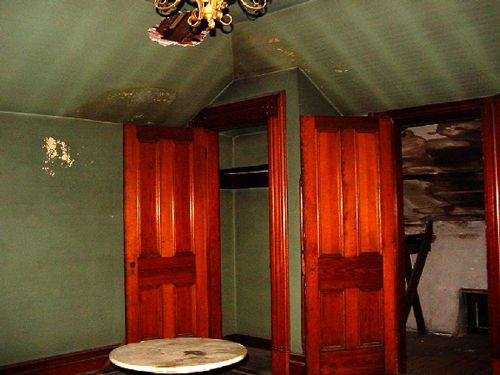
In this room, the woman said she saw a distinct human shadow on the wall when Kathy Alexander took this photograph.
As we made our way back down the stairs and passed by William Lemp Sr.’s room, Amy pulled me aside because the door was wide open, with the key in the lock. We’re not going in; we just wanted to peek. We continued our journey down the hall when the guests of the room raised an alarm. When they returned from dinner, they found the door wide open and were looking for a manager. However, there was no key in the door when they arrived. A manager quickly responded — it was “impossible” that there had been a key in the door, as there were only two keys to that room. One was in the guest’s hands, the other in the manager’s hands. So, who opened the door, and where did we see the key when we passed?
Later, several group members would describe passing a man in the hallway, holding a key and looking irritated as the large group moved through. He was described as pale, older, and wearing a white shirt and black pants; no one thought anything of it at the time, believing him to be a member of the staff. However, we would find that no such gentleman was working or staying at the mansion that night who met that description. Though no harm was done, and nothing was disturbed in the guest room, the experience was very bizarre.
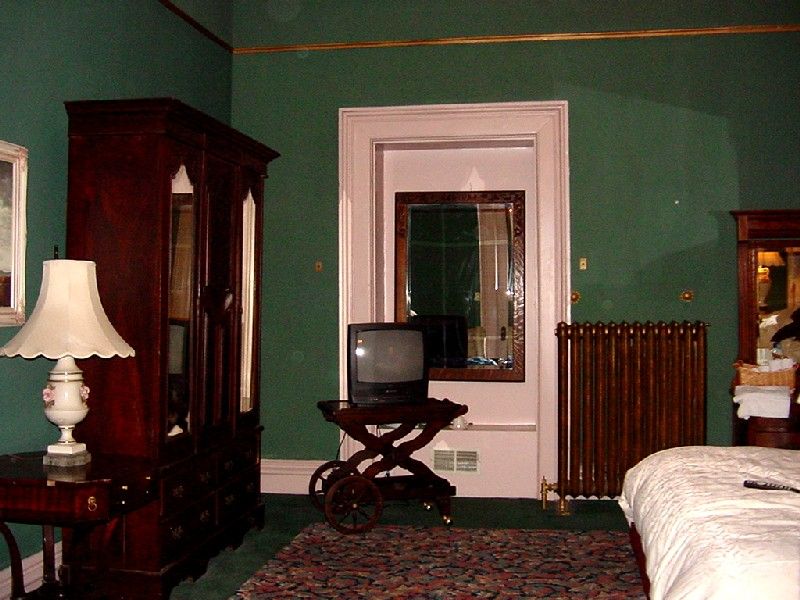
The Charles Lemp Room. Look very closely at the mirror on the door. Do you see anything??? Click on the picture to see a larger version, and you can also see several orbs in this room by Kathy Alexander.
Next, everyone was assembled around the Charles Lemp room. The guests staying in the room kindly allowed us to enter to look around. Amy and I sensed a heaviness in the bedroom area, but this was not the room where Charles shot himself; instead, it was the parlor area.
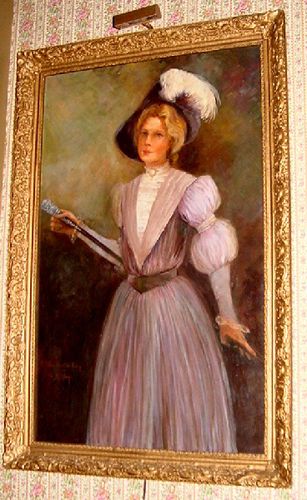
Painting of Lillian in the Lemp Mansion
One of the women who had joined our group told how she had been married in the mansion a year earlier and had carefully laid her dress and other items on the bed. She then turned away for a moment, but when she turned back, all the items were scattered. One group member reported smelling cigar smoke outside of Charles’ room.
On the first level of the mansion, the dining room to the left of the entryway once served as William Lemp II’s office, where he killed himself. In the corner of the room was his desk, where he sat with his gun in his final moments. The temperature in this corner was considerably colder than the rest of the room. On the wall is the painted portrait of Lillian Lemp – “The Lavender Lady.” One group member reported having smelled the distinct aroma of lavender while passing by her portrait.
Reader’s Experiences at the Lemp Mansion
A couple of weeks ago, my husband and I were a part of a large group that dined at that mansion. We were seated straight back from the entrance in a rear dining room. In the past, I have had a number of experiences with spirits (as early as age 6) and have come to the conclusion that I am far more ‘open’ to them than most people. We arrived late, so we were quickly whisked back to our table. Throughout our dinner, I did not sense anything; however, when leaving, we had an opportunity to linger in the entryway/entrance to the dining room, which is on the first left. I felt something immediately… I can’t say it was negative, but more nosy and cranky, and I got a strong sense it was male/masculine. I almost got the sense that he was seeking my attention, and I was drawn to the corner of the room that was diagonal from the entrance to the room. I felt a shiver, immediately developed goosebumps, and told my husband, “There is something/someone in that room. I’m getting major heebies. We left just after I said that, so I did not get another opportunity to explore.
Just today, I decided to Google the mansion, and lo and behold, that was William Lemp II’s office, where he took his own life. I do want to note that I had no sense of the Lavender Lady; however, I did not approach her painting.
Thanks for listening to my experience!
Submitted by Deanna Cole, August 2014
~~~~
Reader Submission – 2006
I stayed at the Lemp Mansion a few years ago with a friend. In the evening, we took the tour of the mansion, and when it was complete, everyone left, including the employees. We were all alone in the big, rambling house, as there were no other guests that night. My friend and I both got the creeps because we wanted to see something SO bad that we scared ourselves. It was kind of like when you get the feeling you’re being watched.
I don’t believe in ghosts one way or the other, really. But, still, it was fun going around and trying to scare each other. There was only one thing that happened that was kind of strange. We heard a cat meow in the top-floor bedroom – the mustard yellow room. We could distinctly hear it coming from the other side of the bed, but when we looked, there was nothing.
The staff had given us a couple of bottles of wine, and after drinking them, I got very brave in the middle of the night. I went up to the attic alone and saw some balloons that were left over from something that had gone on that day. One blew right past me, but I think it was the air coming from the heating system. It’s an old mansion; it could have been anything, so I didn’t freak. But I did go back downstairs.
While I was there, I didn’t have any problems with my camera, but though there were several photographs on the roll, the only ones with orbs in them were at the mansion. I thought it was watermarks or something. I looked at other people’s orb pictures online, and they all look alike. I’m sure there’s an explanation because I don’t think a ghost could show up on film. But here are my photos from that moment with the balloon. These pictures are both from the attic. The one with the “orbs” was the ONLY photo on my entire roll of film that had these in the picture.
Submitted by Robin, August, 2006

This photo shows the orbs in the attic that Robin is talking about.
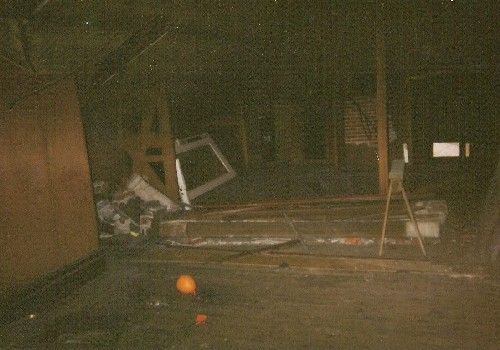
The balloon that Robin saw blowing past her.
Reader Submission – 2005
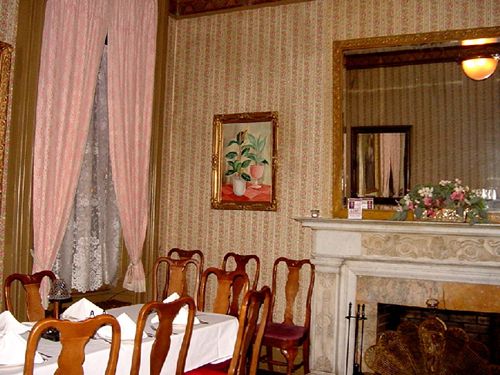
It was in this corner that William Lemp’s desk, where he shot himself, once sat. Notice the streak across the top of the mirror. Similar streaks showed up in many pictures that included mirrors. By Kathy Weiser-Alexander.
Having chosen a weeknight to spend our anniversary at the Lemp Mansion, we arrived at 3:00 p.m. and were given Charles Lemp’s room. We had planned to eat dinner there that evening, but for some reason, the restaurant closed shortly after we arrived, and we were amazed to find that we would be left to spend the night in the entire mansion alone!
When we first arrived and were wandering around on the second floor, my husband mentioned he noticed a sewer odor. I didn’t notice it, so I didn’t pay any attention.
What I have in common with some of the others who have related their experiences on this website is that strange, uneasy feeling that someone was watching you. Someone also mentioned a “creeped out” feeling. These were the exact words I used! I don’t know how many times I told my husband that night that “I keep getting this creeped out feeling.”
Another similarity I had was with USAF Duane’s experience with the missing dimes. When we got to our room, I opened the suitcase and took out two packages of Fuji brand disposable film. I was struggling to open the packages, so I reached into a Ziploc bag containing cheese and sausage and took out the knife I included with these. I then used it to open the film packages. Once I took out the knife, we never saw it again! Let me add that this occurred in the very same room Duane (with the missing dimes) stayed in! The Charles Lemp room.
I had never unpacked our suitcase other than to take the plastic bag out and replace it. Since we were only spending one night, I didn’t want to have to rush and pack the following morning.
Every time my husband and I returned to our room from roaming about the mansion, one or both of us would look for the knife. We checked and re-checked every surface, the floors, under the bed, sofas, drawers, etc. It was nowhere to be found! What was infuriating was that the room was immaculate, yet it was nowhere to be found, and we didn’t leave the room with it. As the night progressed, we both became more and more obsessed with the knife’s whereabouts.
As we roamed about the mansion, we took photos, and as the evening progressed, I, too, began to notice the odor of sewage. It grew stronger and more prevalent until it appeared to be everywhere, ultimately becoming most noticeable when I decided to sit in the bar.
While sitting at a table in the bar, I had my husband snap a photo of me at the bar and another by the Lemp mirror on the right side. I then took a picture of the doorway near where the Lemp mirror hung.
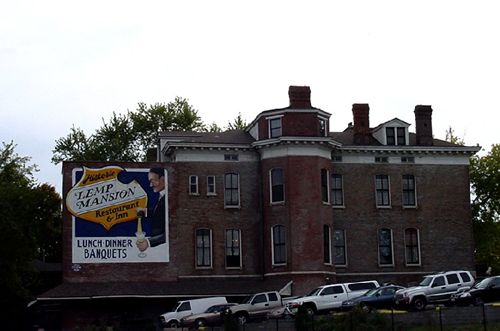
Side view of the Lemp Mansion.
When these photos came back (later) from developing, we discovered some rather unusual images. Of the two rolls of film, with the exception of the photos taken outside, all the photos taken in the house had a greenish cast. The photo of the doorway showed a strange, foggy smoke spreading from the bar to the doorway along the wall, forming a full silhouette of a woman; I believe it is the Lavender Lady.
This past October (2004), my husband and I attended Lemp Mansion’s Halloween party, where he took a picture of me standing in the bar’s doorway. As you may recall, I mentioned the woman’s silhouette previously occupied this very same spot. When we got the film back, this photo contained a huge orb just off to the right of me.
My sentiment about staying at Lemp when we left was similar to that of the USAF retiree, Duane. As we headed out the door and down the stairs toward the sidewalk to our car, I was relieved to be going home and swore I’d never return!
Needless to say, my husband and I frequently eat at the restaurant and have now decided to make it the place we go to celebrate Halloween. But as to whether I’ll spend another night there? Not unless another couple goes with us. Oh, and by the way, we never did find the knife!!!!
Submitted by Xenia Williams, July 2005.
About the Author: I have captured all kinds of strange paranormal activity on film. Some of the more interesting are from this apartment that we’ve lived in for the past five years, the Lemp Mansion, and a storefront in Soulard. I have researched the area we live in, and now I understand why I have experienced the phenomena I have. What I have found in the area is that historically, it has housed a poor house, an insane asylum, an amusement park, and a doctor who ran a medical college that brought “body snatching” not only to his medical students but to St. Louis and literature. It makes sense now.
Read Submission – 2005
My husband, two teenage daughters, and I spent a night at the Lemp Mansion after having a camping trip rained out. It was so much better than camping!!!!! It was like being on an overnight ride at Disneyland!!!!!! First off, Patty Pointer and the staff were the most fun innkeepers we have ever met. They took great care of us. And… the other “hosts” were fun too!!!! They didn’t let us down. My oldest daughter had just finished dressing for dinner when she turned to put her things in her suitcase. Suddenly, she heard a creaking noise and turned to find that the medicine cabinet had opened on its own. This was in the Charles Lemp Suite. The cabinet door had a latch that could not have fallen open.
While we were there, we had an overwhelming feeling of being watched. Though a little disconcerting, the feeling was not bad — more protective. The medicine cabinet incident struck us as funny because she was dressing for dinner, and when the cabinet opened, it was full of soap, as if someone were saying, “If you need soap, there is some in here.” We can’t wait to do this again, and we would recommend it to anyone looking for something different to do.
Submitted by: Kat Robinson, July, 2005
About the Author: I am a yoga instructor and a bit of a ghost hunter. I have always been open-minded to the “other side.” We have raised our children to know that ghosts are just part of the living, and we should respect their space as if we would if we were visiting anyone alive.
Reader Submission, 2004
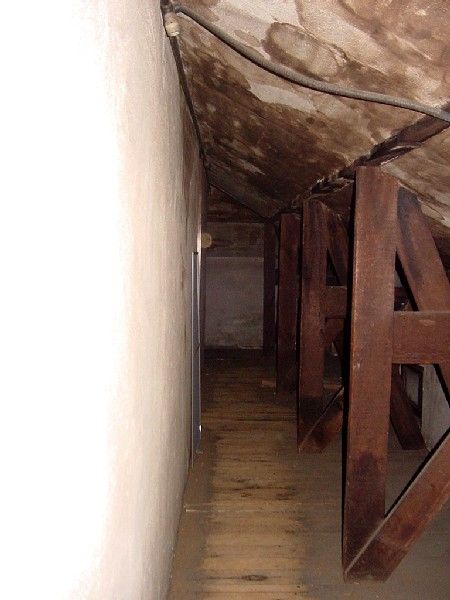
Under the eaves in the attic. It is here that the Monkey Face Boy often played. Notice the large orb at the back. By Kathy Alexander.
My name is Renee, and I have family in St. Louis, Missouri, so when we visit, my husband and I, along with my brother and my cousin, make a trip to the Lemp Mansion. Our last visit was on March 24, 2003. We arrived at the mansion around 8:30 p.m. to find that a show and dinner party were in effect; however, we were told we could look around on the main floor and upstairs. Neither my husband nor I had ever been in the attic, so that’s the first place we headed. Already creeped out because of the darkness and silence, our group soon reached the end of the long hall, where the “monkey boy” was kept. However, as we turned around to leave, all four of us got instant chills when we heard a little boy say, “Come play with me.” I told my brother to shut up, and he responded, “I didn’t say anything.” That’s when the boy repeated himself again. I then turned to my husband, saying the same thing to him as I had to my brother, and he said, “That wasn’t me; it’s time to go.” That was the first encounter in my ten years of visiting the Lemp Mansion, and I hope there will be more. I’m fascinated with ghosts! For Thanksgiving 2004, we’ll be making another trip to Missouri, and hopefully we’ll bring back good stories.
Submitted by Renee, October, 2004
Reader submission 2006
I visited the Lemp Mansion in January 2003 with my aunt. We arrived early and had lunch at the Lemp Mansion before checking out the sights of St. Louis. We, too, were shocked that we were given a key and told we’d be all alone that night in the mansion. We were the only ones staying there that night, mind you, but we didn’t know this then. I assumed someone lived there, and they meant alone, as in no other guests.
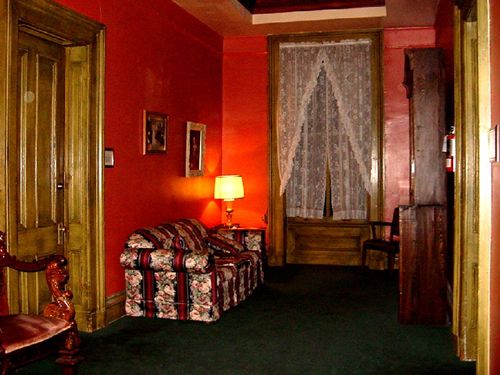
The hallway outside Charles Lemp’s room. Notice the large orb on his doorway. By Kathy Alexander.
I felt uneasy right away, the second I got to the top of the stairs. My aunt seemed okay and wanted to explore, but I felt this heaviness. The hallway off to the left of the stairs was the worst. My body just would not physically go in that hallway! We had reservations at a comedy club that night, so we decided to take a nap. An hour into my nap, I awoke to the sound of a baby crying and a woman talking. I got a little irritated because it was right outside our room (we were in the big suite – the Lavender Lady’s room), and how rude it was of this woman to just stand up there and make all that noise!
But then it stopped, and I went back to sleep. When we got up, we found two women downstairs taking down the Christmas decorations, and we got to talking to them. That was when we learned we were the only ones there that night, and I asked the women to leave the light on in the dining room so it wouldn’t be pitch-dark when we got back from the comedy club. The women told us their experiences, and we laughed. Off-handedly, I asked if they were the ones with the baby. I heard the crying at 5 pm and was promptly told that no one else was there besides them after 3 pm, and definitely no baby. I felt silly for even thinking I had heard such a thing, and was convinced these women were trying to scare us.
That night, when we got back, we were alone. My aunt wanted to explore, but that uneasy feeling overwhelmed me. We went into the other bedrooms and walked around. The bedroom across from the suite was so heavy-feeling. My aunt went towards the “hallway” and went to look into the other rooms, but I could NOT get my body into that hallway! I stopped halfway in and watched my aunt peeking into the rooms. She got to the end of the hallway and bent over to peer into the staircase, and a shadow went past me – but I was looking right at my aunt’s shadow! Well, I freaked out and demanded we call it a night.
The uneasy feeling never left me, and when we went to bed, I was too scared to sleep. The final straw came when the piano began to play. I was done! My aunt gave me a Valium to help me sleep (yes, now I find these events very funny, but at the time, not so funny!). After that, I was out, head under the covers and asleep. My aunt says she awoke at night to someone “petting” her hair. She thought I was messing with her and turned over to find me completely out, and turned the other way. She turned back over and said a few minutes later, it happened again. She said she never felt scared and that it felt comforting to her. Mind you, this is a 55-year-old psychiatrist!
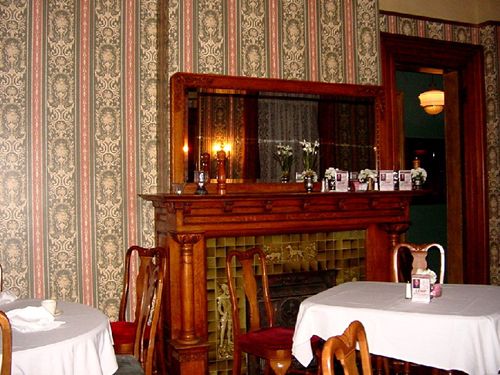
Another Dining Room. Notice the mirror has the strange streaking that tends to show up in every picture taken with a mirror. By Kathy Alexander.
When I got home, I searched my suitcase for my phone, but it wasn’t there. I called the Lemp Mansion, and they sent someone up to look, but it wasn’t there. I called the rental car company, and they couldn’t find it in the car. I ended up having my phone turned off, convinced someone had it. When the bill came in later, we realized ALL the phone calls had come exactly 38 minutes after the hour, and ALL of them had been to my husband’s phone. Now I don’t get that, but I do know that it was creepy! People say that the people at the mansion probably did it on purpose. Whatever the case, I still find the situation disturbing! But will I go back again someday? You bet! But I will make sure my cell phone stays on my person this time! –
Julie Meyer, January 2006
Reader Submission, 2004
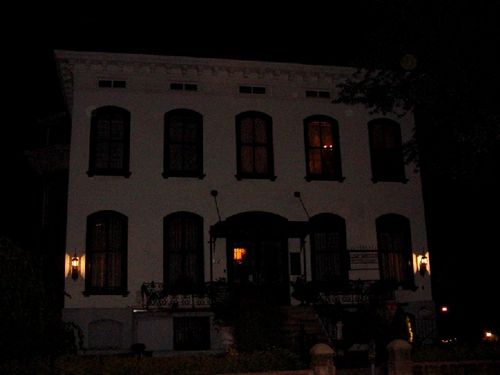
The Lemp Mansion at Night, by Kathy Alexander.
My name is Kristen, and I met Kathy Weiser of Legends of America on October 9 at the Lemp Mansion. My husband and I were staying in the William Lemp Suite and joined the tour of the Lemp Mansion. Other than not being able to sleep until after 3 a.m. (I was unbelievably hot, probably from adrenaline.) Not too much happened. We took a tour of the house by ourselves after the staff left. There was definitely a feeling of being watched, although a big, old house like that, late at night – I guess it’s to be expected. I did, however, have four orbs show up in my photos. 1) On the grand staircase, 2) in The basement bar, right below the stored wine bottles, 3) Our room – in the curtain (window overlooks main street), and 4) In Charles Lemp’s room, top right corner of the armoire. I was extremely skeptical about “orbs.” Following a suggestion from a website, I looked through all my personal photos from the past to see if there might be orbs I had not noticed before. I found none. Now I have four on one roll of film.
Kristen, October 13, 2004.
Reader Submission, 2004
We recently visited the mystery play/Dinner and Bed & Breakfast at the Lemp Mansion. I am a 50-year-old male USAF Retired with a Master’s Degree in I.S. (Simply for credibility purposes). We enjoyed the play and the food. However, will never go back for a night’s stay. First of all, the breakfast had much to be desired. Second, we could not sleep due to an uneasy feeling of being watched. I had a bad dream and woke up several times during the night. My wife could not sleep either. We strongly believe the door to our room was left unlocked after we locked it when we came back from the shared bathroom down the hill. We also dropped two coins in a 10 X 10 open area, and when we knelt down to pick them up, they were gone. We looked throughout the area and under furniture several feet away and still could not find the coins. This was in William Lemp’s Bedroom. It was an interesting stay that we do not intend to repeat.
Duane, June 22, 2004
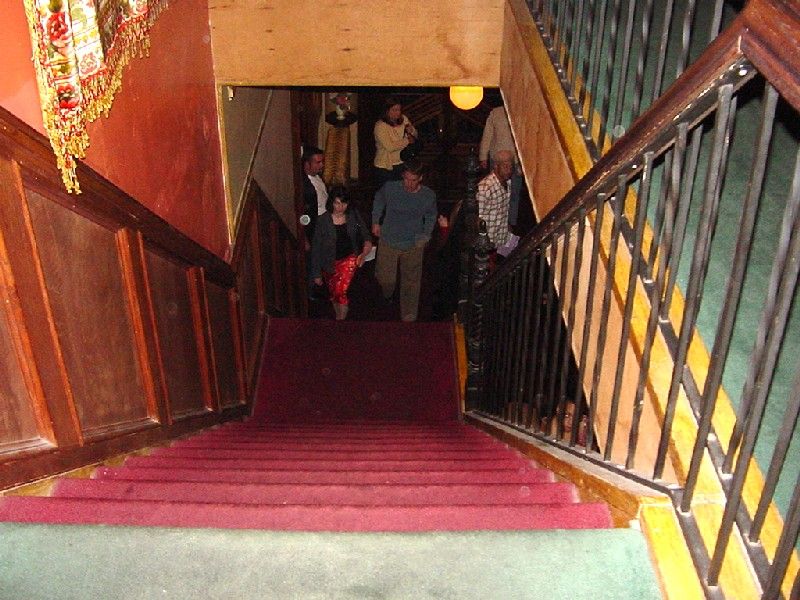
The staircase at the Lemp Mansion is said to be one of the three areas of ghostly activity. When you click on the picture to view an enlarged version, you can clearly see several orbs at the top. Even more creepy, see the little boy peeking through the banisters on the right side of the photograph. There were NO children with us that night. Moreover, that landing is more than 15 feet high!! By Kathy Alexander.
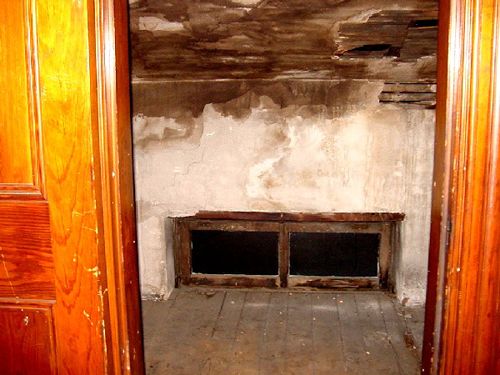
Its this window in the attic that people in the street office see the Monkey Face Boy peeking out of. By Kathy Alexander.
Reader’s Comments:
I was looking at the pictures of the mansion, and one in particular stands out. It’s one of the Lemp Mansion at night, October 2004. Is there supposed to be someone standing in front of the museum? Because if I am looking at this picture correctly, there is a man standing to the right of the staircase just behind the cement pillar. All I can see is his face and possibly a cane. – Carrie, St. Louis, September 2008
Editor’s Note: The photo shows a parking meter and a tree in the background. There is no man. We can’t explain what looks like a face.
In your picture of the Lemp Mansion staircase, right under the boy’s chin is another child. Once I saw the boy in the picture, I heard the other boy’s voice saying, “Me too, I’m here.” I just wanted to let you know. Once again, thank you. – Luz, July, 2006
Also See:
St Louis – Gateway to the West
St. Louis Area Legends & Folklore
Ghosts of the Bethlehem Cemetery, St. Louis
Haunted Bissell Mansion in St. Louis