

An A.I.-generated depiction of La Llorona.
The legend of La Llorona (pronounced “LAH yoh ROH nah”), Spanish for the Weeping Woman, has been a part of the Southwest’s Hispanic culture since the days of the conquistadores. The tall, thin spirit is said to have natural beauty and long, flowing black hair. She wears a white gown and roams the rivers and creeks, wailing into the night and searching for children to drag, screaming to a watery grave.
No one knows when the legend of La Llorona began. Though the tales vary from source to source, the common thread is that she is the spirit of a doomed mother who drowns her children and spends eternity searching for them in rivers and lakes.
La Llorona, christened “Maria,” was born to a peasant family in a humble village. Her startling beauty captured the attention of the area’s rich and poor men. She was said to spend her days in her humble peasant surroundings, but she would don her best white gown in the evenings and thrill the men who admired her at the local fandangos.
The young men waited anxiously for her arrival, and she reveled in the attention she received. However, La Llorona had two small sons, which made it difficult for her to spend her evenings out, and she often left them alone while she cavorted with the gentlemen. One day, the two small boys were found drowned in the river. Some say they drowned through her neglect, but others say they may have died by her own hand.
Another legend claims La Llorona was a vibrant, loving woman who married a wealthy man who lavished her with gifts and attention. However, after she bore him two sons, he changed, returning to a life of womanizing and alcohol, often leaving her for months at a time. He seemed no longer to care for the beautiful Maria, even talking about leaving her to marry a woman of his wealthy class. When he returned home, it was only to visit his children, and the devastated Maria began to resent the boys.
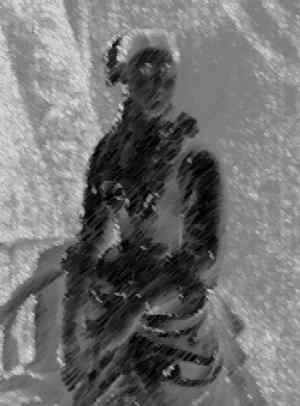
La Llorona – The Weeping Woman of the Southwest.
One evening, as Maria was strolling with her two children on a shady pathway near the river, her husband came by in a carriage with an elegant lady beside him. He stopped and spoke to his children, but ignored Maria, and then drove the carriage down the road without looking back.
After seeing this, Maria went into a terrible rage and, turning against her children, she seized them and threw them into the river. As they disappeared downstream, she realized what she had done and ran down the bank to save them, but it was too late. Maria broke down into inconsolable grief, running down the streets screaming and wailing.
The beautiful La Llorona mourned them day and night. During this time, she would not eat and walked along the river in her white gown, searching for her boys—hoping they would return to her. She cried endlessly as she roamed the riverbanks, and her gown became soiled and torn. When she refused to eat, she grew thinner and appeared taller until she looked like a walking skeleton. Still a young woman, she finally died on the riverbanks.
Not long after her death, her restless spirit began to appear, walking the banks of the Santa Fe River when darkness fell. Her weeping and wailing became a curse of the night, and people grew afraid to go out after dark. She was said to drift between the trees along the shoreline or float on the current, her long white gown spread across the water. On many nights, people saw her walking along the riverbank and crying for her children. So they no longer spoke of her as Maria, but as La Llorona, the weeping woman. Children are warned not to go out in the dark, for La Llorona might snatch them, throwing them to their deaths in the flowing waters.
Though the legends vary, the apparition is said to act without hesitation or mercy. The tales of her cruelty depend on the version of the legend you hear. Some say that she kills indiscriminately, taking men, women, and children — whoever is foolish enough to get close enough to her. Others say she is very barbaric and kills only children, dragging them screaming to a watery grave.

Tolby Creek in Cimarron Canyon, New Mexico, by Kathy Alexander.
When Patricio Lugan was a boy, he and his family saw her on a creek between Mora and Guadalupita, New Mexico. As the family was sitting outside talking, they saw a tall, thin woman walking along the creek. She seemed to float over the water, started up the hill, and vanished. However, moments later, she reappeared much closer to them and disappeared again. The family searched for footprints but found none, and they did not doubt that the woman they had seen was La Llorona.
She has been spotted along many rivers across the Southwest, and the legend has become an integral part of Hispanic culture everywhere. Part of the legend is that those who do not treat their families well will see her, and she will teach them a lesson.
Another story involves a man named Epifanio Garcia, an outspoken individual who often argued with his mother and father. After a heated argument, Epifanio and his brothers, Carlos and Augustine, decided to leave their ranch in Ojo de La Vaca to head toward the Villa Real de Santa Fe. However, on their way, a tall woman visited them, wearing a black tapelo and a black net over her face. Two boys were riding in the front of the wagon when the spirit appeared on the seat between them. She was silent and sat there until Epifanio finally turned the horses around and headed back home, when she said, “I will revisit you someday when you argue with your mother.”
During my travels to New Mexico, I visited with a very friendly Hispanic gentleman, whom I asked if he believed in La Llorona. He wholeheartedly confessed that he did and was very open about his cultural beliefs. However, when I asked him if he believed in ghosts, he said he did not. Interesting.
— Kathy Alexander
In Santa Fe, New Mexico, the tall wailing spirit has been repeatedly seen in the Public Employees Retirement Association building, which was erected on land that was once an old Spanish-Indian graveyard near the Santa Fe River. Many people who have been employed there report hearing cries echoing through the halls and feeling unseen hands pushing them while on the stairways.
Many have heard La Llorona at night, wailing by rivers, and her wanderings have grown wider, following Hispanic people wherever they go. Her movements have been traced throughout the Southwest and as far North as Montana on the banks of the Yellowstone River.
The Hispanic people believe that the Weeping Woman will always be with them, following the many rivers looking for her children. For this reason, many of them fear the dark and pass the legend from generation to generation.
©Kathy Alexander/Legends of America, updated October 2026.
Ghostly woman.
Readers Stories:
La Llorona woke me up once when I was fifteen and camping at Indian Falls Rapids on the Yampa River in Colorado. I walked with her to a cabin with a man in the bed. All I saw was his foot, but when she yelled at me to run, I did. If I hadn’t smashed my toe on a rock, I would have run off the cliff into the Indian Falls rapids. I saw an article in this month’s Mountain Gazette about her and looked her up online. My experience was 21 years ago.- Bryan, Colorado, October 2008
A Kansas Tale
While working as a copy editor for a newspaper recently, I discovered a wire story about La Llorona. That brought back memories of what happened to me as a student at Kansas State University in the early 1980s in Manhattan, Kansas, and led me to your website, where I read more about the legend.
One evening, I visited a mobile home that I seem to recall was near a creek or river to see a couple of my friends who were also attending K-State. I found them sitting on the sofa, somewhat freaked out as I entered the door. They explained that one of the barstools had been spinning and hopping around just moments earlier. As they were Mexican-Americans, they wondered whether La Llorona had anything to do with that incident. They explained the legend to me, as I had never heard about it.
They would invite me to stay the night in a spare bedroom, which I did. Later that night, a woman appeared beside me in bed and asked if I knew where her children were. While I may have been dreaming, I was half awake. Then I fully awoke and looked up toward the doorway, just in time to see a dark figure looking at me, then quickly ducking back out. Right then, I was too scared to see if it was one of my friends checking in on me, maybe to see why I was talking in my sleep or something like that. I went back to sleep and waited until the morning to ask them if either one of them had looked into my room during the night. Neither one did.
To this day, I still do not know whether I truly experienced a supernatural visit or if my dream and mind played tricks on me.
Submitted By: Name and city withheld, August 2006
A Bizarre Coincidence of La Llorona
In seventh grade, I had a frightening dream. I saw myself standing on a dark road with the only illumination coming from a dim streetlight. The ground was wet, and in the distance, I heard rain falling and the tap, tap, tapping of footsteps approaching me. Peering into the darkness, I saw a woman dressed in all black, a dark, lacy veil covering her face, moving toward me. Strangely, as the mysterious woman grew closer, so did the rain.
When the woman was about 15 feet behind me, she looked over my shoulder. When I turned to see what she was looking at, I saw a young child in a white nightgown playing with a doll in the middle of a puddle. When I turned back, she was right in front of me. The veil was lifted, her eyes were abnormally wide, and her face was no more than three inches away from mine. Her terrifying eyes stared into mine, dead on, until I awoke in a panic. I looked toward the window – it was raining. As you can imagine, I didn’t sleep for the rest of the night.
The next day, I shook off the dream and thought nothing more about it until a year later. I spent the night with my friend Veronica, who had also invited another friend named Sarah. That evening, Sarah, who is of Hispanic descent, began sharing some of Mexico’s cultural legends and ghost stories with us. When she began telling the tale of La Llorona, I didn’t think much of it at first. Then she explained how the legendary spirit travels by water, dressed in black or white, and is almost always seen wearing a veil. Sarah continued by telling us that La Llorona lifts her veil only to her “victims” and that in their afterlife, she has chosen to help her find the bones of her lost children.
Now, I constantly wonder if, in my afterlife, I will be forced to help her find the bones of her lost children.
Submitted By: Tonia Apelar of Eureka, California, November 2005
La Llorona in Texas

San Bernard River, courtesy of the Texas Watch Website.
As noted above, La Llorona doesn’t limit her travels to New Mexico. She seems to follow Hispanic people wherever they go, as shown in Pete Sanchez’s story about crossing the San Bernard River Bridge in East Bernard, Texas. East Bernard is Southwest of Houston in Wharton County. This old community built its first residence around 1850 on the East side of the San Bernard River. Today, the San Bernard Bridge spans the river.
Several years ago, Mr. Sanchez was driving along in East Bernard with the radio blaring. As he crossed the bridge, he was startled. He looked to the right and saw a semi-transparent woman sitting in his passenger seat.
Dressed all in black, a lacy black veil covered the spirit’s face. Frightened, Sanchez hit the gas, sped past the bridge, and didn’t look back at the passenger seat. It wasn’t until he passed the bridge that he found the courage to look again. The spirit had vanished. Mr. Sanchez readily admits that he is still haunted by that ghostly image today. When Mr. Sanchez read the story above about the Garcia brothers encountering a tall woman wearing a black tapelo and a black net over her face, who appeared on the wagon seat between them, he obviously saw similarities. We agree!
La Llorona in Mexico
My story of La Llorona takes place in Mexico. When I was eight years old, my abuelita (grandma) told me to go to the store to buy soda in the evening as we were getting ready to eat supper. My brother and I left for the store, and along the way we heard wailing, but we didn’t pay much attention. However, as we continued, we saw a young woman walking toward us. Suddenly, my little brother started to cry, and the woman ran toward him, acting as if she was going to get him. When we saw she was floating instead of walking, we ran back to our house and told our grandmother and mom what had happened. We locked the door and prayed to God to help us and make La Llorona disappear.
Submitted by Daisy Calderon. Daisy is now 12 years old and genuinely believes that La Llorona is a real entity.
An Attack by the Weeping Woman
When I was about eight, I began to develop an interest in all things paranormal. I was researching La Llorona when I suddenly heard a noise, so I decided to investigate. Then I heard it again. It sounded like it was coming from the bathroom, so I walked in and stopped at the sink. Suddenly, my head was pushed into the sink, and the water started running. The sink filled, and I tried to breathe. Then I couldn’t breathe anymore. I thought I was going to die of a lack of oxygen. So I screamed, and my mom came in. She pulled my head out after a struggle and hugged me tightly. She knew I wouldn’t drown myself, so she started thinking. Then she froze, and her face turned white. She screamed and almost fainted. I asked her what was wrong, and she said, stuttering, “La-La-La Llorona.” – Emily Ortiz.
My Story of La Llorona
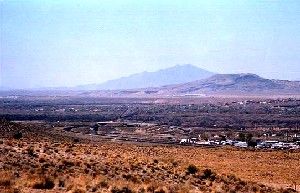
South Valley, Albuquerque, New Mexico.
At the age of seven, I attended the new Pajarito School in the South Valley of Albuquerque, New Mexico. I loved attending the Pajarito School, especially when it was time to play outside in the schoolyard. A high fence surrounded the playground to keep the children from wandering off. Behind the fence ran an irrigation ditch that fed an alfalfa field on the other side. In the high, arid lands surrounding Albuquerque, ditches seemed everywhere, watering the fields beyond the city.
Soon, we met a little boy who was not yet old enough to attend school. He often came to play by the fence, watching the older children frolic in the schoolyard. But one day, a big commotion near the schoolyard fence interrupted our play. We soon discovered the little boy had fallen into the irrigation ditch as we ran toward the fence. One of our teachers pulled the boy from the muddy water and began resuscitation efforts, but it was too late. That was the first time I had ever experienced the loss of a friend.
The next day at school, one of the children told me La Llorona had gotten the boy. I could only stand there speechless, having never heard of La Llorona. They explained that she was the “ditch lady” who wandered up and down the ditches looking for little kids to “steal” because her own children had drowned in a terrible accident. That frightened me because two of these muddy trenches were outside my back door. On cloudy days, we could imagine her ascending from the heavens to take her place along the irrigation ditches.
Submitted By: Reverend Elizabeth Kirkwood
About the Author: Reverend Elizabeth Kirkwood lived in Albuquerque, New Mexico, as a child. Today, she is a practicing Methodist Minister in Oklahoma and Kansas. She and her husband, Cody, have been married for 14 years and love to tell their girls stories that help them embrace their Hispanic heritage. Elizabeth currently attends Northwestern Oklahoma State University in Alva, majoring in Social Work. Enrolled in a Mythology class at the moment, she was assigned to write a paper and has chosen La Llorona.
My Mom’s Bedroom Window
My mom lived in the same house in Santa Fe, New Mexico, for almost 50 years. When she was about 12, she and her cousin sat in her bedroom (which later became mine) at night in the middle of Winter. It had been snowing. At one point, they heard a noise outside the window. When they looked, a woman stood there, dressed all in white and crying.
My mom and her cousin were a little freaked out, and they ran out of the room to tell her mom. Her parents went outside to investigate, but found no footprints in the freshly fallen snow. They came back inside and told her what they had found, or rather, what they hadn’t found. That scared my mom even more; she was afraid to return to her room.
When I was about eleven, I was sitting alone in my bedroom (in the same house my mom grew up in) at night, in the middle of winter, and it was snowing. I heard a noise outside my window. I’m afraid of the dark, so I didn’t check to see what it was; I just left the room and did something else for a while. When I told my mom, she shared a story with me. She said La Llorona was outside the window both nights.
Submitted by Brandi, June 2005. Brandi has lived in Santa Fe, New Mexico, and is passionate about ghost stories and the paranormal. She is also afraid of the dark.
Cries in the Night
When I was 12 years old (1991), my parents separated, and my mother moved my brother and me to Monterrey, Mexico. In the Winter, all three of us slept in the same room because there was no central heating—only electric heaters. My mother and brother had two beds. I slept on the floor in a sleeping bag next to my mother’s bed. One night, around 2:30 a.m., I woke up from a dream about my great-grandmother. She kept calling my name—three times, to be exact. Just a few minutes later, I heard the scariest screams coming from down the street. It was horrible!!! The cries continued, each time coming closer. I was so horrified that I could not even wake my mother, who was lying beside me! I was so scared that I didn’t even blink. It was the most evil cry I have ever heard! Finally, it passed my house and slowly faded away! The next day, I told my mother. I didn’t believe in stuff like this, especially not La Llorona. After that night, I do.
Submitted by: Adriana of Houston, Texas
Did I Really See La Llorona? — A California Version
I don’t think anybody has ever heard of the city I live in, in the suburbs of a small valley town called Lompoc, California.
Well, the story of La Llorona that I know was that she was a prostitute, and every time she would have a child, she would take it to a creek and drown it. Before long, she was murdered by one of her customers and sentenced by God to wander the rivers and streets of the world looking for her children.
La Llorona became so upset that she cried and cried, eventually drying her eyes out — leaving two black holes where her eyes once were. And her mouth grew incredibly large, resembling that of a horse. The legend continues: if she heard a child crying, she would come to them, thinking it was one of her own.
When I was a child, my family would warn us that La Llorona was outside, waiting. During the day, we might cry when we heard this, but as the sun started to die, we were too scared even to walk alone through the house, thinking she might have heard us and was waiting in a dark corner.
One night, when I was about 8 years old, I was angry at my mom, and she made me sleep with her that night. However, I was so upset that I couldn’t sleep, and La Llorona was the last thing on my mind. However, as I tossed and turned, I looked to the foot of the bed, and there stood a lady in a black dress with purple trim. She had two black holes where her eyes should have been, and an enormous grin spread across her face. She had long, straight black hair that seemed to blow in the wind.
The weird part was that I wasn’t scared; I just sat up in bed staring at her for five minutes. I finally got tired and fell asleep when she wouldn’t go away. It wasn’t until the next morning that I got scared, and strange things seemed to happen to me in that house ever since.
This house is said to be built over an old Indian/Spanish cemetery.
Submitted by: Nisi of Lompoc, California
Readers Comments:
I just read your interesting articles about La Llorona, also known as the Weeping Woman. Many of these stories I read on your site appear to coincide with the many “events” our town experienced back in the early to mid-80s in Manor, Texas, a once small, quiet town of 840 population, before the big population explosion. My family and many others in the area heard what sounded like the wailing of a malevolent spirit. My father has claimed to have seen her, and I have seen what appeared to be remnants of a gown floating near the old Forest Creek by our house. Due to the heavy growth in the Manor area, she has not been seen or heard from since. Thank you for your information about this spirit. I genuinely believe this is a real spirit, and for the record—yes, I believe in ghosts. — Carlos, Austin, Texas, June 2010.
Also See:
Ghosts, Legends, Myths & Mysteries
Native American Legends & Tales
See Sources.