
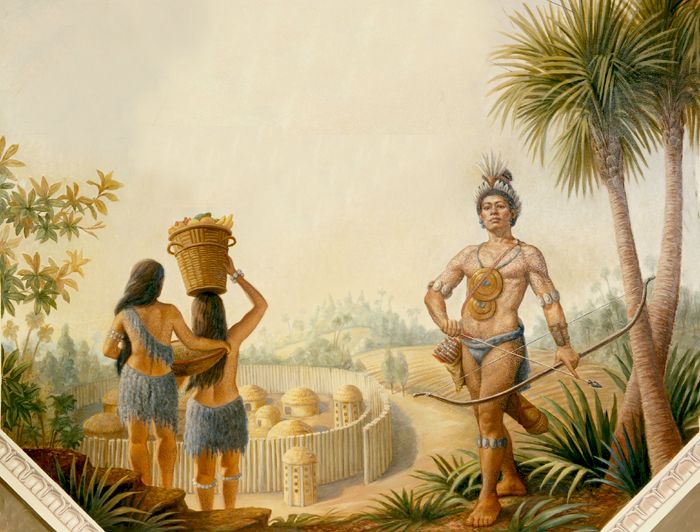
Timucuan People.
The Tacatacuru were a Timucuan tribe who lived on Cumberland Island in Georgia in the 16th and 17th Centuries. The meaning of their name is unknown, but it is thought to relate to fire. The chief of Tacatacuru (now Cumberland Island), or of the neighboring mainland, met French explorer Jean Ribault’s expedition in 1562 and seems to have remained on good terms with the French during their occupancy of Fort Caroline in 1564-65. He, or a successor, is mentioned among those who joined French soldier Dominique De Gourgues in his attack upon the Spaniards in 1567, but soon afterward, they made peace with Spain.
One chief, Don Juan, greatly assisted the white men in many ways, particularly in driving back the Guale Indians after their uprising in 1597. This chief died in 1600 and was succeeded by his niece. The church these Indians built was said to be as big as the one in St. Augustine, Florida. The good relations that subsisted between the Tacatacuru Indians and the Spaniards do not appear to have been broken by the Timucua Rebellion of 1656. By 1675, the tribe had abandoned Cumberland Island, and the Yamasee occupied it.
Missionaries noted in 1602 that the tribe had eight settlements and 792 Christianized Indians in the province. They later became heavily involved in the Spanish mission system, and one of the first missions in Spanish Florida, San Pedro de Mocama, was established in their territory. Consequently, the mission of San Pedro de Mocama does not appear in the 1680 mission list, although it does in the 1655 list.
Like other tribes in the area, they were significantly affected by disease and war with other peoples through the 17th Century. They merged with other Timucua peoples, and there is no independent tribe today.
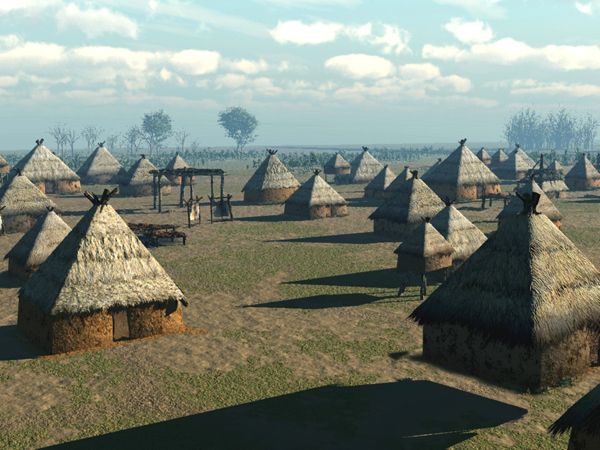
Timucuan Village.
©Kathy Alexander/Legends of America, updated September 2026.
Also See:
Native Americans – First Owners of America
Native American Photo Galleries
See Sources.