
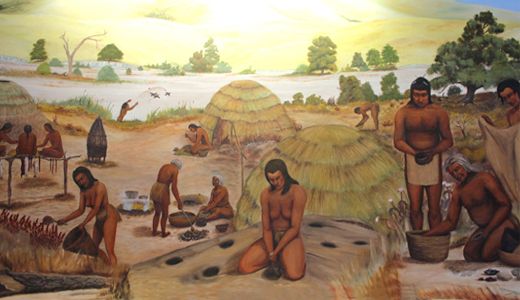
Salinan Village.
The Salinan people were a linguistic group in California who lived along the Salinas River in what is now San Luis Obispo and Monterey Counties. They were named after the Salinas River. Their language was irregular and more complex than most California languages. Scholars say the Salinan language is derived from Hokan roots and is estimated to be 6,000 to 8,000 years old, making it one of the oldest languages and peoples in California.
The people call themselves the “Te’po’ta’ahl,” or “People of the Oaks,” according to current tribal leadership. They appeared to have lived in conical houses made of brush or grass and subsisted on hunting and gathering. They subsisted more on hunting than fishing, lacked canoes, and supplemented their diet with plant foods such as acorns and grass seeds. At first contact, they were estimated to have numbered between 3,500 and 4,000.
The missions of San Antonio and San Miguel were established in the Salinan territory in 1771 and 1797. Like other tribes, the Salinan Indians experienced a rapid decline during mission times. Their numbers fell to fewer than 700 by 1831 and then declined even faster. By the early 1900s, only about 20 people lived near Jolon, California.
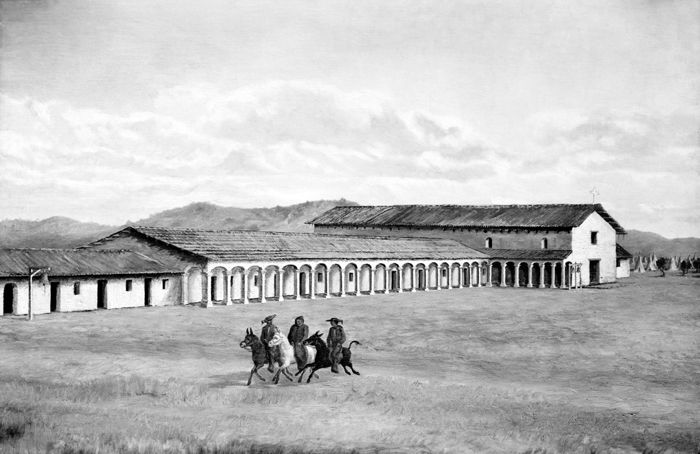
Mission San Miguel Arcangel, California, by Oriana Day.
However, the Salinan language was spoken until the 1950s. Today, Salinan descendants live in California, but no tribes are federally recognized. They are working on reconstructing their language and culture for historical purposes.
©Kathy Alexander/Legends of America, updated October 2026.
Also See:
Native American Photo Galleries
Native American Proverbs & Wisdom
Timeline of the Native Americans
See Sources.