
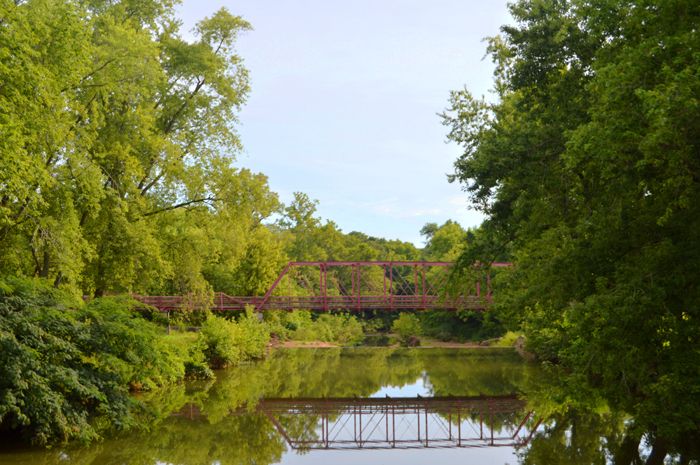
Apple Creek in Old Appleton, Missouri, by Kathy Alexander.
Old Appleton, Missouri, is located on the south bank of Apple Creek in Cape Girardeau County and began in the early 1800s.
In the 1780s, Pierre Louis Lorimier, a French Canadian who had worked as an Indian interpreter for the British during the American Revolution, found it in his best interest to leave the American states. He and his wife, of mixed French and Shawnee Indian ancestry, settled in Cape Girardeau, present-day Missouri.
Lorimier was subsequently appointed Indian Agent by the Spanish colonial authorities, who then controlled the region. Like Lorimier, the Shawnee and Delaware Indians who had sided with the British were also in an unsavory situation and were being pushed off their lands by American settlers. Lorimier appealed to the Spanish for land grants for the Indians, and two large land tracts were granted in the Apple Creek watershed, with the intention of the Shawnee and Delaware acting as a buffer against the Osage Indians, who were not on friendly terms with the Spanish authorities.
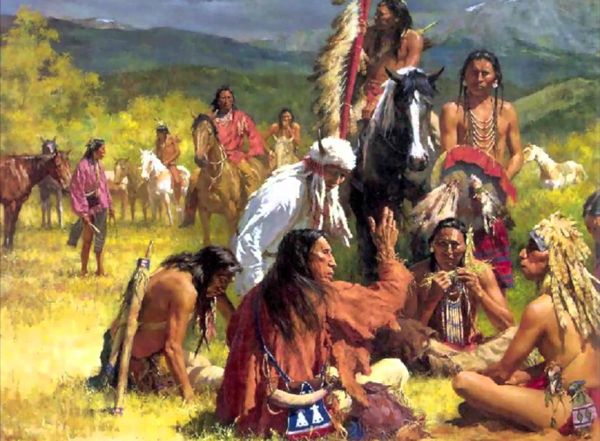
Shawnee Indians.
Lorimer then convinced 1,200 Shawnee and 600 Delaware to relocate to the region. They arrived in 1784 and settled in the area of Old Appleton. Through here ran the El Camino Real, or the King’s Highway, which would soon connect New Madrid and St. Louis. This pathway followed Native American trails and crossed Apple Creek at or near the future site of Old Appleton.
The “Le Grand Village Sauvage,” known to the Americans as the Large Shawnee Village, was west of present-day Old Appleton and ran northward for about a mile toward Uniontown. Another Indian town called “Petit Village Sauvage” was east of Old Appleton. Both villages had significant racial mixing with the French and had adopted mainly French and American ways and lifestyles. They soon built granaries to store their crops and barns to house their cattle and horses. They built their log homes in the French fashion, with posts set together, the interstices filled with clay, and wood-shingled roofs.
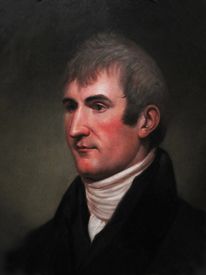
Meriwether Lewis.
By the early 1800s, Kentuckians and German immigrants began to settle in the area, which provided fertile farmland and good proximity to water along Apple Creek. Although the Americans had agreed to honor Spanish treaties made with local tribes, these were ignored as more people moved to the area. As the emigrants encroached upon the Shawnee and Delaware lands around Apple Creek, they requested protection from the Osage tribe.
In 1809, harassment and theft by American settlers drove the Shawnee and Delaware to visit the territorial governor, Meriwether Lewis, where they agreed to exchange their lands in the Apple Creek watershed for lands farther west. However, nothing was done at the time. But by 1815, the situation had worsened to the point that territorial governor William Clark and US President James Madison ordered all white intruders removed from Shawnee and Delaware lands. However, this order was impossible to enforce and was ignored. The following year, the Indians relocated to lands further west. By 1825, all village remains had disappeared, but the Americans long continued to refer to the site as Indian Village.
In the meantime, more settlers moved in, and a post office was established in 1818 called Apple Creek for the many adjacent crab apple trees. In 1824, two settlers, John McClain and John Schatz, arrived and began establishing a town. During this decade, Alfred McClain constructed a dam across Apple Creek to power a gristmill he built on the creek’s northern bank. The first general store was opened by Kimmel and Taylor in 1829.
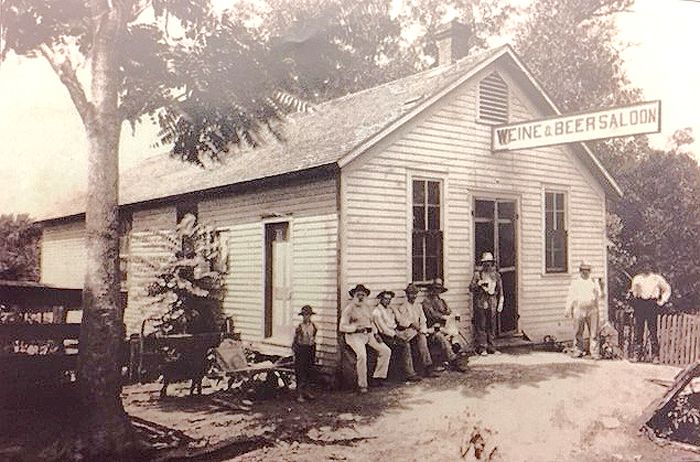
Casper Ludwig’s Saloon in Old Appleton, Missouri.
The town was officially platted in 1847, and its name was changed to Appleton in 1856. In 1856, German immigrant Casper Ludwig built a brewery and saloon near the creek in Appleton. His brewery produced a beer called Kulenbacher, which was quite popular at the time.
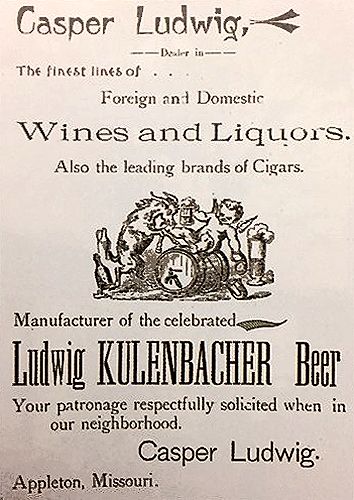
Casper Ludwig Kulenbacher Beer in Appleton, Missouri.
The town was nicknamed “Shakerag” during the Civil War. This was because window glass could not be obtained at the time, and window frames were covered with cloth, which was soon shredded by the wind. The flapping rags were called shakerags.
In 1879, a three-span truss bridge was built over Apple Creek, which greatly helped area residents. This area was a low-lying flood plain where the waters often rose. The bridge was built along the road to Jackson, some 16 miles south, allowing area residents to move more easily for commerce, socialization, and farm needs. From Jackson, it was just another ten miles to Cape Girardeau.
In the late 1800s, a physician named Wilhelm Aaron Schoen began practicing in Appleton. In 1899, he married Bertha Ludwig, the daughter of brewery owner Casper Ludwig. Caspar Ludwig died in 1901, but his brewery continued until 1904. Afterward, the brewery operated under several owners. By 1906, it was called the Appleton Brewing Company; in 1908, it became the Appleton Brewing and Ice Company.
In 1917, the town’s name was changed again to Old Appleton by the postmaster general to remedy delivery confusion with Appleton City in St. Clair County. Though the town never grew very big, it once boasted a distillery, brewery, blacksmith shop, soda water plant, creamery, hotel, bank, and garage. In 1920, it had a population of 106. That same year, Prohibition began, but the brewery continued to operate. During the next decade, it would be raided several times by federal agents, who smashed bottles, opened kegs, and spilled the beer. According to local history, townspeople ran with buckets to catch the foam before it spoiled.
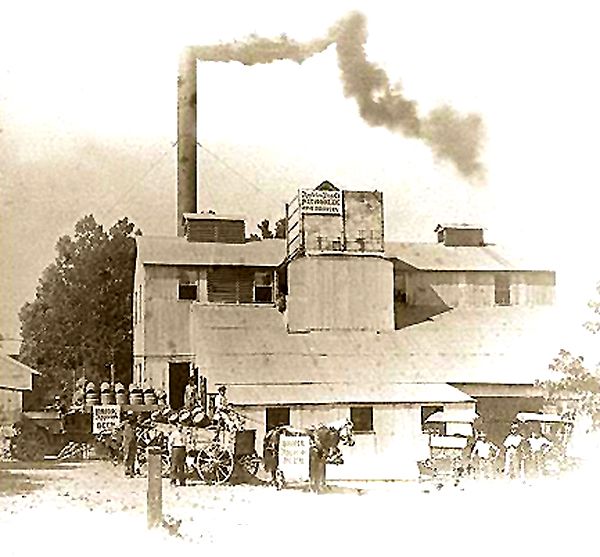
The Appleton Brewing & Ice Company in Old Appleton, Missouri, in 1914.
After Prohibition ended in 1933, the Appleton Brewery and Ice Company continued to operate until 1934. That year, a former prizefighter and bootlegger, Benny McGovern, operated a brewery. We could not determine whether this brewery was the old Ludwig Brewery or another. In any event, it operated as McGovern Brewing from 1934 to 1938. That company’s label was Mule Beer, named after a real mule the brewery maintained. During its operation, brewery representatives would take the mule to various taverns and ask the bartender to open different beer brands and place them on the bar. Dan would sniff out the McGovern beer and drink it!
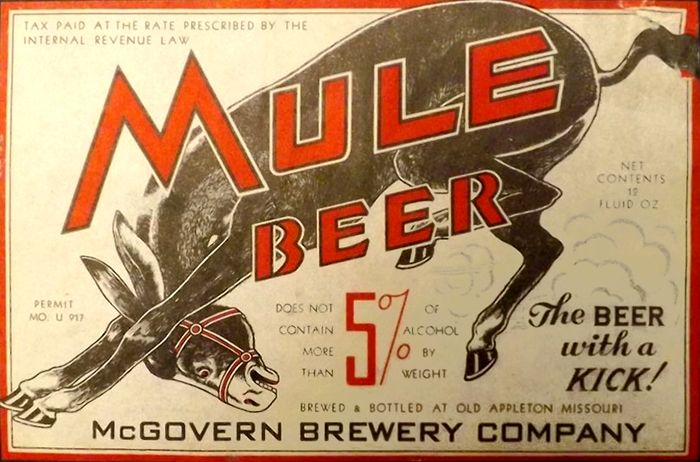
Mule Beer by the McGovern Brewery in Old Appleton, Missouri.
From 1940 to 1947, the Appleton Brewery Company operated again. In the meantime, the old McClain Mill on Apple Creek continued to grind wheat into flour until World War II, and then used it for feed grinding until it finally closed.
In 1950, Old Appleton reached its peak population of 120. Soon afterward, the old McClain Mill began to deteriorate, and efforts were made to restore it in the next decade.
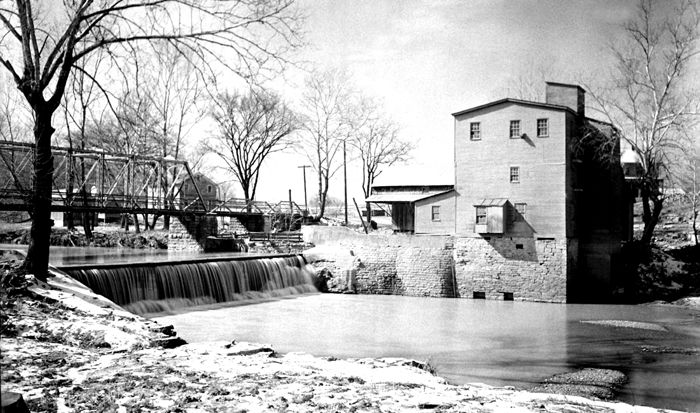
Apple Creek Mill, Old Appleton, Missouri.
A flash flood in December 1982 destroyed the historic 1879 iron truss bridge over Apple Creek, and just four years later, the historic mill from the 1920s was destroyed by another flash flood in May 1986. Though the mill was never rebuilt, restoration on the old bridge began in 2005 and was completed the following year. It was listed on the National Register of Historic Places as one of the last remaining Pratt truss bridges in Missouri in 2009. Today, the Old Appleton Bridge, which once carried traffic along the highway, is a pedestrian bridge over Apple Creek.
This once-thriving community and commercial center is now a semi-ghost town with about 73 people at the 2020 census.
Old Appleton, located along Highway 61, is about 17 miles north of Jackson, Missouri. It still features its beautifully restored 1879 bridge and a few old buildings.
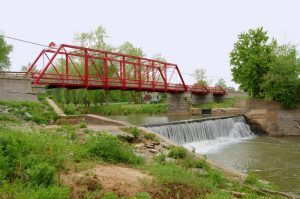
Old Appleton, Missouri Bridge over Apple Creek by Kathy Alexander.
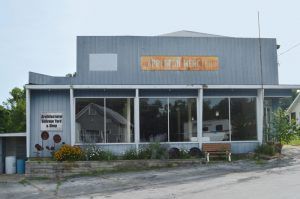
Appleton Mercantile Company in Old Appleton, Missouri, by Kathy Alexander.
©Kathy Alexander/Legends of America, updated April 2026.
Also See:
Missouri Ghost Town Photo Gallery
Sources:
Earngey, Bill; Missouri Roadsides: The Traveler’s Companion, University of Missouri, 1995
National Register Nomination
Old Breweries
State Historical Society of Missouri
Wikipedia