
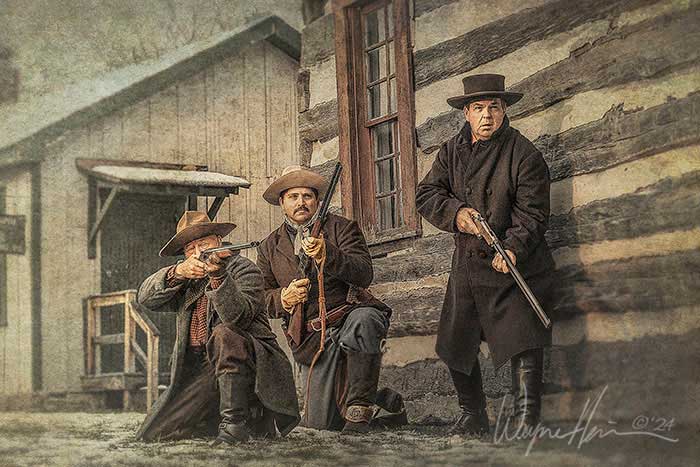
Three cowboys stand ready on the porch of a weathered frontier cabin, rifles in hand, eyes sharp for what’s coming. Photography by Wayne Heim.
By Wayne Heim, K4 Studios – Painterly Fine Art & Historical Photography
Across the American plains, where wind still combs the grass and old stockades fade into the hills, the past has a way of returning. Step into a Western reenactment and you’ll hear the creak of saddles, the ring of a blacksmith’s hammer, and the laughter of campfires after sundown. These aren’t movie sets or costumed festivals—they’re living echoes of the frontier, carried forward by people who refuse to let history fade to sepia.
Historical reenactments trace their roots back to ancient Rome, when great battles were restaged in public arenas. In America, the tradition took hold after the Civil War, as veterans gathered to commemorate the struggles they’d survived. Over time, those memorials grew into a larger movement: the living history experience—where authenticity, education, and storytelling merge.

Set in her ways. Photography by Wayne Heim.
For Western reenactors, it’s about far more than props or spectacle. They’re researchers, craftsmen, and storytellers rolled into one. Each stitches their own clothing, learns period trades, and studies the lives of the people they portray. Whether playing a ranch hand, a pioneer woman, or a frontier lawman, they bring the details to life—the grit beneath the fingernails, the dust on the hatband, the callouses that tell their own stories.
What makes these events truly special, though, isn’t just what you see—it’s who you meet. Spend a few minutes talking with a living historian, and you’ll realize you’re not hearing lines from a script; you’re sharing in someone’s passion. They’ll tell you how they tracked down an original 1880s spur design or the recipes families used on the trail. Those conversations blur the line between past and present. You walk away understanding that history isn’t something distant—it’s a living conversation between generations. It is also a powerful antidote to the myths we grew up with.
The “spaghetti western” gave the world stylized gunslingers and tumbleweed towns, but the real West was more complex, more human. It was a place of survival, sweat, and stubborn determination—people carving lives from rock and dust, chasing freedom against impossible odds. That universal spirit is what keeps the world fascinated with the American West. It’s not the gunfights that resonate—it’s the perseverance. The belief that even when the horizon looks endless, you keep riding.
That’s the thread I try to follow in my photography.
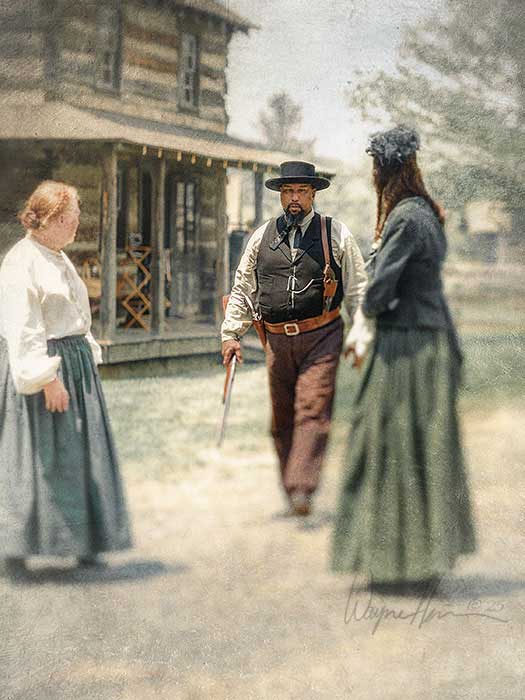
A richly colored Western photograph depicting a tense moment outside a frontier home. Photography by Wayne Heim.
Through my Facing History: Western Cowboy Portraits series, I focus on moments that fall between performance and truth—the way a reenactor adjusts his bandanna, or looks toward a setting sun, lost in two centuries at once. I’m drawn to what I call frontierism—that eternal pull toward self-reliance and story, the quiet pride of those who build something lasting from the dust. My images aren’t staged illusions; they’re painterly interpretations of real people stepping into history’s light.
Across the country, living-history events keep that light burning. From the roaring beach landings of D-Day Conneaut in Ohio to cowboy encampments in Pennsylvania and Civil War weekends in the Midwest, these gatherings offer something more tangible than nostalgia. They invite us to feel, hear, and even smell the past—to see the truth that movies can only hint at.
In a world of screens and simulations, this authenticity matters. You can stream a thousand Westerns, but you can’t replace the sound of a hammer striking an anvil, or the warmth of a reenactor’s handshake as he tells you why he rides. These moments remind us that the frontier was never about myth—it was about people.
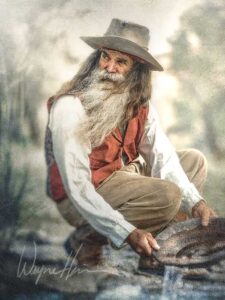
This rugged spirit artwork by Wayne Heim showcases Frederic Remington in a western cowboy art style.
And through the dedication of those who relive it—and those who strive to capture it—the story of the West continues to ride, alive and unbroken, across the dust and distance of time.
Explore more portraits celebrating living history at K4 Studios – Facing History: Western Cowboy Portraits.
©Wayne Heim, K4 Studios, for Legends of America, November 2025.
Also See:
Frederic Remington – Painting the Old West
John C. H. Grabill – Photographing the West
Arthur Rothstein – Historic Photo Journalist