
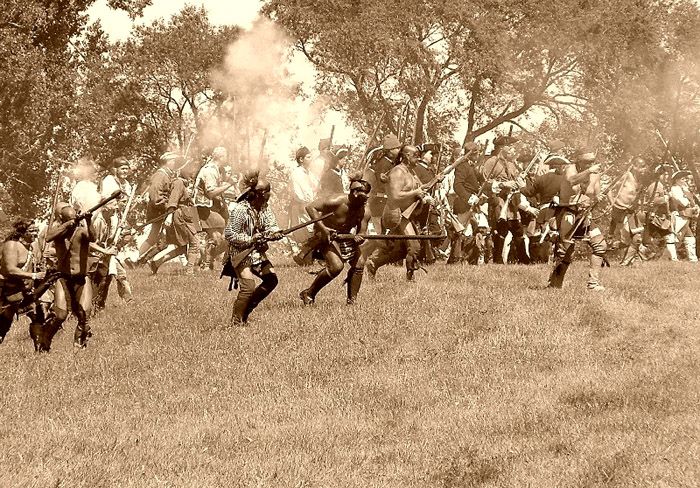
French and Indian Attack.
Fort Granville, Pennsylvania, was established during the French and Indian War on the north bank of the Juniata River near present-day Lewistown.
After the French victory in the Battle of the Monongahela, Pennsylvania, on July 9, 1755, English settlers on the Pennsylvania frontier were exposed to hostile raids by the French and their Indian allies. As the Shawnee and Delaware Indians grew bolder in their excursions into the frontier, the provincial government decided to build a string of forts across Pennsylvania from the Delaware Water Gap to the Maryland line.
The Pennsylvania Militia, under the command of Captain George Croghan, built the fort in December 1755. The post was a 100-foot square stockade with a blockhouse on two corners and enclosed barracks that could house 50 men. It was named for John Carteret, the Earl of Granville.
On July 22, 1756, the French and their Indian allies challenged the fort and demanded its surrender. When Captain Edward Ward refused their demands, the attackers plundered the farms of Mr. Baskin and then Hugh Carroll and took them prisoners. On July 30, Captain Ward and most of his men left the fort to journey to Shearman’s Valley to protect harvesters. The fort was left under the command of Lieutenant Edward Armstrong, supervising 24 troops. On August 2, a raiding party of 55 Frenchmen attacked the fort and 100 of their Indian allies under French Captain Louis Coulon de Villiers. The small force held out until the next morning, when Sergeant John Turner surrendered it after the fort had been set on fire. Lieutenant Edward Armstrong was killed.
After the surrender, Sergeant Turner, 22 soldiers, three women, and seven children were loaded up and taken to Kittanning. Upon their arrival, Turner was scalped alive and burned at the stake. The remaining captives were taken to Fort de Chartres, ransomed by French officers, and eventually returned to the American colonies.

Fort Granville, Pennsylvania Historical Marker
The fall of Fort Granville confirmed the vulnerability of the string of forts on the western frontier of Pennsylvania.
Although it is known that the site was about a mile from Lewistown, the exact location cannot be determined because the construction of the Pennsylvania Canal destroyed the spring around 1829.
© Kathy Alexander/Legends of America, updated November 2025.
Also See:
Forts & Presidios Across America
Pennsylvania – The Keystone State
See Sources.