
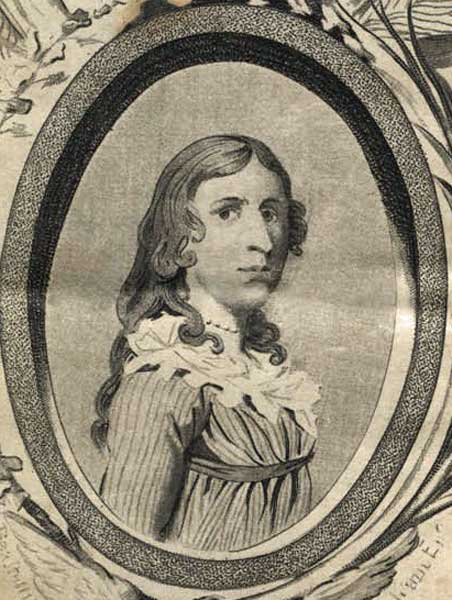
Engraved portrait of Deborah Sampson, female American Revolutionary War soldier, Massachusetts Historical Society; Used as the frontispiece of The Female Review: Life of Deborah Sampson, the Female Soldier in the War of Revolution, by Herman Mann, published 1797.
Deborah Sampson Gannett (1760–1827) stands as one of the most remarkable figures of the American Revolution; a woman who disguised herself as a man, enlisted in the Continental Army, and served honorably in combat. Her story blends courage, hardship, and later embellishment, but the core truth remains: she is one of the best‑documented women to fight as a soldier in the Revolutionary War.
Deborah Sampson was born on December 17, 1760, in Plympton, Massachusetts, the eldest of seven children. Her family struggled financially, and after her father abandoned the household, later resurfacing in Maine, Deborah was placed in a series of foster arrangements. She eventually lived with the Thomas family of Middleborough, where she worked as a servant and received only limited formal education. Resourceful and determined, she taught herself to read and write by studying the family’s books at night.
As she reached adulthood, Sampson worked as a schoolteacher and a weaver. The Revolutionary War had been raging for years, and although women were barred from military service, Sampson was drawn to the cause. In early 1782, she attempted to enlist under a male alias but was discovered before being mustered in. Undeterred, she tried again.
On May 20, 1782, Deborah Sampson successfully enlisted in the 4th Massachusetts Regiment under the name Robert Shurtliff (also spelled Shirtliffe). She was assigned to the Light Infantry Company, an elite unit typically composed of tall, strong, and agile soldiers. Her ability to pass as a man in such a demanding role remains one of the most extraordinary aspects of her service.
Sampson served for roughly 17 months, participating in patrols, skirmishes, and garrison duty during the final phase of the war.
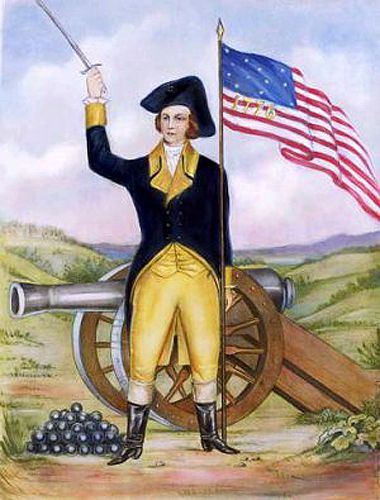
Deborah Sampson Gannett
She sustained two significant wounds: A sword cut to the head during a skirmish, and a musket ball to the thigh, which she treated herself by removing the bullet to avoid revealing her sex.
Later retellings, especially her 1797 memoir, ghostwritten by Herman Mann, added dramatic episodes, including being shot in the shoulder or carrying secret messages to General Washington. Military records do not support these stories.
In the summer of 1783, while stationed in Philadelphia, Sampson fell seriously ill with a fever. During treatment, a physician discovered her biological sex. Rather than face punishment, she was quietly sent back to Massachusetts with an honorable discharge signed by General George Washington on October 25, 1783.
In 1785, Deborah married Benjamin Gannett, a farmer from Sharon, Massachusetts. The couple had three children and later adopted a fourth. Although her military service was unusual, she lived a largely conventional domestic life afterward.
In 1802, Sampson embarked on a public speaking tour, one of the earliest known by an American woman, where she recounted her wartime experiences. She often appeared in partial uniform and demonstrated military drills, blending fact with theatricality.
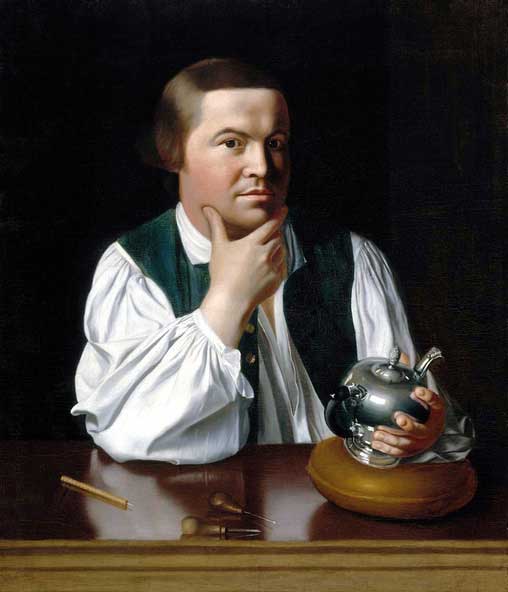
Paul Revere by John S. Copley, 1768
Sampson struggled financially, and in 1792, the Massachusetts legislature granted her a small pension for her service. In 1805, with the support of Paul Revere, she successfully petitioned Congress for a federal pension. Revere’s letter praised her courage and attested to her honorable service.
After her death in 1827, her husband received a survivor’s pension, the first such award granted to the spouse of a female veteran.
Deborah Sampson Gannett’s life has inspired generations of historians, writers, and advocates for women’s military service. While some popular stories about her have been embellished over time, the documented facts reveal a woman of extraordinary determination who risked everything to serve her country.
Today, she is recognized as the Official Heroine of the Commonwealth of Massachusetts, and her story remains a powerful example of courage, ingenuity, and the fight for recognition in a world that often denied women a place in history.
©Legends of America, updated December 2025.
Also See:
See Sources.