

Sally Noble was the last known fluent speaker of the Chimariko language.
The Chimariko people are a small tribe comprising the Chimarikan family, who formerly lived on the Trinity River near the mouth of New River in Northern California.
They adjoined the Hupa downstream and the Wintu upstream. The Chimariko first came to the whites’ attention with the influx of gold miners in about 1850. At that time, they were a small tribe, friendly with the Hupa and the neighboring Shasta tribes, but at war with the Wintu of Hay Fork on the Trinity River.
In 1903, they numbered only nine people, including mixed-bloods, who lived scattered among Indians of other tribes and among the white settlers. In general culture, they were much like their neighbors, the Hupa, though they are said to have lacked canoes and to have not practiced the deerskin dance of the Hupa and Yurok. They mainly lived on salmon, eels, and vegetable foods, especially acorns.
Like the other tribes of northwest California, they had no political organization or divisions other than villages. In the 2010 census, 60 people claimed Chimariko ancestry, and 19 were full-blooded.
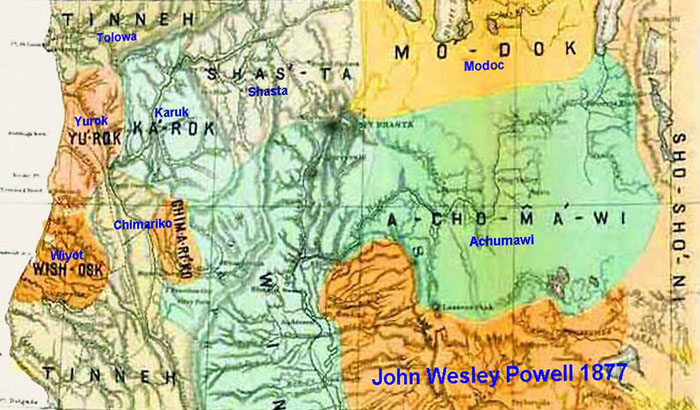
Northern California Tribes Map.
©Kathy Alexander/Legends of America, updated November 2025.
Also See:
Native American Photo Galleries
Native Americans – First Owners of America
See Sources.