
Vintage Jack Rabbit Trading Post in Joseph City, Arizona.
Joseph City, Arizona, is an unincorporated Navajo County community located about 11 miles West of Holbrook on Route 66.

Little Colorado River in Arizona by the Department of Interior.
Mormon pioneers led by Captain William C. Allen first settled this area along the Little Colorado River in 1876. Joseph City was first called Allen’s Camp for their leader. The settlers’ first task was building a U-shaped cottonwood log fort. They were also focused on getting water for their crops and built a dam and irrigation canals the same year. However, taming the capricious river proved difficult, and over the next several decades, the settlers watched in despair as the dams washed out and their crops amounted to nearly nothing. Not just once or twice, mind you, but ten times before a dam was built in 1894 that was strong enough to withstand the floods. This led Andrew Jensen, a Mormon church historian, to call the settlement “the leading community in pain, determination, and unflinching courage in dealing with the elements around them.”
In 1878, the town’s name changed to St. Joseph in honor of Joseph Smith, the Mormon prophet, and a post office opened that year. In 1883, the Atlantic and Pacific Railroad, which later became part of the Atchison, Topeka & Santa Fe Railway, reached the area and established a railroad station.
Soon, the threat of Indian attacks diminished, and the old fort served various purposes until it was abandoned entirely in 1896. Afterward, it fell into ruins, and there are no remains today, but the site is marked with a bronze plaque in a petrified wood monument on Main Street.
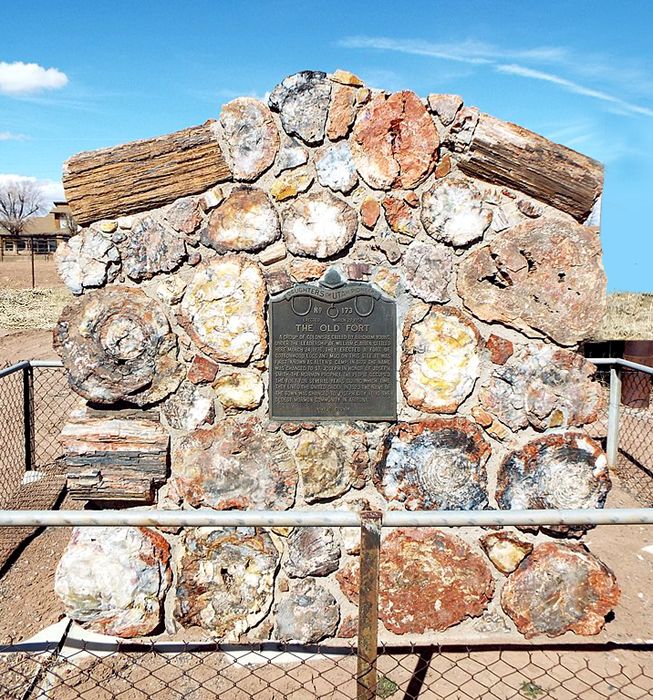
Marker at the site of the old Mormon fort in Joseph City, Arizona.

St. Joseph Bridge Historic Bridge Southeast of Joseph City, Arizona, courtesy of Wikipedia.
In 1913, the National Old Trails Road reached Joseph City, which would later become Route 66. To accommodate traffic on the new road, Navajo County began planning a bridge over the Little Colorado River. The St. Joseph Bridge was completed by June 1917. The six-span Pratt pony truss bridge is 500 feet long and 12.5 feet wide. It served travelers for decades before a newer bridge replaced it in 2010. However, the old bridge still serves as a county road bridge. Listed in the National Register of Historic Places, it is located on Obed Road, 4.4 miles Southeast of Joseph City.
In 1923, the town’s name was changed again to “Joseph City” to avoid confusion with another station named St. Joseph along the Atchison, Topeka & Santa Fe Railway in Missouri. That same year, the previous dam on the Little Colorado River finally gave way after 29 years, forcing area residents to build a new one. This structure continues to stand today.

Last Frontier Trading Post, Joseph City, Arizona.
By then, three other Mormon settlements established along the lower Little Colorado River at the same time had all but disappeared. These included the old towns of Brigham City, Sunset, and Obed.
Route 66 came through the area in 1926 along the path of the Old Trails Highway. One of the first businesses to be established along the new highway was San Diego’s Old Frontier Trading Post in 1927. Frederick “San Diego” Rawson built the trading post from telephone poles. Born in 1858, Rawson spent a couple of years of his childhood enslaved by Plains Indians before being rescued by the US Cavalry. Later, he worked as an Indian scout, trapper, wagon freighter, circus clown, prospector, cowboy, and author. When he first arrived in Joseph City, he operated a small museum to exhibit his collection of Old West artifacts. However, business was too slow, so he moved to the West end of town and opened the trading post. At his store, he offered space for Navajo Indians to make jewelry, blankets, and quilts.

Ruins of Ella’s Trading Post in Joseph City, Arizona, by Kathy Alexander.
After 20 years in business, Rawson sold the trading post to Ramon Hubbell, son of the famous Indian trader Don Lorenzo Hubbell, in 1947. A few years later, in 1951, it was sold again to Ray and Ella Blackwell Meany, who owned the Hopi House Indian Trading Post West of Winslow. When the two divorced in 1955, each ended up with one of the trading posts. Ella then rebranded the trading post in Joseph City and operated it as “Ella’s Trading Post” until she died in 1984. A former student at the Juilliard School, Ella kept a piano in the store, which she claimed was established in 1873, making it the oldest such establishment on Route 66. Ella, however, was considered quite eccentric by locals, who said she talked to imaginary people and animals and doubted her claim about the building’s date. Next to the ruins of Ella’s Trading Post are the remains of the long-abandoned Big Arrow Campground.
Joseph City remained a quiet stop for services along Route 66 until after World War II, when people began to travel, and traffic increased through the small town. When Jack DeVere Rittenhouse published “A Guide Book to Highway 66” in 1946, he mentioned that the community supported a population of 308 residents and boasted two motels, including the Hopi Village and the Oasis.

Hopi Village in Joseph City, Arizona, later known as Howdy Hanks, by Kathy Alexander.
Hopi Village operated as a motel, cafe, and trading post on the West end of Main Street. When the original owners sold out, it reopened as Howdy Hanks and greeted visitors with a cowboy painting. Howdy later sold the store to V.P. Richards, who later sold it to Max Ortega. Ortega renamed it “Sitting Bull’s Indian Store”. Business waned after Route 66 was replaced with I-40, and the trading post closed. It later was used as a feed store and a welding shop. The building still stands with its main feature in front- a teepee with a legless horse placed on its tip.
When Route 66 peaked, another hardy man named James Taylor built the Jackrabbit Trading Post in 1949. Though Taylor wasn’t originally from Joseph City, he showed the same determination to make his business successful as the citizens of Joseph City had earlier shown in saving their town.
Here It Is! Trading Post Marketing 101

Jack Rabbit Trading Post, Joseph City, Arizona, by Kathy Alexander.
In the beginning, Taylor bought an asphalt-shingled shack that had formerly been used as a snake farm, and then he turned out all the snakes, much to the alarm of several area residents. Soon, he began to revamp the building, with dancing chiefs painted on the front, 30 twelve-inch jackrabbits hopping along the roofline, and a giant rabbit painted on one side of the building. He then installed a three-foot-high composition jackrabbit with yellow eyes inside the door to welcome tourists. Many an old-time traveler can tell a story of having their picture taken atop this rabbit as a child. Inside, the counters and shelves were lined with pieces of petrified wood, turquoise jewelry, and Indian souvenirs.
But owning a Trading Post in those days just wasn’t enough. Dotting the highway, they were a dime a dozen and competing with the nearby Geronimo Trading Post; with its visual pulling power of large decorative teepees, Taylor had to do something more.

Jack Rabbit Trading Post sign by Kathy Alexander.
And something more he did! Joining forces with Wayne Troutner, owner of the For Men Only Store in Winslow, the pair traveled Route 66 to Springfield, Missouri, plastering billboards all along the way. Hopping rabbits paired up with a dancing cowgirl for more than 1,000 miles, enticing travelers to stop at the Jackrabbit and the Men’s Only Store in Winslow. After all those miles, travelers couldn’t miss the giant yellow sign that said “Here It Is” paired with its famous jackrabbit icon.
Taylor’s tactics worked because the Jackrabbit is still in business and has long since become a Route 66 icon. Taylor operated the post for two decades before leasing it to Glen Blansett in 1961. Blansett purchased the business in 1967 and passed it on to his son and daughter-in-law, who eventually sold it to their daughter and son-in-law, Cynthia and Antonio Jaquez, who operate the trading post today.
When Interstate Highway I-40 bypassed the town in the 1960s, business declined along Main Street, but the town still preserves some iconic places of the old Mother Road.
Today, Joseph City is home to about 1,400 residents. It is one of Arizona’s oldest Mormon settlements.

The Jack Rabbit Trading Post today by Kathy Alexander.
©Kathy Alexander/Legends of America, October 2026.
Also See:
Arizona Route 66 Photo Gallery
Sources:
Archaeology Southwest
Bridge Hunter
Ghost Town Arizona
Sonderman, Joe; Route 66 in Arizona, Arcadia Publishing, 2010
Sharlot Hall Museum
Wikipedia