

Perilous stagecoach trail in California by Detroit Photographic, 1899.
By William Daugherty for the Reno Evening Gazette in 1891
An old-timer drummer was seated in the barroom late last night at a downtown hotel, waiting for the midnight train to return to San Francisco. He had attended to the trade that calls him here once in three months and, having nothing to do but kill time, was entertaining a friend with talks of the road. “It is easier traveling now,” he said, “than 20 years ago, but trade isn’t as good now, and it is harder work to make a showing.” Then he drifted into a comparison of present-day methods of locomotion with earlier ones and said that, just after the opening of the overland railroad, a great deal of staging was required. During one season, he traveled over 3,500 miles by stage in Utah, Idaho, Nevada, and California, and over 7,000 miles by rail and steamer. The further he traveled, the more timid he became about stagecoach travel.
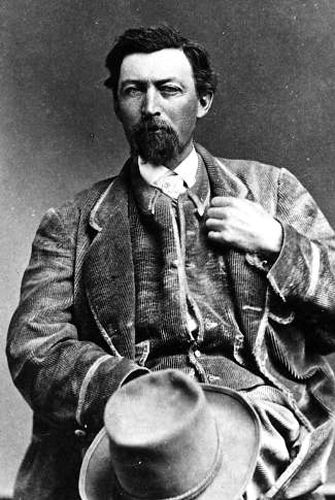
Hank Monk, stagecoach driver.
This, he explained, was not owing to any natural timidity inherent within himself but was due principally to the disappearance from the road of the crack whips that handled the ribbons during the times of the Pioneer and Overland lines and the substitution of a cheap class of sheepherders on the short lines that sprang up as lateral feeders to the railroads. The old drivers had left a reputation and romantic glamour clinging to their names, inspiring their successors to believe that a reckless swagger was all that was necessary to add their names to the list of distinguished knights of the whip. But that couldn’t be. The old stock was the product of natural genius. The high wages secured by the best resulted in the survival of the fittest and placing in prominent positions of such experts as Curly Bill, Dan Robbins, Ned Hudson, Si Hawley, Charles Levitt, Tom Stevens, Johnny Burnett, John Wilson, Billy Hodge, Baldy Green, Hank Monk, George Richmond, Con Denise, George Clinton, Vic, Dave Red, Smith Grey, Charlie Livermore, Billy Vosburg, and others further east. When the conditions changed, and the companies could no longer pay $300 per month, the old stock drifted into the livery business or sought other fields, leaving behind the tradition of departed glory. “And so,” said the drummer, “from 1872 to 1875, I frequently rode over drives that nothing could tempt me to take again.
One of the most perilous that I now recall,” said he, “was in making the trip over the Greenhorn Mountains on the road from Caliente to Havilah in Kern County, California. There were seven of us passengers, six on the inside and one with the driver, on a thoroughbred mud wagon that was just wide enough to hold two on a seat, and in fact, it seemed to be a very narrow-tracked wagon for the side hill and neglected grade, when driven with the utmost care. But, in the hands of the drunken Texas cowboy who held the ribbons, it seemed as ready to upset as a bicycle. The driver was a man of large frame and such great muscular strength that he was a terror, dreaded by all the line employees, and domineered over them like a tyrant.
Of course, we passengers didn’t know this, and after supper, about 8 p.m., at the Summit station, we rode away smoking our cigars in the best of humor and unaware that the driver had been drinking while we were eating.
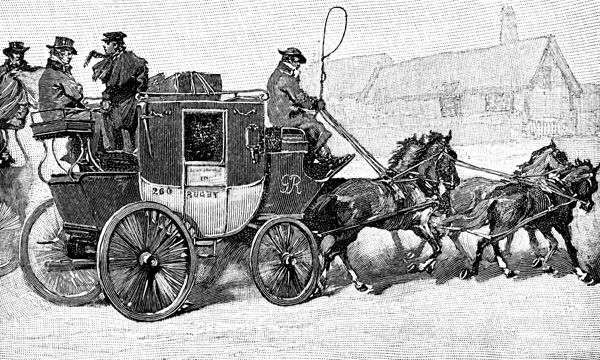
Stagecoach.
As we began descending the mountain, the quarter moon was at times obscured by drifting clouds, which cast weird shadows among the broad, branching oaks that covered the hillsides. At times, in the dim light, it seemed to us that the stage was dangerously near the outer edge of the grade. As we were all old travelers, this did not raise any alarm until, with a startling ‘ki-yi’ from the driver, he set the team on a rapid run down the grade in a narrow, dangerous place. The stage rolled heavily to one side and raised on two wheels only when I swung myself outside, clinging to the bows, and my weight held it an instant poised in the air. It was just long enough to disclose that the team was beyond control and accelerating toward destruction. I acted quickly to give the others a chance, and holding my breath, I leaped into the air and down the hillside in a moment of darkness from the obscured moon. I fell heavily on my neck and shoulders with my arms folded and head forward and, turning one somersault after another, rolled down the steep embankment of loose soil until stopped by an uprooted oak. I sustained no damage except a shock and a collection of loose soil in my face and clothing, and as soon as I could rise and shake myself up, I followed on down the grade to the wreck. One passenger suffered a broken leg and arm; others were severely scratched and painfully bruised; the driver was dead.
By William Daugherty, article in the Reno Evening Gazette, March 28, 1891. Compiled and edited by Kathy Weiser/Legends of America, updated November 2025. About the Author: Written by William Daugherty for the Reno Evening Gazette in 1891. The Reno Evening Gazette was first published on October 12, 1876, and continued for the next 107 years. In 1977, it was merged with the Nevada State Journal and continues to exist today as the Reno Gazette-Journal. The text here is not verbatim, as it has been heavily edited for the modern reader.
Also See:
Pioneers on the Nevada Frontier (Reno Evening Gazette)
Nevada Mining Tales (Reno Evening Gazette)
Pioche Land Jumpers and the Death of Jack Harris (Reno Evening Gazette)
Violence on the Nevada Frontier (Reno Evening Gazette)