
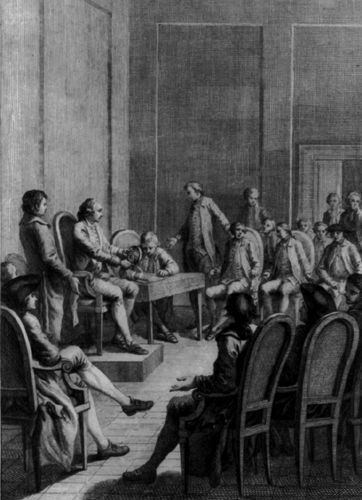
First Continental Congress, September 1774, in Philadelphia, Pennsylvania.
In 1776, the Continental Congress appointed a committee to create a plan for a central government. The committee quickly wrote the Articles of Confederation, creating a loose alliance between the states. While the Articles were drafted quickly, their ratification was delayed until 1781. The primary sticking point concerned disagreements about how to deal with the western lands claimed by several states. Without such claims, the states argued that the national government should own the western lands. The states with land claims were reluctant to relinquish them. The Articles of Confederation were adopted when Virginia finally gave up most of its claims to western lands.
The Articles of Confederation created a union of sovereign states. An assembly of delegates acted on behalf of the states they represented. Because the smaller states feared the domination of the larger ones, each state had one vote in the Confederation Congress, regardless of its size or population. Any act of Congress required the votes of nine of the thirteen states to pass.
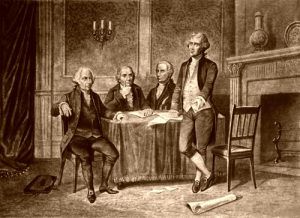
Leaders of the Continental Congress: John Adams, Gouverneur Morris, Alexander Hamilton, and Thomas Jefferson. By Augustus Tholey, 1894.
Congress claimed the following powers: to make war and peace, conduct foreign affairs, request men and money from the states, coin and borrow money, regulate Indian affairs, and settle state disputes. Enforcing laws, regulating commerce, administering justice, and levying taxes were powers reserved for the states. Representatives were forbidden to serve in Congress for more than three years to avoid the formation of a political elite. Even with these limits on its powers, the Confederation Congress achieved some remarkable successes during its short life.
At the successful conclusion of the Revolutionary War with Great Britain in 1783, Americans could reflect on the revolutionary events of the preceding three decades. American colonists had first helped the British win a global struggle with France in that period. Soon, however, troubles surfaced as Britain began to assert tighter control of its North American colonies. Eventually, these troubles led to a struggle in which American colonists severed their colonial ties with Great Britain. Meanwhile, Americans began to experiment with new forms of self-government. This movement occurred in the Continental Congress during the Revolution and at the local and state levels.
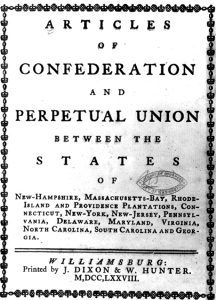
Articles of Confederation.
After winning their independence, Americans continued experimenting with how to govern themselves under the Articles of Confederation. Over time, some influential groups — and these by no means reflected the sentiments of all Americans — found the Confederation government inadequate. Representatives of these groups came together in Philadelphia, Pennsylvania, to explore the creation of yet another, newer form of government. The result was a new constitution. Not all Americans embraced this new Constitution, however, and its ratification produced many disagreements. Even so, the Constitution was ratified, and with a new constitution in place, Americans once again turned to George Washington for leadership, this time as President of the new republic.
Although Washington proved to be personally popular and respected, conflict over the proper functions and locus of governmental power dominated his two terms as president. These disputes soon led to the formation of factions and, later, political parties that were deeply divided over the nature and purposes of the federal government, foreign affairs, and the very future of the new nation. Events during John Adams‘ single term as our second president made these divisions even worse, and they continued into the presidency of Thomas Jefferson.
Even so, President Jefferson nearly doubled the size of the new nation by purchasing the Louisiana Territory from France. This purchase also led Jefferson to organize the Lewis and Clark Expedition to explore the new land. Jefferson’s successor as President, James Madison — one of the Constitution’s authors — led the new nation through another war with Great Britain. This, of course, was the unpopular War of 1812. This war ended in 1815; if nothing else, it convinced Britain that the United States was on the map to stay. Meanwhile, Americans began to develop a culture and way of life that were truly their own, no longer those of mere colonials.

The United States – A New Nation
©Kathy Alexander/Legends of America, updated March 2026.
Also See:
About the United States Constitution
The United States Bill of Rights
Heroes and Patriots of America
Source: Library of Congress