

Eureka, Colorado, by William Henry Jackson, 1900.
The ghost town of Eureka, Colorado, is situated along the Animas River in San Juan County between Silverton and Animas Forks. Its longevity largely depended on the nearby Sunnyside Mine.
Miners first explored the area for minerals in 1860, when Captain Charles Baker led a group to the San Juan Mountains. Making their camp at Baker’s Park, which is the present-day site of Silverton, they roamed the area and found placer gold in the Animas River. However, this region was the Ute Indian Tribe’s territory at the time, and the miners were forced to leave.
That changed after the Utes ceded their lands to the U.S. Government in the Brunot Treaty of 1873. That same year, prospectors returned to the area, some of whom had been with the original Baker party more than a decade earlier.
As the men worked the hills above Eureka, several new claims were established, the largest of which became the Sunnyside Mine near Lake Emma’s shores. On the North side of the Animas River, at the head of Eureka Gulch, Reuben J. McNutt and George Howard staked the Sunnyside claim. The pair also organized the Eureka Mining District to ensure their claims would be officially recognized.

Early day, Eureka, Colorado.
Reuben McNutt built the first log cabin at Eureka, and before long, other prospectors joined him, forming a mining camp. It took its name from the Greek phrase “I have found it!” Because of the camp’s strategic location, local speculators predicted it would become a formal settlement, organized the Eureka Townsite Company, and platted a townsite. The town was built between two mountainsides to reduce avalanche risk. The founders did little to promote the town or attract businesses and residents, as they, like most camp residents, were busy prospecting.
Reuben McNutt soon paid George Howard for his share of the Sunnyside property, and in 1874, McNutt began developing the mine. On the other side of Hanson Peak, prospectors staked additional vein segments, including the Sunnyside Extension.
A post office was established at Eureka in 1875. The following year, Milton and Emma Thompson Engleman arrived from Canon City and opened a mercantile store. Milton bought a half interest in the Sunnyside Mine from Ruben McNutt, and Emma purchased interests in the nearby George Washington and Poughkeepsie No.2 Mines. The lake near the Sunnyside Mine was named for Emma Engleman. Eureka was one of a few towns in this high-altitude area to remain open through the Winter.

Eureka, Colorado Miners.
The Miltons had little money left to develop their claims, but they hired several miners who began sending down ore from shallow workings. In the late 1870s, Milton wanted to develop the mines and offered his in-laws, Frank and Louis Thompson of Canon City, an interest in the property for capital. This proved a bad idea, as they quarreled over profits, control, and ownership, poisoning the relationships between Milton and Emma and the Thompson family. As a result, when Milton Engleman learned that the miners had struck rich gold ore at the Sunnyside Mine, he stockpiled it rather than sell it.

Pack trains of mules hauled the ore down from the Sunnyside Mine to Eureka and returned with supplies.
In 1883, Engleman hired John H. Terry, fresh from the mines and mills of Gilpin County, to manage his mining operations and build a mill at the Sunnyside Mine. After the ten-stamp mill at Lake Emma was complete, the Englemans primarily used their profits to fund their legal squabbles.
After several years, Terry was dissatisfied with the stamp mill at Lake Emma due to its small capacity, inefficiency, and remote location, and petitioned Milton Engleman to fund a new facility. Construction began on a new mill in 1889, about one mile West of Eureka. A small hydropower plant was installed at the mill for electricity. The Midway Mill was completed in 1890, allowing production at the mine to increase, and that decade saw several tunnels driven into the mountainside to reach the ore.
Terry also wanted to install a tramway, but he waited until capital reserves were replenished. In the meantime, a herd of pack animals brought the ore down the mountain to the mill. About a year later, Milton Engleman died, and the family was willing to sell. Terry bought the mine and mill and immediately began to make improvements. The 1893 silver crash slowed Terry’s progress.

Sunnyside Mine Tramway.
However, in 1895, Terry located a rich vein, paid off all his debts, and began buying out other investors’ sole ownership. By 1896, Terry felt financially secure enough to construct a tramway, replacing the costly mule trains to the Midway Mill. Around the same time, a group of New York investors showed interest in the Sunnyside and offered Terry $450,000 to buy the mine, with payments over time and a $100,000 advance as earnest money. Terry accepted the offer, and the investors immediately began building a new mill at Eureka, overhauling the Midway Mill, and making other improvements. However, soon afterward, the miners lost the vein and, afraid to risk further loss, allowed the property to revert to Terry.
Meanwhile, Otto Mears and other Colorado capitalists incorporated the Silverton Northern Railroad and began building a line from Silverton North up the Animas River. In the fall of 1895, the company utilized Otto Mears’ Animas Forks Toll Road as the rail bed and began construction. Workers labored between snowstorms through the Winter and finished the line to Eureka in June 1896. The railroad connected to the Denver & Rio Grande Railroad at Silverton, significantly reducing transportation costs. The railroad also offered passenger service, allowing miners and mill workers to live in Silverton.
Between 1896 and 1897, Terry’s miners struck the rich vein and produced so much ore that Terry had to run both the Midway Mill and the old facility on Lake Emma. With the $100,000 advance he had received from the New York investors, he resumed construction on what became known as the Eureka or Terry Mill, its tramway, and a power plant. At the mine, infrastructure was also built on Lake Emma’s shore, including boarding houses, shops, and mine buildings.

Sunnyside Mine and Lake Emma, Colorado.
The new Eureka Mill started operations in 1899. In 1904, the Silverton Northern Railroad extended its line to Animas Forks. By then, John Terry had groomed his two sons for the mining operations. Joseph managed the mine, and William ran the mills. When John Terry died in 1910, his sons continued the work.
In 1911, William Terry enlarged and refitted the Eureka Mill with a zinc ore separator, which increased its operations. Joseph managed a workforce of 90 employees producing 180 tons of ore per day, double the usual per-worker average.
In 1917, the U.S. Smelting, Mining, and Refining Company (USSRMC) made a generous offer to the Terrys for the Sunnyside Mine. The Sunnyside Mining & Milling Company was formed, consolidating the Sunnyside, Washington, and Gold Prince groups. The company planned yet another mill at Eureka, capable of treating 500 tons per day, and to finish the Terry Tunnel from the mill site to undercut the vein system at great depth.

Sunnyside Mine Fire, 1919
But soon after they bought these mines, the company faced problems, including the Sunnyside surface plant burning down, forcing a temporary closure of the mine, the influenza epidemic of 1918, avalanches, and power blackouts. However, the Sunnyside Mill was completed at Eureka, the surface plant was rebuilt, and the mine complex housed 220 workers.
During these busy construction days, Eureka was bustling as workers filled the available housing and provided business for local merchants. With the Sunnyside Mill finished in 1918, the town’s permanent population grew to about 250 people. The town boasted several boarding houses, a barbershop, J.F. Warnock’s Mercantile, McJunkin Station, which sold feed and fuel, the Eureka Hotel and restaurant, A.L. Lashbaugh Livery, a doctor named William Carter, C.F. Worden’s billiard hall, and several mining companies and assayers.
But in 1920, a national recession hit, and the price of industrial metals dropped so low that operations at the Sunnyside Mine were suspended once again. In 1922, the mine reopened, 216 men were working, and 500 tons of ore were processed per day. The company then began developing its adjoining claims, and by the following year, its workforce reached 360 men.
The Great Depression caused Sunnyside to suspend work in 1930, and it remained closed until 1937. That year, the Sunnyside Mining & Milling Company was Colorado’s largest gold producer. The accessible ore reserves were almost exhausted, and in 1939 the company laid off its workforce and closed the mine.

Eureka, Colorado, from the top of the Sunnyside Mill.
The town of Eureka suffered dramatically. It had never grown very big during its many years of existence and was made up primarily of miners working at the Sunnyside Mill. At one point, it was described as having “the finest saloons anywhere” on its main street.
The Silverton-Eureka segment of the Silverton Northern Railroad also stopped operations in 1939. In its final years, the railroad operated a unique railcar that was a favorite of the miners. The little railbus “The Casey Jones” was built in the shops at the Sunnyside Mill. You can see it today at the San Juan Historical Society’s museum in Silverton.
The Sunnyside Mill operated until 1941. The railroad removed its tracks in 1942, and the post office closed the same year. The mill facilities were sold for scrap in 1948. By this time, the town was abandoned and comprised of empty buildings

Eureka, Colorado, by Russell Lee, 1940.
In 1959, Marcy-Shenandoah Company leased the Sunnyside from USSRMC. It began driving the American Tunnel from the Gold King Tunnel at Gladstone, on the other side of Bonita Peak, through the Sunnyside and Washington veins under Lake Emma. But before they made much progress, Standard Metals Company bought Marcy-Shenandoah. The new company continued with the plan. The ore was removed from the tunnel in Gladstone and trucked down to Silverton.
In 1970, the Standard Metals Company went bankrupt and stopped work at the American Tunnel, but the Washington Mining Company continued work. At this time, some of the most valuable workings were located below Lake Emma. Eventually, only 90 feet separated the lake and the underground tunnels.
During the Winter of 1977-78, a fault in the mine shafts under the lake began leaking, but experts believed the distance between the lake and the mine was safe. They were wrong.

Lake Emma, Colorado, drained.
On Sunday, June 4, 1978, at approximately 6:50 p.m., the lake broke through into the mine, dumping its entire contents, estimated to have been 500 million gallons of mud and water, into the mine. The violent rush of water blew out of the two-mile-long American Tunnel and the one-mile-long Terry Tunnel. At the American Tunnel portal at Gladstone, on the other side of the mountain, water flowed from the mine in 8- to 10-foot waves, carrying mine timbers, equipment, and debris. A 20-ton Plymouth Locomotive parked below the main ore pass was completely flattened. Fortunately, because this accident occurred on a Sunday, the mine was closed, and no one was working inside. Had it happened on any other day, as many as 125 men would have been killed in the violent inrush of mud and water.
Afterward, the tunnels were filled to the top with mud, and the mine was closed for two years to repair the damage. Although the mine was insured for $900 million, the insurance company initially refused to pay any damages. However, after an expensive court battle, the insurance company was ordered to pay $5,500,000. But Sunnyside would never regain its profitable status. The mine was closed in January 1985.
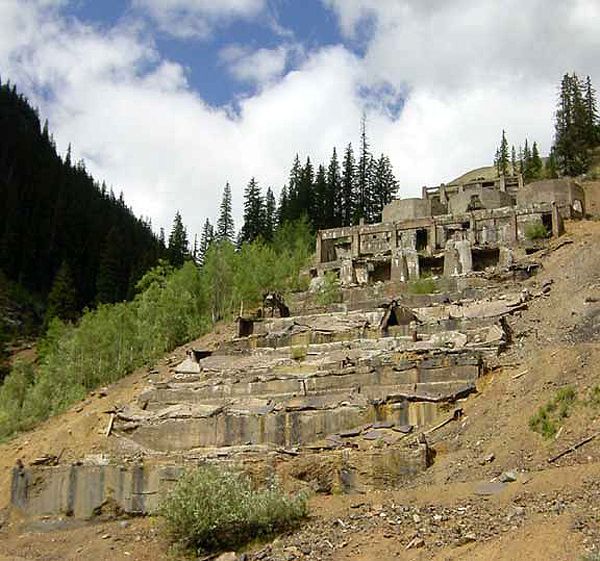
Remains of the Sunnyside Mill in Eureka, Colorado, courtesy of Wikipedia.
Afterward, Alta Bay Mines, in a joint venture with Echo Bay Mines, Ltd., leased the mine and returned it to production. Later, the mine was sold to the Sunnyside Gold Corp., a subsidiary of the Canadian mining giant Kinross Gold. The company could not make the mine profitable, and it closed for the last time in July 1991.
Over the years, the Sunnyside became Colorado’s largest operating gold mine and also produced silver, lead, copper, and zinc. It is credited with producing more than 7 million short tons of ore over its 118-year lifespan. In the years after the mine’s final closure, the entire mining area has been reclaimed by plugging miles of tunnels and using other methods. The cost of reclamation exceeds all the profits the mine made over its nearly 118 years of operation. Today, the overall Superfund cleanup remains in the study stages.
Though the town of Eureka once had many buildings, the elements destroyed many, and others were torn down to avoid taxes. Today, the old townsite is marked only by its gravel roads, one small rebuilt building, and the old Sunnyside Mill’s foundation on the hillside. It is now home to the Eureka Campground.

Eureka, Colorado Campground
You can reach the Sunnyside Mine site by traveling about 1/2 mile north on Co Rd 2, then taking a sharp left onto Co Rd 25 for 3.5 miles. Only old mine foundations remain today, and an empty “bowl” marks where Lake Emma once stood.
Eureka is located about 7.5 miles northeast of Silverton on County Road 2. The road can be traveled by any vehicle in good weather. Beyond Eureka, it is just 4.2 miles to Animas Forks, the access point to the Alpine Loop Backcountry Byway. The byway, which requires a 4-wheel drive high-clearance vehicle, offers stunning views, numerous mining remains, and several ghost towns along the 65-mile loop.
Just about a half-mile North of Eureka, a side road veers right to the Eureka Lodge. This 1929 boardinghouse was once part of the Martin Mining Complex and is now listed on the National Register of Historic Places. It now serves as a lodging facility for groups, weddings, family reunions, and retreats.
©Kathy Alexander, Legends of America, updated November 2026.

The Eureka Lodge is a restored 1929 boarding house that now hosts groups.
Also See:
Colorado – The Centennial State
Silverton – High in the San Juans
Silverton Road to the Alpine Loop
Sources:
Friends of Mineralogy
Historic Mining Resources of San Juan County
New Mexico Bureau of Geology & Mineral Resources
The Silverton Railroads