
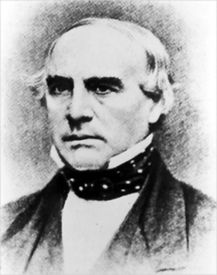
John Butterfield.
Mid-19th-century stagecoach and freight line operator Butterfield founded the companies that became American Express, Wells Fargo, and the Overland Mail Company. While many articles indicate his middle name was Warren, no primary reference supports that.
Born in Berne, New York, in 1801, John grew up on a farm and was mostly self-educated. At the age of 19, he became a professional stage driver in Albany, New York. He married Malinda Harriet Baker in 1822, and after carefully saving his money, he became the owner/operator of a livery business. Later, he established stage routes throughout New York and got involved in other means of transportation, including steamboats on Lake Ontario, the street railroad in Utica, local plank roads, and the Black River Railroad.
Through shrewd business skills, he soon controlled most of the stage lines west of New York, and in 1849, formed the Butterfield, Wasson & Company. The following year, he merged his company with two rivals, Wells & Company, and Livingston, Fargo & Company, to form the American Express Company (the same company that exists today).
In 1857, Butterfield won the government contract for the first transcontinental stage line, carrying the mail from Missouri to California and receiving $600,000 yearly. Before this, mail had been carried to the West by various private companies, some under federal contract, using various routes, including an ocean steamer around South America or overland across the Isthmus of Panama. When finalized, the new mail contract was the largest ever awarded. The original bid request was responded to by nine companies, all of which submitted routes north of Albuquerque, New Mexico. However, once the bid was awarded, the southern Postmaster General mandated that the new line run through Fort Smith, Arkansas, to El Paso, Texas, and through Fort Yuma, California, before reaching San Francisco. This new route, called the “Ox-bow Route,” added 600 miles to the original bids. Butterfield complied and formed the Overland Mail Company to carry the mail, for which Butterfield became president.
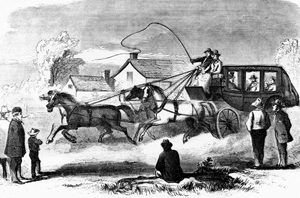
The Butterfield stage starts its journey in Tipton, Missouri.
Service began in September 1858 but was, unfortunately, short-lived. When the Civil War began, service was discontinued in 1861. Portions of the Butterfield Trail were then used by both the Confederate and the Union armies, leaving portions of the West virtually cut off from outside communication. The Confederate States of America continued to operate parts of the Overland Mail route with limited success from 1861 until early 1862. However, this success would soon be replaced by the completion of the transcontinental railroad in 1869.
John Butterfield later became the mayor of Utica, New York. He died in 1869 after suffering a stroke.
©Kathy Alexander/Legends of America, updated April 2026.
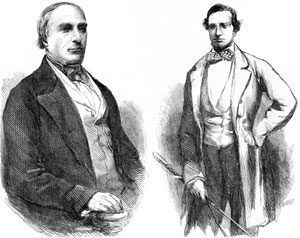
John Sr. and John Jr. Butterfield
Also See:
Butterfield Overland Stage Company
Stagecoaches of the American West
See Sources.