
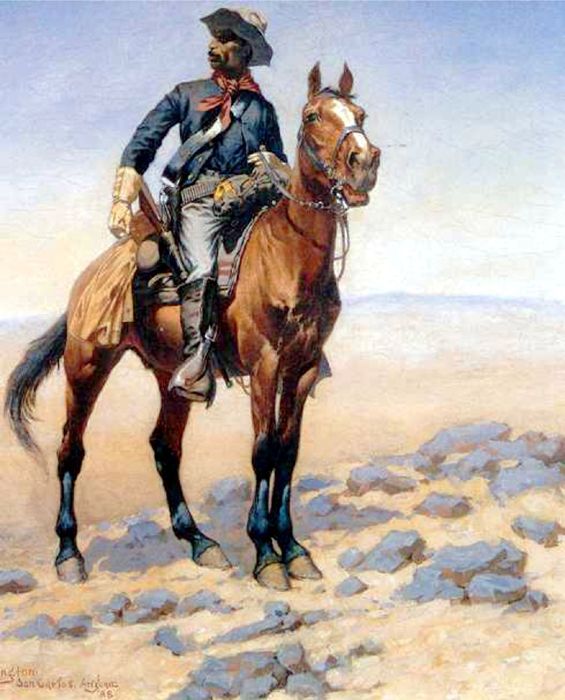
Buffalo Soldier by Frederic Remington.
Though African Americans have fought in various military conflicts since colonial days, they did not receive the nickname “Buffalo Soldiers” until they began to battle Cheyenne Indian warriors in 1867.
The actual Cheyenne translation was “Wild Buffalo,” given to the soldiers out of respect for their fierce fighting abilities, but was soon familiarly nicknamed “Buffalo Soldiers” by their white counterparts.
Although several African American regiments were raised during the Civil War and fought diligently alongside the Union Army, Congress established the first peacetime all-black regiments in 1866.
The legislation created six all-black army units: the 9th and 10th Cavalry Regiments and the 38th, 39th, 40th, and 41st Infantry Regiments. The four infantry regiments were later reorganized to form the 24th and 25th infantry regiments. White officers commanded all of these units.
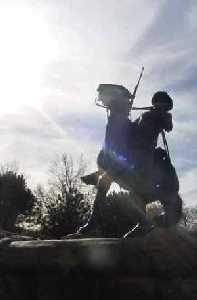
Buffalo Soldier Monument at Fort Leavenworth, Kansas.
The first regiment, comprised of former slaves, freemen, and Black Civil War soldiers, was formed on September 21, 1866, at Fort Leavenworth, Kansas. The term “Buffalo Soldiers” was initially applied to the 10th Cavalry Regiment but soon became a generic term for all African American soldiers.
When the Westward movement began in earnest, the black regiments were charged with and responsible for escorting settlers, protecting railroad crews, building forts and roads, and escorting the U.S. Mail. The 9th and 10th Cavalry Regiments also conducted campaigns against American Indian tribes on the western frontier that extended from Montana in the Northwest to Texas, New Mexico, and Arizona in the Southwest.
During the Indian Wars, approximately 20% of the U.S. Cavalry troopers were African American, fighting in over 177 engagements. Participating in these military campaigns, the Buffalo Soldiers earned a distinguished record, with 13 enlisted men and six officers earning the Medal of Honor during the Indian Wars.
After the Indian Wars ended in the 1890s, the regiments continued to serve and participated in the Spanish-American War, where five more Medals of Honor were earned. In 1899, some served as the first African-American National Park Rangers in California’s Sierra Nevada, at Yosemite, Sequoia, and General Grant (Kings Canyon) National Parks.
The Buffalo Soldiers also participated in many other military campaigns, including the Philippine Insurrection, the Mexican Expedition, World War I, World War II, and the Korean Police Action.
Eventually, African-American regiments were integrated into the regular military. However, the term “Buffalo Soldier” remained a proudly worn “badge of honor,” which signified unsurpassed courage and patriotism.
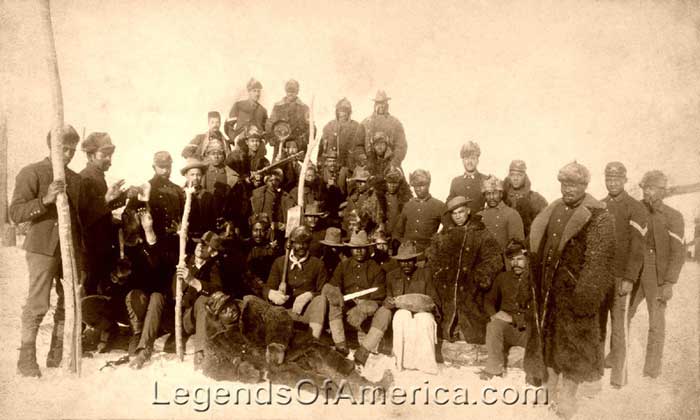
Buffalo Soldiers in 1890.
On September 6, 2005, Mark Matthews, the oldest living Buffalo Soldier, died at the age of 111. He was buried at Arlington National Cemetery.
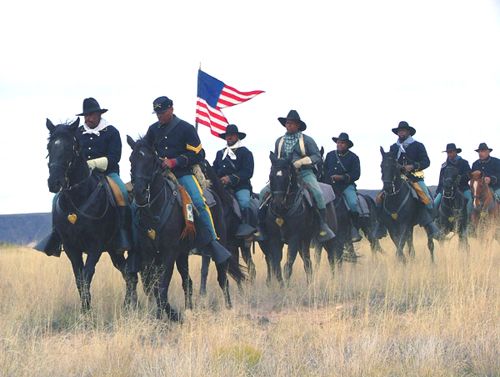
Buffalo Soldier Reenactment.
Today, several monuments and museums commemorate the Buffalo Soldiers, including the Buffalo Soldier Monument at Fort Leavenworth, Kansas; a memorial statue in Junction City, Kansas; and others in Tucson, Arizona, and Washington, D.C. The Buffalo Soldier National Museum is located in Houston, Texas.
©Kathy Alexander/Legends of America, updated March 2026.
Also See:
African American History in the United States
Soldiers & Officers in American History
See Sources.