
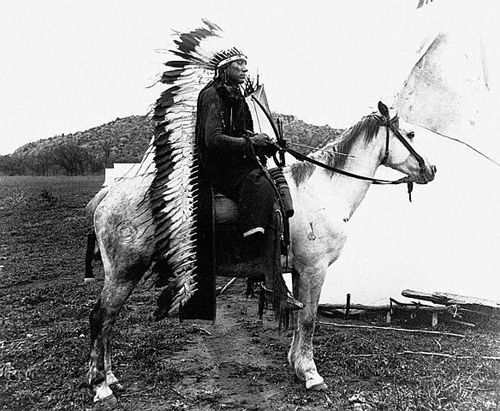
Quanah Parker.
The last Chief of the Quahadi Comanche, Quanah Parker, was both a major opponent of white settlers and a leader in the tribe’s adjustment to life on the reservation.
Quanah was born around 1845 to Chief Peta Nocona and Cynthia Ann Parker, a white captive of the Comanche near the Wichita Mountains of Oklahoma. After 24 years of living with the Indians, the Texas Rangers recaptured Quanah’s mother in the Battle of Pease River. After his wife’s recapture, Quanah’s father was a broken and bitter man and soon died. However, before his death, he told Quanah of his mother’s capture from the whites, and with that, other tribesmen soon began to call him a half-breed, and before long, the group split.
Quanah joined the Destanyuka band of the Comanche but later formed his own band, the Quahadi, which eventually became one of the most prominent and notorious Comanche bands on the Great Plains.
When the Quahadis refused to sign the Medicine Lodge Treaty in 1867, they became fugitives, continuing their buffalo-hunting way of life and sometimes raiding white settlements in the Texas Panhandle.
In 1871 and 1872, several attempts by the Fourth United States Cavalry to subdue them failed. However, when numerous buffalo hunters began invading their hunting grounds, Quanah, along with Comanche medicine man Isa-tai, sought to rid them of those decimating their chief source of survival and attacked their camp at Adobe Walls.
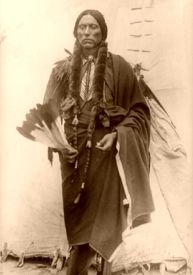
Quanah Parker.
Though Quanah had recruited some 700 warriors from not only his tribe but also that of the Cheyenne, Arapaho, and Kiowa, the attack on the Adobe Walls camp, occurring on June 27, 1874, was in vain. The buffalo camp, where only 28 men resided, fought off the Indians with their superior weapons, forcing the warriors to retreat. Quanah was wounded in what is referred to as the Second Battle of Adobe Walls. Within a year, Parker and his band of Quahadis surrendered and moved to southwestern Oklahoma’s Kiowa-Comanche reservation.
Though most Indians found the transition to reservation life extremely difficult, Quanah adapted so quickly that he was soon made chief. For the next 25 years, he provided leadership, promoted self-sufficiency and self-reliance on the reservation, built schools, created ranching operations, and planted crops. He also served as a judge on the tribal court and established the Comanche police force. He encouraged the tribe to learn most of the white man’s ways. However, he did not reject the Comanche traditions altogether, maintaining five wives, refusing to cut his long braids, and rejecting Christianity. Through his investments, he became a wealthy man, some say the wealthiest Native American of the time.
Though praised by many in his tribe, Quanah was also criticized for “selling out to the white man.” He also received rebuke because he was not elected Chief by the Comanche tribe but was appointed by federal agents. Because of this and the claim that Quanah was never given the title of chief before 1875, many assert that Chief Horseback was the last Comanche chief.
Despite his efforts to protect the tribe and their reservation lands, in 1901, the U.S. Government voted to break up the Kiowa-Comanche reservation into individual holdings and open it to settlement by outsiders.
Parker spent the rest of his life operating his profitable ranch. On February 23, 1911, he died of an undiagnosed illness. He is buried at Fort Sill, Oklahoma.
©Kathy Alexander/Legends of America, updated November 2025.
Also See:
Oklahoma Land Run.
Comanche – Horsemen of the Plains
Adobe Walls- Buffalo & Battles
Red River War – Subduing the Southern Indians
See Sources.