
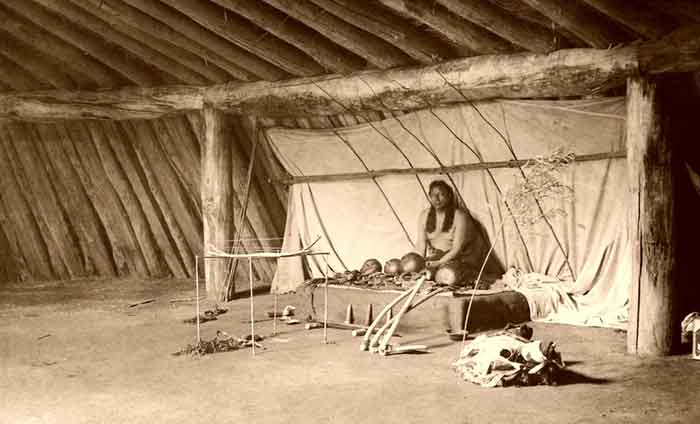
Arikara Indian at the altar, by Edward Curtis, 1908.
By Frederick Webb Hodge in 1906
The Arikara are an Indian tribe of the northern group of the Caddoan linguistic family. In language, they differ only dialectically from the Pawnee. The name Arikara means “horn, referring to the tribe’s former custom of wearing hair with two pieces of bone standing up like horns on each side of their heads.
When the Arikara left the body of their kindred in the southwest, they were associated with the Skidi, one of the tribes of the Pawnee Confederacy. Tradition and history indicate that at some point in the broad Missouri Valley, the Skidi, and Arikara parted, the former settling on the Loup River in Nebraska and the latter continuing northeast where they built on the bluffs of the Missouri River, villages of which traces have been noted nearly as far south as Omaha.
In their northward movement, they encountered members of the Sioux making their way westward. Wars ensued, with intervals of peace and an alliance between the tribes. When white men reached the Missouri River, they found the region inhabited by Siouan tribes, who said the Arikara had once occupied the old village sites.
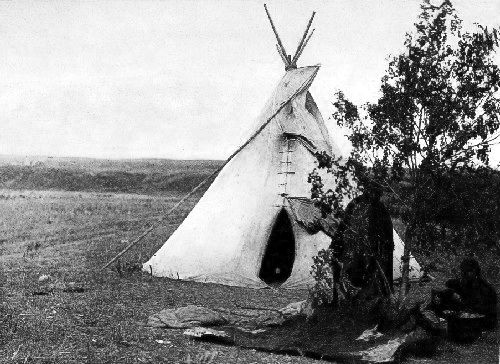
Arikara tipi, 1908, photo by Edward S. Curtis.
In 1770, French traders established relations with the Arikara, below the Cheyenne River, on the Missouri River. Lewis and Clark met the tribe 35 years later, reduced in numbers, and lived in three villages between the Grand and Cannonball Rivers in South Dakota. By 1851, they had moved up to the vicinity of Heart River. The steady westward pressure of the colonists, together with their policy of fomenting intertribal wars, caused the continual displacement of many native communities. This condition bore heavily on the semi-sedentary tribes, like the Arikara, who lived in villages and cultivated the soil. Almost continuous warfare with aggressive tribes, together with the ravages of smallpox during the latter half of the 18th and the beginning of the 19th centuries, nearly exterminated some of their villages. The weakened survivors consolidated to form new, necessarily composite villages so that much of their ancient organization was significantly modified or ceased to exist. During this period of stress, the Arikara became close neighbors and, finally, allies of the Mandan and Hidatsa. In 1804, when Lewis and Clark visited the Arikara, they were disposed to be friendly to the United States. However, owing to intrigues and the rivalry between trading companies, which brought suffering to the Indians, they became hostile.
In 1823, the Arikara attacked an American trader’s boat, killing 13 men and wounding others. This led to a conflict with the United States, called the Arikara War, but peace was finally concluded. Due to these troubles and the failure of crops for two successive years, the tribe abandoned their villages on the Missouri River and joined the Skidi on the Loup River in Nebraska, where they remained for two years.
However, the Arikara’s animosity toward the white men made them dangerous and unwelcome neighbors, so they were requested to go back to the Missouri River. Under their first treaty, in 1825, they acknowledged the supremacy of the National Government over the land and the people, agreed to trade only with American citizens, whose life and property they were pledged to protect, and to refer all difficulties for final settlement to the United States.
After the Mexican-American War ended, the government sent a commission to define the territories claimed by the tribes living north of Mexico between the Missouri River and the Rocky Mountains. In the treaty made at Fort Laramie in 1851 with the Arikara, Mandan, and Hidatsa, the land claimed by these tribes is described as lying west of the Missouri River, from Heart River in North Dakota to the Yellowstone River, and up the latter to the mouth of the Powder River in Montana; then southeast to the headwaters of the Little Missouri River in Wyoming, and skirting the Black Hills to the head of Heart River and down that stream to its junction with the Missouri River.
Owing to the non-ratification of this treaty, the landed rights of the Arikara remained unsettled until 1880, when, by Executive Order, their present reservation was set apart. This reservation included a trading post established in 1845 and named for Bartholomew Berthold, an Austrian founder of the American Fur Company.
The Arikara, Mandan, and Hidatsa together share this land and are frequently spoken of, from the name of their reservation, as Fort Berthold Indians.
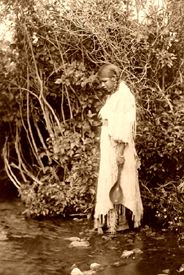
Arikara Maiden.
By the act of February 8, 1887, the Arikara received allotments of land in severalty. On approval of the allotments by the Secretary of the Interior on July 10, 1900, they became citizens of the United States and subject to the laws of North Dakota.
The Government maintained an industrial boarding school and three-day schools on the Fort Berthold reservation, and the Congregational Board of Missions supported a mission boarding school and a church. In 1804, Lewis and Clark estimated the population of the Arikara to be 2,600, of whom more than 600 were warriors. In 1871, the tribe numbered 1,650; by 1888, it had been reduced to 500, and the census of 1904 gave the population 380.
As far back as their traditions go, the Arikara have cultivated the soil, depending for their staple food supply on crops of corn, beans, squashes, and pumpkins. In the sign language, the Arikara are designated as “corn eaters,” the movement of the band simulating the act of gnawing the kernels of corn from the cob. They preserved the seed of a particular kind of small-eared corn, which is said to be very nutritious and much liked. It is also said that the seed corn was kept tied in the skin and hung up in the lodge near the fireplace, and when the time for planting came, only those kernels showing signs of germination were used.
The Arikara bartered corn with the Cheyenne and other tribes for buffalo robes, skins, and meat and exchanged these with the traders for cloth, cooking utensils, guns, etc. The women carried on early dealings with the traders. The Arikara hunted the buffalo in winter, returning to their village in the early spring, where they spent the time before planting and dressing the pelts.
Their fish supply was obtained using basket traps. They were expert swimmers and ventured to capture buffalo that were disabled in the water as the herd was crossing the river. Their wood supply was obtained from the river; when the ice broke in the spring, the Indians leaped on the cakes, attached cords to the trees whirling down the rapid current, and hauled them ashore. Men, women, and older children engaged in this exciting work, and although they sometimes fell and were swept downstream, their agility and courage generally prevented severe accidents.
Their boats were made of a single buffalo skin stretched, hair side in, over a frame of willows bent round like a basket and tied to a hoop 3 or 4 feet in diameter. A woman could easily transport the boat and would carry three men across the Missouri River with tolerable safety.
Before the coming of traders, the Arikara made their cooking utensils of pottery; mortars for pounding corn were made with much labor from stone; hoes were fashioned from the shoulder blades of the buffalo and the elk; spoons were shaped from the horns of the buffalo and the mountain sheep; brooms and brushes were made of stiff, coarse grass; knives were chipped from flint, and spears and arrowheads from horn and flint; for splitting wood, wedges of horn were used.
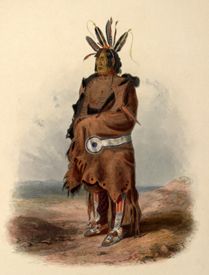
Arikara Warrior by Karl Bodmer.
Whistles were constructed to imitate the antelope’s bleat or the elk’s call and served as decoys; popguns and other toys were contrived for the children and flageolets to amuse young men. Garments were embroidered with dyed porcupine quills; tooth shells from the Pacific were prized as ornaments. Also noteworthy was the skill of the Arikara in melting glass and pouring it into molds to form high-colored beads used for trade. Their basket weaving has been identified as one practiced by former tribes in Louisiana, and they probably survived from their ancestors, who migrated from the far southwest.
The Arikara were equally tenacious in their language, even though they were next-door neighbors to the Sioux tribes for more than a century, living in terms of intimacy and intermarrying to a great extent. At the turn of the century, almost every tribe member understood the language of the other tribes yet spoke his own most fluently. At this time, they also adhered to their ancient form of dwellings, erecting them at the cost of great labor. These earth lodges were generally grouped about an open space in the center of the village, often quite close together and usually occupied by two or three families. Each village generally contained a huge lodge where ceremonies, dances, and other festivities occurred. The religious ceremonies, in which the individuals subscribed, or village had its particular part, bound the people together by common beliefs, traditions, teachings, and supplications centered on the desire for long life, food, and safety.
In 1835, Prince Maximilian of Wied, the German explorer and naturalist, noticed that the hunters did not load on their horses the meat obtained by the chase but carried it on their heads and backs, often so transporting it from a great distance. The man who could carry the heaviest burden sometimes gave his meat to the poor, in deference to their traditional teaching that “the Lord of life told the Arikara that if they gave to the poor in this manner, and laid burdens on themselves, they would be successful in all their undertakings.”
Corn held a prominent place in the series of rites, which began in the early spring when the thunder first sounded. The ear was used as an emblem and was addressed as “Mother.” Some of these ceremonial ears of corn had been preserved for generations and were treasured with reverent care. Offerings were made, rituals sang, and feasts were held during the ceremonies. Rites were observed when the maize was planted, at certain stages of its growth, and when it was harvested. Ceremonially associated with maize were other sacred objects kept in a special case or shrine. Among these were the skins of certain birds of significance and seven gourd rattles that marked the movements of the seasons.
Elaborate rituals and ceremonies attended the opening of this shrine and the exhibition of its contents, which were symbolic of the forces that make and keep all things alive and fruitful. Aside from these ceremonies, there were other quasi-religious gatherings in which feats of jugglery were performed, for the Arikara, like their kindred, the Pawnee, were noted for their sleight-of-hand skills.

Arikara Medicine Men, 1908
The dead were placed in a sitting posture, wrapped in skins, and buried in mound graves. The property, except personal belongings interred with the body, was distributed among the kindred, the family tracing descent through the mother.
The Arikara were a loosely organized confederacy of sub-tribes, each with a separate village and distinctive name, few of which have been preserved. The following names were noted during the middle of the 19th century:
Hachepiriinu (Young Dogs)
Hia (Band of Cree),
Hosukhaunu (Foolish Dogs),
Hosukhaunukare rihn (Little Foolish Dogs’),
Sukhutit (Black Mouths)
Kaka (Band of Crows)
Okos (Band of Bulls)
Paushuk (Band of Cut-throats’)
Today, the Arikara are a part of the Mandan Hidatsa and Arikara Nation in New Town, North Dakota.
Contact Information:
Mandan, Hidatsa & Arikara Nation
404 Frontage Road
New Town, North Dakota 58763
701-627-4781
By Frederick Webb Hodge, 1906. Compiled and edited by Kathy Alexander/Legends of America, updated November 2025..
About the Author: Excerpted and adapted from the Handbook of American Indians by Frederick Webb Hodge, written in 1906. Though the context generally remains the same, some words, phrases, and the order of the material have been changed to correct grammar and spelling, making this old document easier for modern readers to read.