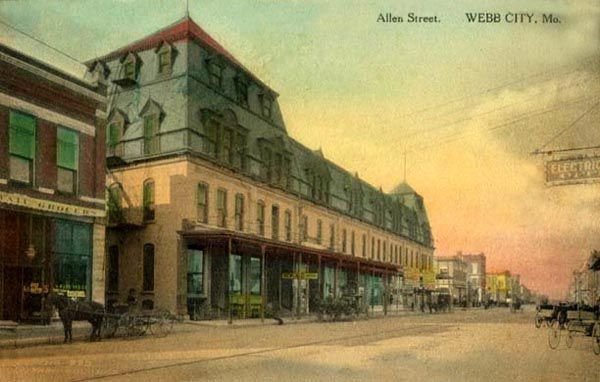
Historic Webb City, Missouri.
When traveling Route 66, mining country continues as you near Webb City and Joplin, where you’ll notice piles of chat and old mine tailings in the area.
Webb City, now principally a suburb of Joplin, was once a large corn and wheat farm belonging to John Cornwall Webb. John had come to Missouri from Tennessee in 1856, settling on about 200 acres and subsequently acquiring an additional 120 acres, part of which would later become the community of Webb City.
When Webb discovered lead in his cornfield in 1873, he partnered with W.A. Daugherty and began mining. However, the mine was continually filled with water, and Webb, discouraged, sold his interest and leased his land to Daughterty and another experienced miner, G.P. Ashcroft, two years later.
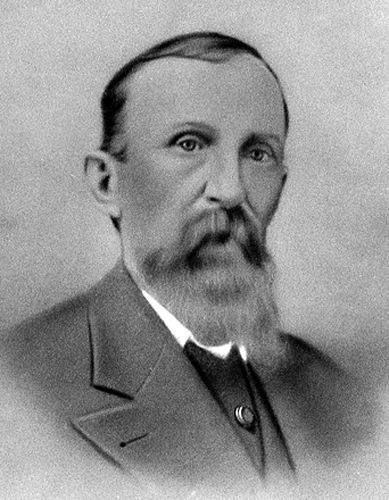
John C. Webb
In another direction, Webb platted the town of Webb City, also called Webbville, in July 1875. The following year, the Center Creek Mining Company began operations on Webb’s land, and the area was soon flooded with miners, most of whom made their homes in nearby Joplin, which, at the time, was filled with gambling halls, saloons, and brothels.
In the meantime, the mine owners made their homes in prosperous Webb City, and the town was incorporated in December 1876 with a population of about 700. John Webb’s younger brother, Benjamin C. Webb, became the town mayor.
Before long, a business district was born. John Webb was influential in its development, providing land for a school and the first Methodist Episcopal Church, and building the first brick home, the first brick business building, and the first hotel. More businesses quickly followed, including a hospital.
In 1879, the St. Louis and San Francisco Railway was built to Webb City, followed by the Missouri Pacific Railroad two years later. By 1880, Webb City was home to nearly 1,600 people. In January 1882, town founder John Webb and his son, Elijah, established the Webb City Bank. The following year, John Webb died, but his son continued to run the bank, which still exists today. However, like so many other small banks, it was taken over by a larger corporation several years ago.
In 1889, A. H. Rogers established a horse-drawn streetcar line from Carterville to Webb City. In 1893, the horse-drawn streetcar became the Southwest Missouri Electric Railway, which operated to Joplin and Cartersville. One of the country’s pioneer interurban railways, the line expanded to Carthage, Missouri, and Galena, Kansas, in the next few years.
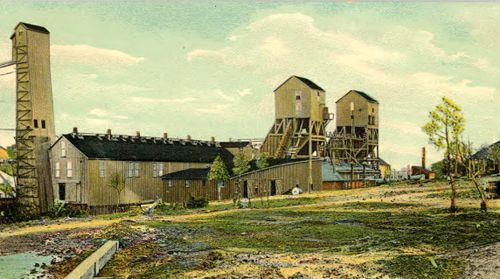
Yellow Dog Mine, Webb City, Missouri.
After the success of the first sheet ground mine, called the “Yellow Dog,” in the 1890s, business boomed. By 1896, there were 700 mines in the Webb City-Carterville-Prosperity District, which produced $ 23 million in lead and zinc between 1894 and 1904, though they wouldn’t reach their peak until 1918. That same year, the co-educational Webb City College was established.
In the meantime, Elijah Webb, son of the town’s founder, had continued to operate the bank and manage the family’s land and mineral interests, which were leased to numerous operators. Having become very wealthy, he built a magnificent Queen Anne-style home during the last decade of the 19th century that featured two stories, 12-foot ceilings, inlaid wood floors, three fireplaces, oak trim, and all the trimmings of a successful man. It is just one of several historic homes that continue to stand in the city today and was placed on the National Register of Historic Places in July 2020.
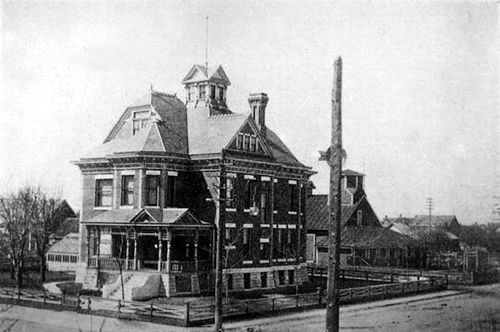
Elijah Webb’s beautiful home in the late 1800s.

Elijah Thomas Webb Residence today. Photo courtesy of Don C. Freeman.
Over the next several years, Webb City continued to grow, and by the turn of the century, the town was home to more than 9,000 people.
Most of the wooden buildings were replaced with brick; the 100-room Newland Hotel was built, there were 18 churches, an Opera House seating 1,500 people, four banks, two railroad depots, and multiple other businesses. The city soon boasted a fire department, paved streets, electric lights, waterworks, sewer systems, and two telephone companies.
In 1903, the Southwest Missouri Electric Railway expanded again, building a loop line through Duenweb and, in 1906, north to Alba. It then became known as the Webb City Northern. With Webb City as its hub, numerous buildings were established, including offices, a powerhouse, and car barns on Madison Street between Broadway and Daugherty Streets.
In 1910, the Southwest Missouri Electric Railway built a Clubhouse for its employees, which was used to pass the time between shifts. It was equipped with showers, beds, cards, and pool tables. Adjacent to the railroad operations was the site of a large surface mine called the Sucker Flats Mine. Nearby, a second business district developed with several restaurants, retail businesses, and light industry.
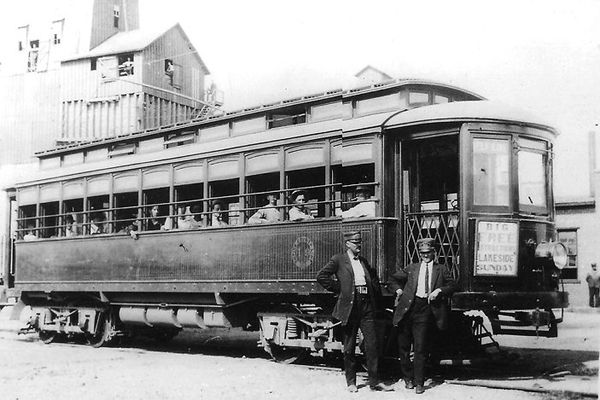
Southwest Missouri Electric Railway.
Today, the area is known as King Jack Park. A fully restored streetcar continues to operate on special occasions, and the depot houses the Webb City Area Chamber of Commerce. The first floor of the powerhouse and the clubhouse are still used today. A skating rink occupies the powerhouse, and the clubhouse is the headquarters of the Webb City Historical Society.
In 1914, the Webb City Public Library was established at Liberty and First Streets. It operates today and is also home to the Webb City Area Genealogical Society. World War I broke out that same year, and the mines were extremely busy producing minerals for the war effort. During this time, the zinc and lead concentrate produced in the Webb City-Carterville-Prosperity District was valued at more than $18 million, and the city’s population increased to about 15,000. In the meantime, the Southwest Missouri Railroad network expanded into Galena and Baxter Springs, Kansas, and Picher, Oklahoma, in 1917. The electric railroad line encompassed 94 miles, serving the Tri-State Mining Field.
However, Webb City’s boom days were nearing their end. When the war ended in 1918, the mining industry declined due to low ore prices and the discovery of richer ore deposits in Oklahoma. However, Webb City’s citizens diversified into industrial and agricultural production. Several factories were enticed to relocate to the city, including those producing leather, shirts, shoes, cigars, boxes, caskets, and other products. They did such a good job that in 1920, the city attained the distinction of increasing its industries more than any other city in the United States, increasing 250 percent. The area also expanded into the gravel industry, shipping countless tons of gravel, chat, and sand nationwide. In the 1930s and during World War II, explosives were manufactured by powder plants located near Webb City.
In the meantime, automobiles and buses had taken over the roads, ending the streetcar era. The Southwest Missouri Electric Railway discontinued all of its routes in 1939. Though mining continued for some years after World War II, it ceased altogether.
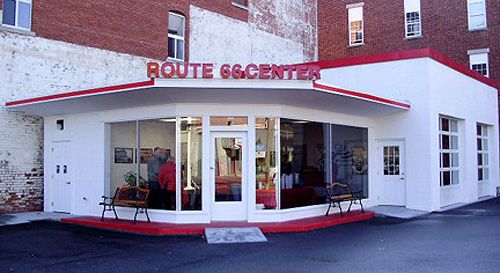
Route 66 Center, Webb City, Missouri
In 1926, Route 66 was established, running right through Webb City’s downtown area. After World War II, people began to travel as they never had before, and all manner of businesses sprang up to accommodate the traffic along the popular highway.
After mining was discontinued, Webb City continued to diversify, but the city suffered, losing its population and several businesses. Recent years, however, have once again seen the city thriving with new businesses and a new generation of Route 66 travelers. Today, the town is home to about 11,000 people.
The old Mother Road runs right through downtown Webb City and is prominently marked. Several historic buildings can be seen, and the Route 66 Center, located in a renovated old gas station, sits at the corner of Webb and Broadway Streets. The Center provides information, Route 66 displays, and offices for the Chamber of Commerce. The focal point is a mural by Mayor John Biggs, measuring 8 feet tall and 16 feet wide, depicting travelers from the 1940s along old Route 66. Visitors can also see movies at the Route 66 Theater, at 24 S. Main, one block off Route 66. The theater is situated in the historic Newland Hotel building.
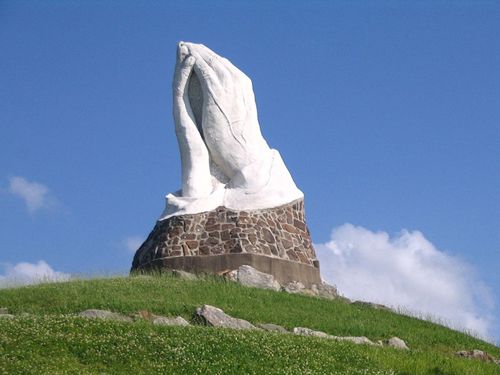
Praying Hands, Webb City, Missouri.
While traveling through Webb City, keep an eye out for several beautiful murals painted by local artists. A 30-foot oil painting depicting the city’s history hangs inside the Webb City Bank. The city is filled with historic Victorian architecture, and two distinctive art pieces can be seen at the southern end of Main Street – the Kneeling Miner and the Praying Hands, a statue that stands 32 feet high and weighs over 100 tons. The Praying Hands are perched on a hill in King Jack Park, just behind the railroad tracks. Visitors can also see the Southwest Missouri Electric Railroad Association’s trolley, the Mining Days Community Building and Amphitheatre, the old trolley depot, which houses the Chamber of Commerce, the powerhouse, and the Employee Clubhouse, which houses the Webb City Historical Society.
The city also pays homage to its war heroes in three locations. In Mt. Hope Cemetery is an outdoor chapel and Veteran’s Memorial inscribed with the names of the 77 Missouri Congressional Medal of Honor recipients; in Memorial Park is a World War II Memorial bearing the names of those Webb City servicemen and women who lost their lives in our wars; and, just west of the Praying Hands, a WW II howitzer stands in silent vigil over the memories of those who have served their country.
After seeing all the sights of Webb City, Route 66 continues south on US-71 Business Route (Madison Street) into Joplin, Missouri, the self-proclaimed lead-mining capital of the world.
©Kathy Alexander/Legends of America, updated March 2026.
Also See: