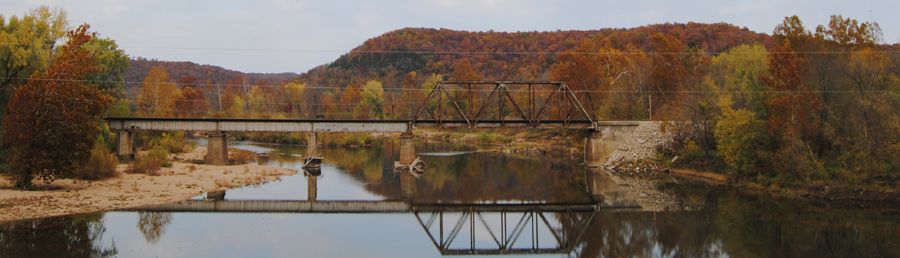
Railroad bridge over the Gasconade River between Arlington and Jerome, Missouri by Kathy Alexander.
Jerome, Missouri, is an unincorporated community located on the Gasconade River in western Phelps County.
With its relatively broad river valleys in an otherwise rugged region of the Ozark Mountains, this area was attractive to some pioneer immigrants in the 1820s and 1830s. However, the area remained sparsely settled until after the Civil War.
In 1866, General John Charles Fremont gained control of the bankrupt Southwest Branch of the Union Pacific Railroad, which before the Civil War had been constructed west from St. Louis to Rolla. Fremont then began to resume construction to push the railroad westward. By 1867, the line had reached Arlington, across the Gasconade River from Jerome, and construction began on a railroad bridge. That year, Thomas C. Harrison platted the town of Arlington along the new railroad on the east side of the Gasconade, while Fremont’s associate William F. Greely platted “Fremont Town” on the west side.
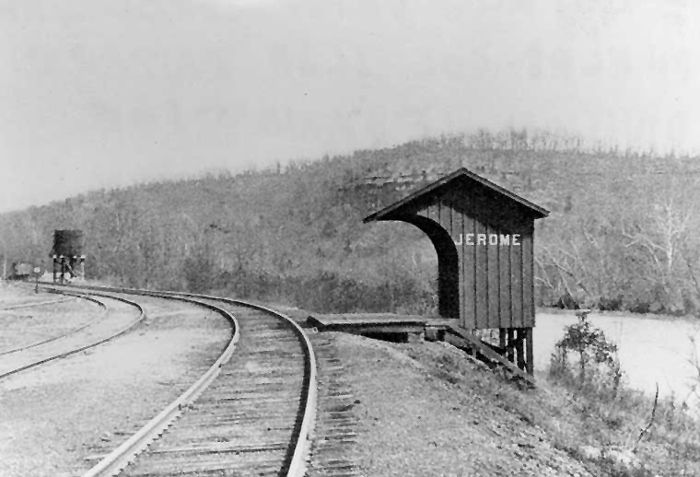
Railroad depot in Jerome, Missouri.
As the railroad’s western terminus, Freemont Town enjoyed immediate and rapid growth. The townsite covered several acres centered around a large square where Greely started constructing a massive stone hotel. Within two years, the town had a large population estimated at nearly 1,500 people. In 1869, however, construction of the rail line resumed under new owners. No longer a strategic transportation terminus, Freemont Town declined as quickly as it had risen. Its inhabitants deserted en masse, and Greely’s unfinished hotel lay abandoned. The Phelps County Court officially vacated the plat of Freemont Town and its additions in 1874. By that time, it sported only one store, a schoolhouse, and three sawmills. Its sister city, Arlington, across the river, fared somewhat better as a lumber shipping point, with a post office and two stores.
Though the town was all but abandoned, at some point, its name was changed to Jerome. Lumbering of the region’s dense forests of oak and pine provided both towns with at least some commerce in the late 19th century. The timber throughout the Gasconade and Little Piney drainages was harvested and floated downstream in immense rafts to Jerome and Arlington. The wood was milled into finished lumber and railroad ties, then shipped out on the railroad. John F. Rucker and his son Booker Hall Rucker operated a lumber business in Jerome in the 1880s and 1890s, supplying the Missouri Pacific and the St. Louis and San Francisco railroads with cross-ties. Booker Rucker also served as Arlington’s postmaster and ran a general store there in the 1890s. By the turn of the century, the area’s timber resources were depleted.
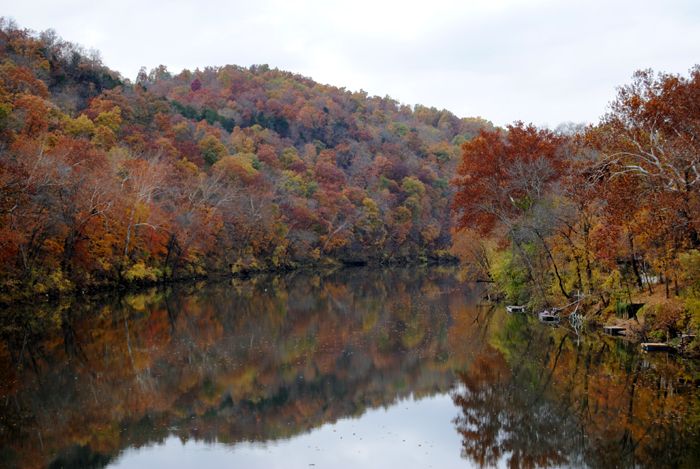
Gasconade River near Jerome, Missouri by Kathy Alexander.
Though Arlington’s post office continued to survive, by 1901, Jerome had only one occupied building remaining — the clubhouse of the Jerome Hunting and Fishing Club, northwest of the Frisco railroad bridge, established by a group of St. Louis sportsmen. Though it didn’t last, this clubhouse proved to be a predictor of the future. Jerome and Arlington revived in the early 20th century as this stretch of the Gasconade River Valley became a favorite spot for fishing, boating, and outdoor recreation. After 38 years of being closed, Jerome’s post office reopened in June 1910. At about this same time, automobiles were traveling the roadways, and Missouri State Highway 14 was created.
In 1914, the St. Louis-San Francisco Railway operated a weekend-only train between St. Louis and the Gasconade River at Jerome, called “The Fisherman,” and people arrived in great numbers to enjoy fishing, hunting, and other sports activities on the Gasconade and Big Piney Rivers. In about 1916, Sylvester J. Bryant established the Bryant Resort at Jerome, which, within ten years, was reported to be “one of the largest and most famous resorts in the middle-west.”
In 1923, two steel bridges were built on Highway 14, linking Jerome and Arlington—one over the railroad bridge across the Gasconade River and the other across the Little Piney River. In 1926, Missouri Highway 14 was made part of Route 66, which was paved by 1931. This dramatically increased travel and tourism in the area.
As a result, Sylvester Bryant added nine more cottages to his complex at Jerome in the spring of 1926 to better accommodate the growing number of visitors. During the next summer, Bryant brought in the Bryant Jazz Orchestra–“a dandy good orchestra”– which played in his new open-air pavilion every night after July 1. Across the river at Arlington, Judge and Mrs. G.V. Randolph operated Piney View Cottages; they would open the 1927 summer season with 34 guests. Other residents served as fishing guides and provided boats and tackle for vacationers. There are no remains of this resort today.
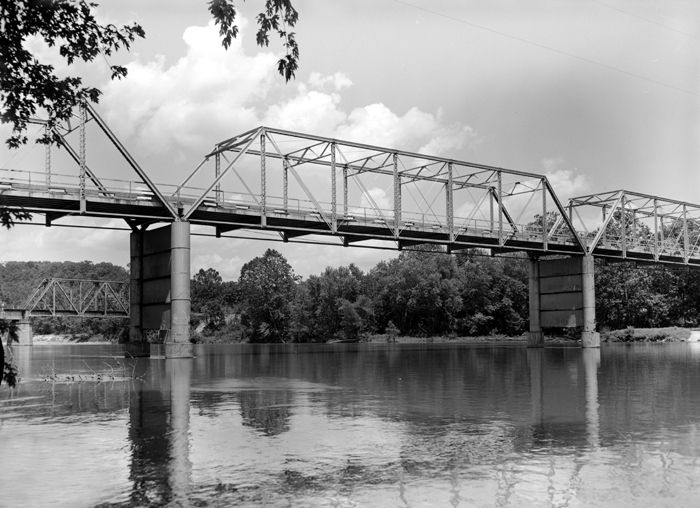
1928 steel truss bridge over the Gasconade River to Jerome, Missouri.
The rapid expansion of the state road system and the corresponding increase in travel provided a tempting climate for entrepreneurs hoping to capitalize on the unprecedented traffic and tourist dollars. These favorable conditions prompted a group of wealthy Rolla businessmen to join Lawrence W. Fitzpatrick, president of the St. Louis Construction Company, in an investment scheme to construct a toll bridge across the Gasconade River to link Route 66 with the nearby resorts at Jerome. While the Jerome Bridge was under construction, the State of Missouri made plans to designate a three-mile-long stretch of road running from Route 66 across the new Jerome Bridge to the county line as a state highway. The four-span truss bridge, measuring 126 feet long, was completed in 1928. Unfortunately, this bridge was replaced with a nondescript bridge in 1997.
By that time, the village of Jerome had moved about a half-mile to the north on the west bank of the Gasconade River.
The Jerome Bridge, its area resorts, and Route 66 were located south of the town of Jerome on what is now D Highway. Locals once referred to this area as Tater Hollow.
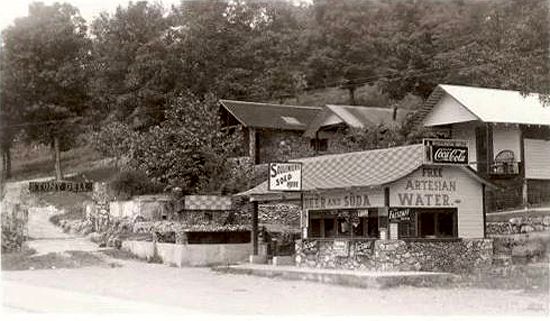
Stony Dell Resort, Jerome, Missouri.
One of the most popular destinations on Route 66 was the Stony Dell Resort. When it was built in 1932, it was part of Arlington because it was located on the east side of the Gasconade River near the old town. It is now within the jurisdiction of the town of Jerome.
This complex was built, owned, and operated by George Prewett and his son, Vernon. Stonemasons by trade, the Prewetts, along with a carpenter named George Badger, began building this resort in the early 1930s. By the time it was complete, it boasted a spring-fed swimming pool, a two-story stone bathhouse, a restaurant, a service station, tennis courts, landscaped gardens, picnic grounds, and several cabins, some made of stone and others constructed of wood. They rented for $1 to $2 a night. In 1935, the resort was described by the Rolla Herald as “one of the beauty spots of Phelps County.
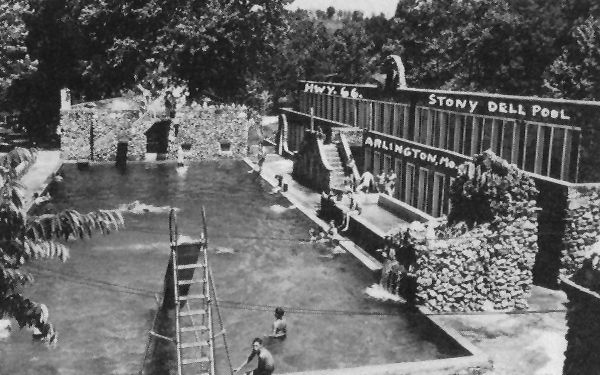
Swimming pool at the Stoney Dell Resort in Jerome, Missouri.
Its best-known feature was its 100-foot-long rock swimming pool fed by an artesian well via a large stone fountain. Though the water was extremely cold, it didn’t stop plenty of people from enjoying the water. In fact, the resort became so popular that the police sometimes had to be called to direct traffic. The artesian spring water was also sold in the Stony Dell gift shop and fed tanks in the restaurant, where live fish were kept. After viewing the live fish, diners could select the one they wanted for dinner.
Eight stone cabins were built on a terraced hill overlooking the old highway. They were accessed by way of a flagstone path that led from the road and beneath a stone archway. A retaining wall and the archway were built of native stone using a variety of textures and patterns. The remains of one of the cabins, the retaining wall, and the archway still stand.
The Stony Dell Swimming Pool and Park complex once stood on the south side of the road, while the cabins and restaurant were on the north side. Today, the park complex is long gone.
Located at the base of a wooded hillside on the north side of the highway, a long building housed a restaurant and curio shop called Granny’s Vittles and served as a Trailways bus station in the 1930s. An ornamental “fish pond” constructed of random rubble stone once stood on the west end of the building. Burned out today, its ruins are still visible.
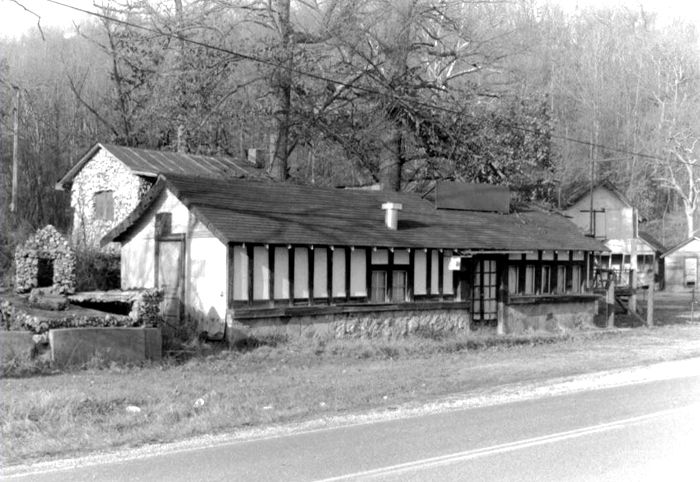
Stony Dell Bus Station and Restaurant, 1993.
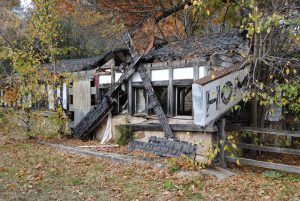
The old restaurant and bus station at the Stony Dell Resort are burned out and in ruins today, by Kathy Alexander.
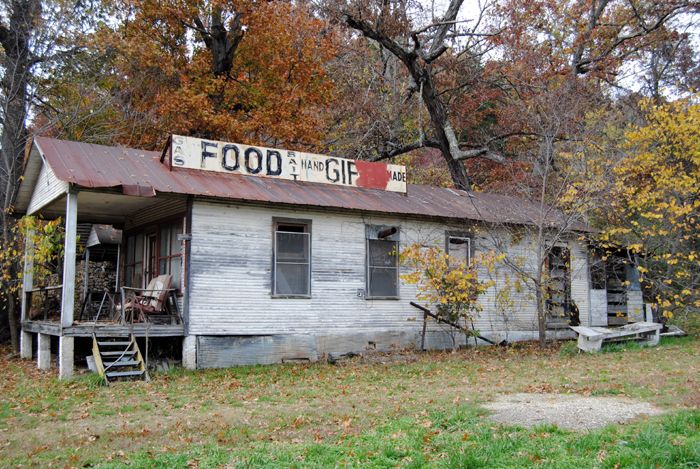
The old store at the Stony Dell Resort in Jerome, Missouri, by Kathy Alexander.
Next door stood a couple of craftsman-style buildings, one of which was alternately called the Bear’s Den and the Bushwhackerood building. These buildings still stand with a sign advertising “Gas, Food, Bait, Handmade Gifts.” In a large lot across from these buildings, also on the north side of the road, are the remains of four of eight small wood cabins that once stood here. At the north end of the line, the largest of them is said to have been the Arlington Schoolhouse. Though deteriorating, the cabins continue to stand today.
For decades, the river resort was popular among Route 66 travelers and servicemen from nearby Fort Leonard Wood. At one point, it was said to have been a favorite of old-time actress Mae West, who made several visits. In addition to its facilities, the resort offered dancing, tennis, boating, fishing, and even a Justice of the Peace.
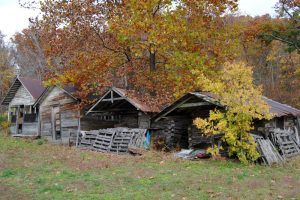
Old cabins at the Stony Dell Resort in Jerome, Missouri.
By 1952, the Prewetts had sold the property, and from 1954 to 1967, it was operated by Fred Widener. However, by the 1960s, it was showing signs of age and wear. In 1967, Stony Dell’s swimming pool and park complex on the south side of Route 66 was torn down to accommodate I-44, and the resort closed its doors forever.
Just about ½ mile to the southwest was a popular Route 66 stop variously called the Happy Hill Restaurant, the Happy Hill Cafe, and the Honey & Hot Biscuit Cafe. This long narrow building was built in about 1945. In the 1950s, the restaurant was heralded in newspapers as having delicious barbecued pork, beef, and ribs. Though it served customers along the highway for years, it eventually closed, and the building is in ruins today.
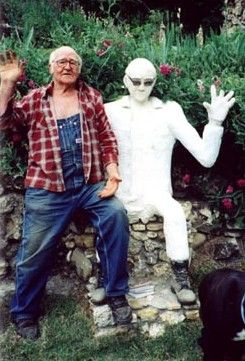
Larry Baggett courtesy Two Wheel Adventures
Right next door to this old restaurant is a private residence that became known as Larry Baggett’s Trail of Tears Memorial. Somewhere along the line, a man named Larry Baggett obtained this property intending to build a campground, but those plans were changed when his wife died. Sometime later, an old Cherokee Indian visited Larry, who he said looked to be about 150 years old. The old Indian told Baggett that his house was built on the Trail of Tears, and it was blocking the path. The Indian further conveyed how they were made to walk hundreds of miles and how the Cherokee had camped right near Larry’s home.
Before meeting the elderly Cherokee man, Larry had built a stone wall adjacent to his house, and the Indian told him to put stairs there because the spirits were unable to get over the wall. Well, Larry did just that. He built those stairs to nowhere, and when they were complete, the knocking stopped. Afterward, he built a tribute to the Trail of Tears that included a stone archway labeled “Trail of Tears” that sits between a statue of himself on one side and another pouring water out of a bucket on the other side. On the property, he built several stone walls, folk art statues, a wishing well, several rock gardens, and a sign that described the plight of the American Indians who suffered along the Trail of Tears. His big stone house was constructed around three living trees.
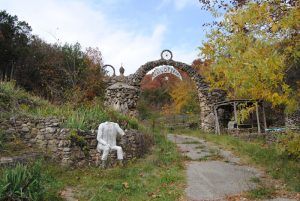
Trail of Tears Memorial in Jerome, Missouri by Kathy Alexander.
Baggett’s memorial immediately attracted all kinds of attention. It made him into a local legend when the media focused on “local curiosities” and tourists sought out cultural oddities on old Route 66. He was featured on several local stations as well as in a documentary televised in Great Britain.
Mr. Baggett passed away in 2003, and two years later, his “shrine” was sold. Until 2018, it stood empty, the structures deteriorating, and even the head of his “self-portrait” sculpture going missing. However, in 2017, Marie Ryberg purchased the property to restore the attraction. With help from local artist Chris Richardson and volunteers, the Memorial was reopened in April 2018 under the new name of “Trail of Tears and Herbal Gardens.”
For Route 66 travelers, the historic sites are not actually located in the present-day town of Jerome but rather are located to the southwest on Missouri Highway D. From Interstate-44, travelers will take exit #172 and turn right on Missouri Highway D, and within less than a mile, they will come upon these Route 66 sites.
To continue the journey westward on Route 66, return to I-44 and continue southwest to Devil’s Elbow.
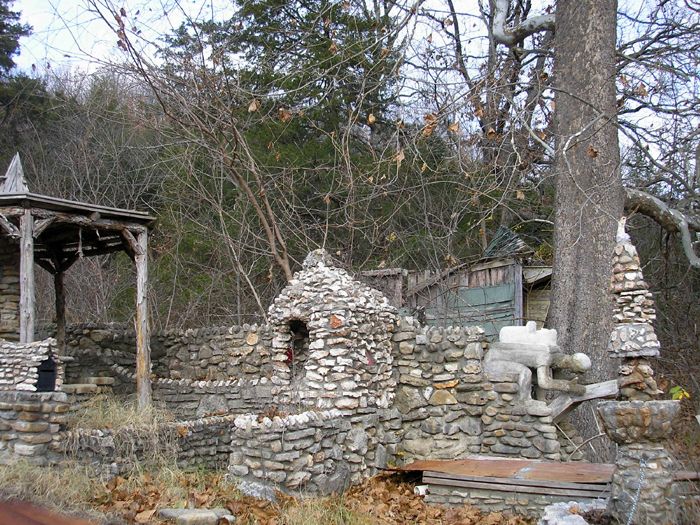
Sculptures at the Trail of Tears Memorial in Jerome, Missouri by Kathy Alexander.
©Kathy Alexander/Legends of America, updated May 2025.
Also See:
Arlington Road – True Vintage Route 66
Missouri Route 66 Photo Gallery
Sources:
Hub Pages
Library of Congress
Missouri Department of Natural Resources
Springfield-Greene County Library District