
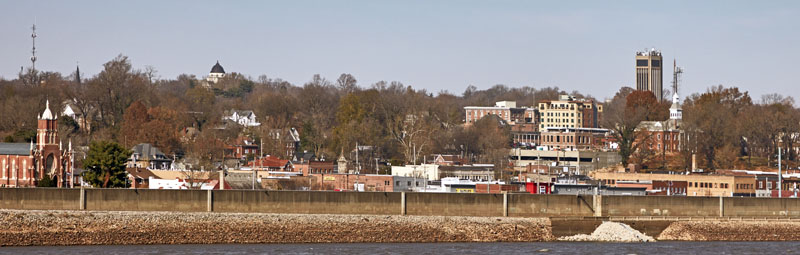
Cape Girardeau, Missouri, on the Mississippi River. Photo by Carol Highsmith.
Sitting on the first continuous high ground in Missouri upstream of the Ohio River, Cape Girardeau, Missouri, was deemed an important site during the Civil War for numerous strategic reasons. In 1861, General Ulysses S. Grant approved the construction of four forts at strategic locations around the city of Cape Girardeau. They were named Forts A, B, C, and D.
Fort A was positioned on a bluff overlooking the Mississippi River at the north edge of town. It was meant to defend the city against Confederate gunboats. The site was located north of present-day Bellevue Street between Lorimier and Spanish Streets. Nothing remains of the fort today.
Fort B was located on a hill now occupied by Southeast Missouri State University and was built to protect the city from enemy approaches on Perryville Road and Jackson Road (now Broadway Avenue). The fort was open-sided, with earthworks on the north and west sides. It was well-armed with howitzers and 24-pound siege guns. Nothing is left of the fort today, but a monument marks the site.
Fort C was near the present intersection of South Ellis Street and Good Hope Street. Guarding approaches on Bloomfield Road, Gordonville Road (now Independence Street), and Commerce Road (now Sprigg Street), controlling access to the city. During the Battle of Cape Girardeau, Confederate forces stayed out of range of the fort’s cannons. Though nothing is left of the fort today, a monument marks the site.
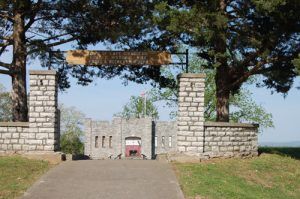
Fort D, Cape Girardeau, Missouri, by Kathy Alexander.
Fort D was located on a river bluff south of the city, and like Fort A, it was primarily a river defense. It was the region’s largest and most important garrison and is the only fort remaining in Cape Girardeau today. Union troops constructed the post at the same time as the other Cape Girardeau forts in 1861. Like the others, Fort D was designed by Captains Franz Kappner and Henry Fladd of the Army Engineers. Construction began on August 6, 1861, under the direction of Lieutenant John W. Powell from Illinois. The design is a French bastion form, a triangle with an open base. The earthworks faced away from the river. Reportedly, Fort D housed both 24 and 32-pound cannons, which would easily control any upriver movement on the Mississippi River.
Soldiers who served at the fort reported that “Quaker” cannons (logs painted black) were used to enhance the appearance of the armament. Soldiers dug artificial caves in the hillside below the fort to keep warm during the winter. Fort D did not see action during the Battle of Cape Girardeau and probably never fired its guns in anger, mainly serving as a symbolic deterrent.
In 1936, the American Legion Post purchased the site, and the earthworks were restored to their original height, with some modifications. A stone building, constructed in the middle of the fort at the site of the original powder house, was dedicated to the city and is today part of the City of Cape Girardeau Parks & Recreation Department.
The earthwork walls remain intact, and historical signage throughout the fort’s grounds brings its storied past to life. Fort D is located at the intersection of Fort Street and Locust Street in Cape Girardeau. The fort is open daily from dawn to dusk.
Lieutenant John W. Powell was in charge of the various forts for some months, recruiting local citizens from Cape Girardeau, who were mustered into Battery F, 2nd Illinois Artillery. He fought with his troops at the Battle of Shiloh, Tennessee, where he lost his arm. After the Civil War, he became famous as the first expedition leader to successfully navigate the Colorado River through the Grand Canyon.
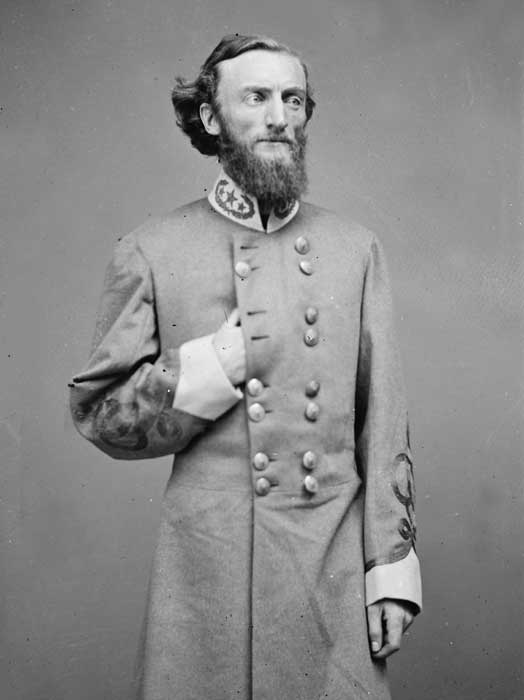
Confederate Brigadier General John S. Marmaduke, about 1863.
Battle of Cape Girardeau – Part of the Trans-Mississippi Campaign during the Civil War, this conflict, more of a skirmish than a full-fledged battle, occurred as Confederate Brigadier General John S. Marmaduke pursued Union Brigadier General John McNeil through Southeast Missouri.
Marmaduke sought to strike General McNeil and his combined force of about 2,000 men at Bloomfield, Missouri. However, McNeil retreated, and Marmaduke followed. On April 25, 1863, Marmaduke was notified that McNeil was near Cape Girardeau. That same night, in anticipation of an attack, General McNeil ordered the evacuation of women and children via steamboat to a safe location upriver. In the meantime, two gunboats and a steamer arrived with additional troops to support McNeil’s forces. With the river protected, McNeil canons from Forts A and D along the river to Forts B and C on the city’s western side. McNeil’s instincts were correct. With a force of about 4,000 men, they were ready for the attack when, early on April 26, two columns of Confederate soldiers arrived on the western edge of the city.
The Confederate forces began to attack at about 10:00 a.m., and cavalry charges were made from both sides, though neither succeeded. Federal troops were driven back by Colonel Joseph O. Shelby’s famous “Iron Brigade,” but the other column was met with heavy fire from field artillery and the guns of Forts B and C. The fighting lasted approximately four to five hours, ceasing sometime after 2:00 p.m. when General Marmaduke ordered his forces to withdraw. Following the conflict, General Marmaduke retreated to Jackson, Missouri, and then led his troops back to Arkansas, ending his second Missouri raid.
In the end, the skirmish was a Union victory, with 12 U.S. casualties and an estimated 300+ Confederate casualties, though some historians believe this number is exaggerated.
©Kathy Alexander/Legends of America, updated April 2026.
Also see:
Forts & Presidios Photo Gallery
See Sources.