
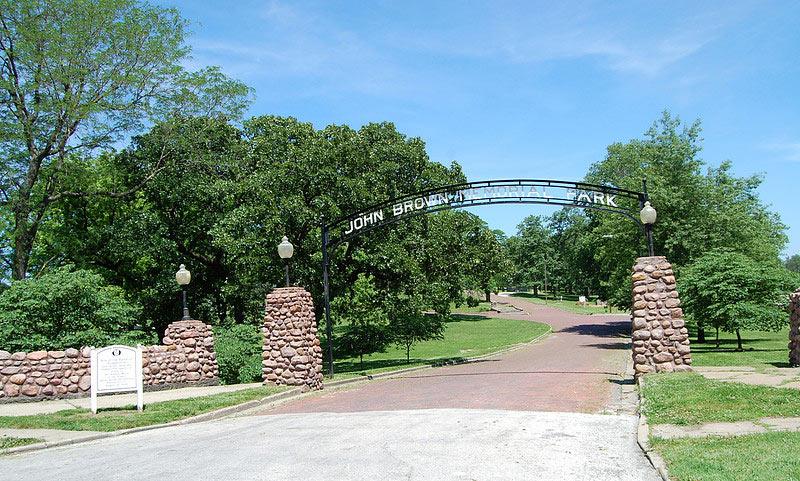
John Brown Memorial Park in Osawatomie, KS.
During the early summer of 1856, armed bands of Free-State and pro-slavery men were traversing the eastern part of Kansas Territory. Several encounters occurred between the two factions. Soon after the Sacking of Lawrence, the pro-slavery men decided that every Free-State settler must be driven out of the territory. The settlement of Osawatomie was chosen as one of the places to exhibit this policy. The residents feared the whole settlement, including John Brown’s family, would be destroyed.
Early in June, a party of 150 Missourians, under the command of John W. Whitfield, learning that most of the men of the Free-State forces were occupied elsewhere, attacked the town. No resistance was made, and no significant damage was done beyond plundering some houses and running off horses.
However, the residents were in hourly fear from then on, as the territory from Mound City to Fort Scott, and as far west as the border, was occupied by border ruffians, and neither person nor property was safe.
About the middle of August 1856, the Missouri-Kansas militia began plundering and killing in the vicinity of Osawatomie. On August 25, around 150 Missourians camped not far from the town, expecting to take it by surprise. While they were quick, the Free-State men were quicker, and the camp was captured after a complete rout of the ruffians. It was not anticipated that another attack would occur soon. Still, on the night of August 29th, a band of about 400 Missourians, commanded by General John William Reid, started from Bull Creek for Osawatomie, intending to reach the town about midnight and make an attack about daylight.
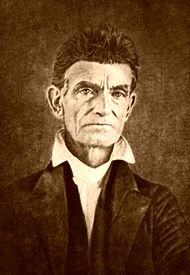
John Brown, 1850s.
On the morning of August 30, Frederick Brown, son of abolitionist John Brown, left Osawatomie before sunrise to return to Lawrence. While on his way to S.L. Adair’s home, he met Reid and a small advance guard guided by a minister named Martin White. The attacking forces had crossed the Marais des Cygnes River at Bundy’s Ford, about four miles northwest of Osawatomie, and were approaching the town when Brown was recognized by White, who raised his rifle and shot Brown upon the spot. The shot aroused some of the settlers living in the vicinity. Messengers were dispatched to notify the people in the village and Captain John Brown, who was half a mile east of town. Dr. Updegraff and Captains Brown and Cline quickly collected their men and decided on plans for defense.
At first, they planned to use the blockhouse, but abandoned it when they learned that Reid had a cannon with him. Brown, with 41 men, took a position in the timber on the south side of the Marais des Cygnes, facing south. Brown, with 17 men, was on the right; Dr. Updegraff, with ten men, formed the center; and Captain Cline, with 14 men, the left wing of the defending company. An independent company was still farther to the left in the Emigrant Aid Company’s mill. The Missourians passed about 600 yards in front when these forces were arranged. One man, sent to inspect, upon finding the enemy so close, had fired at them. He immediately retreated to the main body, followed closely by the Missourians, who formed on the ridge west of where the John Brown monument now stands. After forming in line, they fired three guns to signal the Free-State men to surrender. Orders had been issued to the defenders not to fire until Captain Brown gave the signal, but they could not be restrained when they heard these three shots, believing that the enemy had opened the engagement. Although the men knew it was contrary to orders, they fired all of Brown’s commands.
The Missourians first attacked the right wing and were partially repulsed when they brought the cannon into action about 400 yards before Brown’s command, moving it further east at each shot to scour all the timber. It was loaded with grapeshot, but the bullets passed over the men’s heads, and minor damage was done.
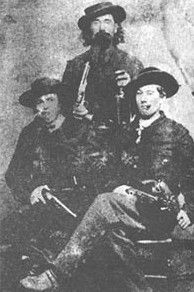
Missouri Bushwackers.
The Free-State forces kept moving eastward, firing at the enemy, who finally abandoned the cannon, dismounted, and charged into the timber, where the main body of the defenders was located. After having held the ground for over an hour against ten times their number, the Free-State men were now placed in a position where they must surrender or retreat. Most escaped across the Marais des Cygnes River, losing a few killed or taken prisoners. The Missourians then entered the town and commenced to pillage and burn it. They first fired at the blockhouse, in which several men were stationed, and only four houses escaped being destroyed. When the ruffians left, they had two wagons filled with their wounded and ten loaded with the plunder taken from the citizens’ homes.
Reid and his force started east, intending to cross the Marais des Cygnes River near the mill, but the men stationed there opened fire, and not knowing the number of the defenders, the Missourians faced about and left town by the way they came. The Free-State men who escaped assembled at a log house north of the river, including Brown and Updegraff. They moved to the south side of the Marais des Cygnes and commenced fortifying another camp the following day, but it was never completed.
The Free-State men lost about six men killed or captured, and several more were seriously wounded. It is supposed that the Missourians suffered about the same number of dead and wounded, although it was never definitely known.
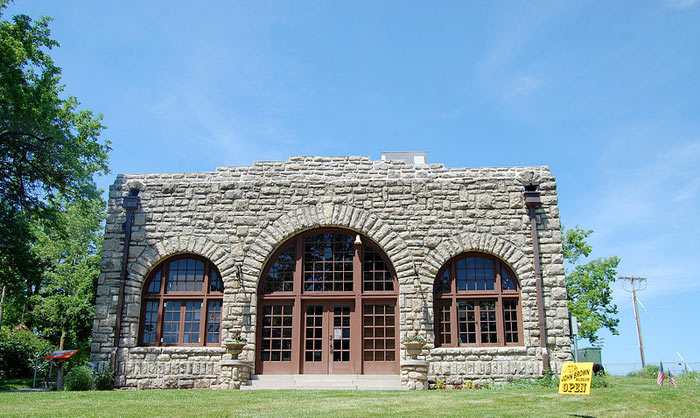
John Brown Museum in Osawatomie, Kansas. Photo by Kathy Alexander.
Compiled by Kathy Alexander/Legends of America, updated February 2026.
About the Article: The above text is based on information in Kansas: A Cyclopedia of State History, Volume I, edited by Frank W. Blackmar, A.M. Ph. D.; Standard Publishing Company, Chicago, IL, 1912. The text is not verbatim; we have edited it for readability, corrected errors, and updated it.

Osawatomie Soldiers Memorial.
Also See: