
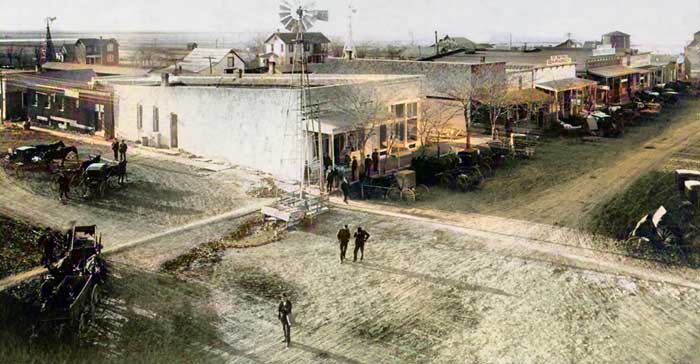
Dodge City, Kansas
In the spring of 1879, the wicked little town of Dodge City, Kansas, had not yet been tamed, a fact that would show itself once again in a gunfight at the Long Branch Saloon. The Long Branch Saloon Shootout, also known as the Richason-Loving Gunfight, involved Levi Richason, a buffalo hunter, and “Cockeyed Frank” Loving, a professional gambler.
Though Richason was known as a slow and awkward man, he also had a reputation as an excellent gunfighter. The pair often met at the Long Branch Saloon, where they played the many games of chance that were offered, and became friends. However, somewhere along the line, Richason developed some affection for Loving’s wife, Mattie, and the friendship dissolved as the two began to argue about the woman.
The dispute finally came to blows as the two argued in Front Street in March 1879. Richason ended up punching Loving in the face. However, an unarmed Frank Loving turned his back on Levi and walked away, with Richason yelling, “I’ll blow the guts of you, you cockeyed son-of-a——.”
A few weeks later, on April 5, Levi Richason strode purposefully into the Long Branch Saloon, looking for Frank Loving. Believing it time to settle their differences, Levi was sure he would find Frank in the saloon, as it had come to be his favored place to gamble. But Loving wasn’t there.
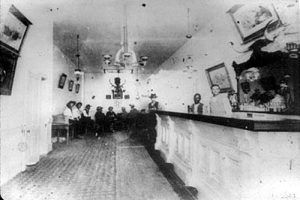
The original Long Branch Saloon, courtesy Ford County Historical Society
Undaunted, Levi headed to the bar for a drink before settling in before the pot-bellied stove in the front of the saloon. By about 9:00 p.m., Richason had decided that Loving wasn’t going to show up and headed for the door. Just about that time, Frank Loving stepped into the saloon.
When Frank sat down at a long table, Richason turned around and took a seat at the same table. The two were then heard speaking lowly, though no one could hear what they were saying. Then someone heard Richason say, “You wouldn’t fight anything, you damn ——-,” to which Loving replied, “You try me and see.”
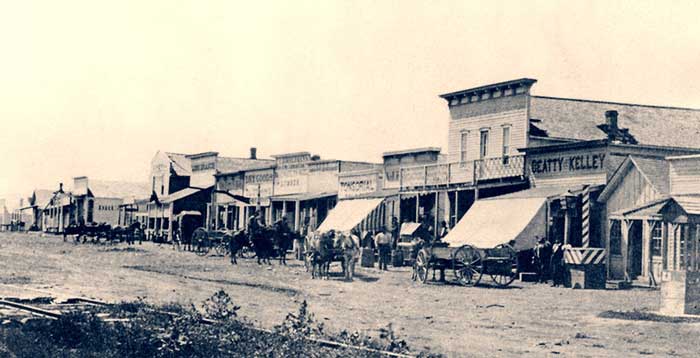
The next thing you know, Richason had drawn his pistol, and Loving drew his in response. The Long Branch Saloon was filled with smoke. Charlie Bassett, the Dodge City Marshal, heard the shots from where he was in Beatty & Kelley’s Saloon and came running.
Both men were still standing, but Richason had shot five shells from his gun and Loving’s Remington No. 44 was empty. Deputy Sheriff Duffey threw Richason down in a chair and took his gun, while Bassett disarmed Loving. Richason then got up and started toward the billiard table, when he fell to the floor with a fatal gunshot in the chest, as well as a shot through the side and another through the right arm. Frank Loving, who had only a slight scratch on his hand, was immediately taken to jail. Two days later, on April 7, 1879, the coroner’s inquest ruled that the killing had been in self-defense and Loving was immediately released.
Later, Frank Loving would leave his wife Mattie, a two-year-old son, John, and a one-year-old daughter, Mintie. After Dodge City, Loving moved on to another lawless town – Las Vegas, New Mexico, before finally making his way to Trinidad, Colorado in 1882. There, he would die in the same manner as Richason in the Trinidad, Colorado shootout on April 16, 1882.
Historical Accounts:
April 8, 1879 – Ford County Globe
“There is seldom witnessed in any civilized town or country such a scene as transpired at the Long Branch Saloon, in this city, last Saturday evening, resulting in the killing of Levi Richason, a well-known freighter, of this city, by a gambler named Frank Loving.
For several months Loving has been living with a woman toward whom Richason seems to have cherished tender feelings, and on one or two occasions previous to this which resulted so fatally, they have quarreled and even come to blows.
Richason was a man who had lived for several years on the frontier, and though well liked in many respects, he had cultivated habits of bold and daring, which are always likely to get a man into trouble. Such a disposition as he possessed might be termed bravery by many, and indeed we believe he was the reverse of a coward. He was a hard-working, industrious man, but young and strong and reckless.
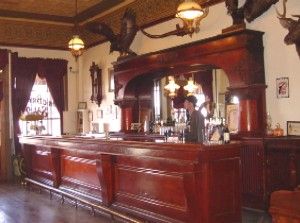
Inside the Long Branch Saloon, Kathy Weiser-Alexander.
Loving is a man of whom we know but very little. He is a gambler by profession; not much of a rowdy, but more of the cool and desperate order, when he has a killing on hand. He is about 23 years old. Both, or either of these men, we believe, might have avoided this shooting if either had possessed a desire to do so. But both being willing to risk their lives, each with confidence in himself, they fought because they wanted to fight. As stated in the evidence below, they met; one said: “I don’t believe you will fight.” The other answered, “Try me and see,” and immediately both drew murderous revolvers and at it they went, in a room filled with people, the leaden missives flying in all directions. Neither exhibited any sign of a desire to escape the other, and there is no telling how long the fight might have lasted had not Richason been pierced with bullets and Loving’s pistol left without a cartridge. Richason was shot in the breast, through the side, and through the right arm. It seems strange that Loving was not hit, except a slight scratch on the hand, as the two men were so close together that their pistols almost touched each other. Eleven shots were fired, six by Loving and five by Richason. Richason only lived a few moments after the shooting. Loving was placed in jail to await the verdict of the coroner’s Jury, which was “self-defense,” and he was released. Richason has no relatives in this vicinity. He was from Wisconsin. About twenty-eight years old.
Together with all the better class of our community, we greatly regret this terrible affair. We do not believe it is a proper way to settle difficulties, and we are positive it is not according to any law, human or divine. But if men must continue to persist in settling their disputes with firearms, we would be in favor of the dueling system, which would not necessarily endanger the lives of those who might be passing up or down the street attending to their own business.
We do not know that there is cause to censure the police unless it be to urge upon them the necessity of strictly enforcing the ordinance preventing the carrying of concealed weapons. Neither of these men had a right to carry such weapons. Gamblers, as a class, are desperate men. They consider it necessary in their business that they keep up their fighting reputation, and never take a bluff. On no account should they be allowed to carry deadly weapons.
April 1879 – Witness statement by Adam Jackson, bartender, regarding the Long Branch Saloon Gunfight
“I was in the Long Branch Saloon about 8 or 9 p.m. Saturday. I know Levi Richason. He was in the saloon just before the fuss, standing by the stove. He started to go out and went as far as the door when Loving came in at the door. Richason turned and followed back into the house. Loving sat down on the hazard table. Richason came and sat near him on the same table. Then Loving immediately got up, making some remark to Richason, and Richason could not understand what it was. Richason was sitting at the table at the time, and Loving was standing up. Loving says to Richason: ‘If you have anything to say about me, why don’t you come and say it to my face like a gentleman, and not to my back, you dam son of a bitch.’ Richason then stood up and said: ‘You wouldn’t fight anything, you dam—’ could not hear the rest. Loving said, ‘You try me and see.’ Richason pulled his pistol first, and Loving also drew a pistol. Three or four shots were fired when Richason fell by the billiard table. Richason did not fire after he fell. He fell on his hands and knees. No shots were fired after Richason fell. No persons were shooting except the two mentioned. Loving’s pistol snapped twice, and I think Richason shot twice before Loving’s pistol was discharged.”
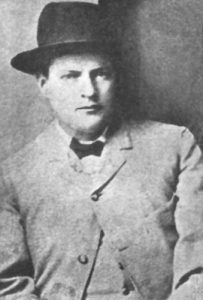
Charlie Bassett, Dodge City Lawman
April 1879 – Witness statement by Marshal Charles Bassett, regarding the Long Branch Saloon Gunfight
“When I first heard the firing, I was at Beatty & Kelley’s saloon. Ran up to the Long Branch as fast as I could. Saw Frank Loving, Levi Richason, and Duffey. Richason was dodging and running around the billiard table. Loving was also running and dodging around the table. I got as far as the stove when the shooting had about ended. I caught Loving’s pistol. Think there were two shots fired after I got into the room; I am positive there was one. Loving fired that shot, to the best of my knowledge. Did not see Richason fire any shot, and did not see him have a pistol. I examined the pistol which was shown me as the one Richason had. It contained five empty shells. Richason fell while I was there. Whether he was shot before or after I came in, I am unable to say. I think the shots fired after I came in were fired by Loving at Richason. Richason fell immediately after the shot I heard. Did not see any other person shoot at Richason. Did not see Duffey take Richason’s pistol. Do not know whether Loving knew that Richason’s pistol had been taken away from him. There was considerable smoke in the room. Loving’s pistol was a Remington No 44 and was empty after the shooting.”
©Kathy Alexander/Legends of America, updated August 2026.
Also See:
Dodge City — A Wicked Little Town
Wyatt Earp – Frontier Lawman of the American West
See Sources.