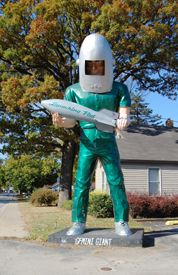
Wilmington Gemini Giant at the Launching Pad.
Wilmington, Illinois, calls itself home to a little more than 5,000 people, but its most photographed “citizen” isn’t a person at all. Rather, it is the Gemini Giant, a large fiberglass “muffler man” from the 1960s. It was during this time that these colossal men could be found all over America, holding all manner of “tools” in their hands, from mufflers to hot dogs to axes and more. In this case, the Gemini Giant sports a rocket ship, a remnant of our fascination with outer space. Most of these very tall men lost their lives as America began to move faster and faster. But here in Wilmington, the large green man hangs tight, along with several other historic icons.
Wilmington was founded in 1834, when Thomas Cox acquired 400 acres of land from the government and built a sawmill. He later added a corn cracker, a gristmill, and a carding machine, and the enterprise was renamed Cox’s Mills. Patronized by settlers from as far as 50 miles away, pioneers brought their corn and wheat to Wilmington to be ground.
In the spring of 1836, the enterprising Mr. Cox laid out the town of Winchester and began to sell lots. One such home, built of stone by Daniel McIntosh near Forked Creek, still stands today just south of Route 66. Another building built during this first year also stands – that of the Eagle Hotel, which also became a stage stop. Later, it was used as part of the Underground Railroad in the days before the Civil War.
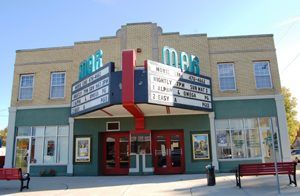
The Mar Theater in Wilmington has been doing business since 1937. Photo by Kathy Alexander.
The hitching yard was located on Main Street between Baltimore and Jackson, where wild horses were driven to be sold. Adjacent to the hitching yard was the Westbound Stage Depot. The early stage, which ran between Chicago and Pontiac, was routed on Kankakee Street between River Road and Baltimore.
In 1837, a post office was established in the new community, and church services were held in Peter Stewart’s barn. A year later, the town’s name was changed to Wilmington. Before long, other entrepreneurs laid out new additions. A man named Elias Brown opened another hotel, and Henry Brown opened a new store.
In 1839, a public school was established, and soon after, a small school building was erected. The next year, the town’s first church was built.
When the Chicago and Alton Railroad pushed through town on July 4, 1854, it brought with it added prosperity to the city. In no time at all, land prices increased threefold, and Wilmington was incorporated as a village.
Later, many of the family homes in the area became depots for the Underground Railroad before and during the Civil War. Fugitives were hidden in attics, barns, woodpiles, haystacks, or anywhere else that they might remain undetected.
Several manufacturing facilities, including a flour mill, butter and cheese factory, and paper mill, were built in the burgeoning town in the 1870s.
By the time Route 66 passed through, Wilmington responded with services for the many travelers on the Mother Road. The Eagle Hotel, having served the stagecoaches of the past, now served those traveling on the new trail to the west. In 1937, the Mar Theatre, which contained 500 seats, opened at 121 S. Main Street.
 The Dairy Delight was opened in the late 1950s by John and Bernice Korelc at 810 E. Baltimore St. In 1965, they expanded the business and renamed it the Launching Pad. That same year, John Korelc saw one of the famous Muffler Men during a restaurant convention and decided to put one out front, giving it his own twist by making it look like an astronaut. Naming it the “Gemini Giant”, after the Gemini space program, the icon would become one of the most photographed on the Mother Road, and, along with the restaurant, was inducted into the Illinois Route 66 Hall of Fame in 2000. Korelc retired in 1986, and the business was kept alive by Jerry and Sharon Gatties until 2007. After Morey Szczecin bought the property, it struggled and finally closed in 2013. Fortunately, the property was sold in October 2017 to Tully Garrett and Holly Barker, who re-launched the Launching Pad in the Spring of 2018.
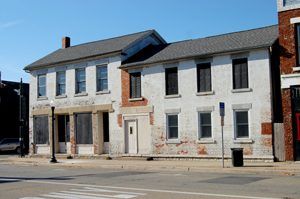
The Eagle Hotel.
The Eagle Hotel fell into serious disrepair by the late 20th century, and the City of Wilmington was at one time considered for demolition. This old hotel is the oldest on Route 66, having first catered to riverboat and stagecoach travelers when it was built in 1836. After some years of struggle, the building was converted into a boarding house and then into apartments in the 1940s. It was converted into the Wilmington Area Historical Society museum in 1982. Badly damaged by fire in 1990, the museum was forced to relocate, and the building’s future was in serious doubt. However, the Route 66 Corridor Preservation Program and other preservationists kept the building from the wrecking ball. The old hotel was listed on the National Register of Historic Places in 1994 and, as far as we know, still sits empty at 100 Water Street.
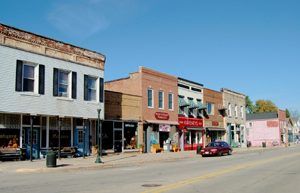
Water Street/Route 66, Wilmington, Illinois, by Kathy Alexander.
As you cruise through this pretty little town with its historic buildings and dedication to the past, it appears that all of Wilmington is dedicated to preservation. Be sure to visit the many antique stores in the historic downtown area.
Nearby, Kankakee River State Park provides anglers with great fishing opportunities for bass, catfish, northern pike, and walleye. The Park also provides numerous hiking trails, horseback riding, and camping.
Another opportunity for wildlife adventurers is the Mildewin National Tallgrass Prairie. Created from more than 19,000 acres and once used by the U.S. Army as the Joliet Arsenal, the land has been returned to the U.S. Department of Agriculture Forest Service to conserve the environment and wildlife. Today, it offers numerous hiking trails, wildlife viewing, and limited hunting opportunities on land being returned to Mother Nature.
Having had a fine time in Wilmington, head on down Route 66 through the old coal mining communities of Braidwood, Braceville, and Gardner.
©Kathy Alexander/Legends of America, updated March 2026.
Also See:
See Sources.
Back to Route 66 Main Page