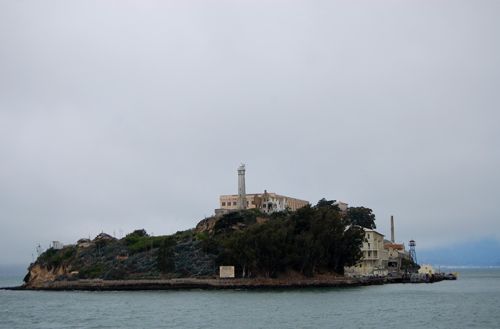
Alcatraz Island, San Francisco, California, by Kathy Alexander.
With its centuries-old history,ry from ancient Native Americans to Fort Alcatraz to a military barracks, ks and most often known for its n service as one of the toughest federal penitentiaries in the Nation, it is no wonder that this place is said to be one of the most haunted in the nation.
Often described as a portal to another dimension, Alcatraz is filled with the energy of those who came to the “Rock” and seemingly never left.
Tales and legends about the island have circulated for several centuries since its first visitors. At first, Native Americans believed evil spirits inhabited the island.
As severe punishment for violations of tribal law, Indians were sometimes isolated on the island or even banished for life to live among the evil spirits.
Today, staff and many visitors to Alcatraz have heard, seen, and felt these spirits, which continue to lurk in the shadows of the often fog-enshrouded island. People say you can hear men’s voices, screams, whistles, clanging metal doors, and other terrifying sounds within these historic walls, especially near the dungeon.
While the island served as a federal penitentiary, several guards reported extraordinary experiences, including sobbing and moaning, terrible smells, and what they called “The Thing,” an entity said to appear with glowing eyes. Others reported phantom prisoners and soldiers appearing before the guards and families who lived on the island.
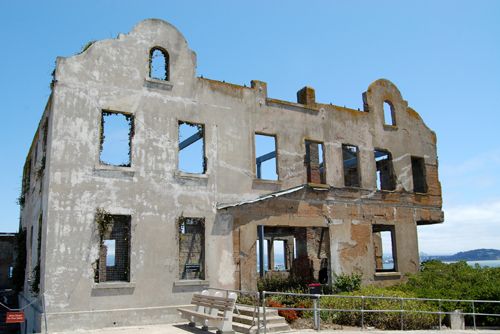
The old warden’s home on Alcatraz Island, by Kathy Alexander.
Reportedly, even Warden Johnston, who did not believe in ghosts, once heard a woman sobbing while leading several guests on a prison tour. The warden and the guests described the cries as coming from inside the dungeon’s walls. As the sobbing stopped, an icy cold wind blew through the group.
Since the 1940s, apparitions have been seen at the site of the now burned-out shell of the warden’s house. During a Christmas Party at Warden Johnston’s, several guards told the story of a ghostly man who suddenly appeared before them wearing a gray suit, brimmed cap, and sporting mutton-chop sideburns. As the startled guards stared at the apparition, the room suddenly turned very cold, and the fire in the Ben Franklin stove was extinguished. Less than a minute later, the spirit vanished.
People have often reported that the old lighthouse suddenly appears on foggy nights, accompanied by an eerie whistling sound and a flashing green light that slowly makes its way around the island. Appearing to guards and visitors alike, the spectacle vanishes as suddenly as it appears.
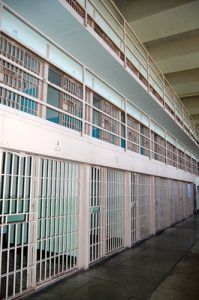
Cellblock at Alcatraz today, by Kathy Alexander.
When the prison was still open, other guards told of hearing phantom cannons and gunshots, accompanied by screams that were so real they sent the seasoned guards to the ground, believing that prisoners had somehow escaped and obtained weapons. After taking cover, the guards would cautiously look about to see nothing. These incidents could never be explained.
Another often-reported experience was the smell of smoke that often came from a deserted laundry room, as if something were on fire. When they investigated, the black smoke was so thick it drove the guards from the room. However, just minutes later, the room was completely smoke-free.
The notorious D-Block is said to have been, and continues to be, the most haunted block in the prison. While first built the same as the other cell blocks, the Bureau of Prisons appropriated additional money for a more secure D-Block after the 1939 escape attempt, in which Arthur “Doc” Barker was killed.
D-Block, known as the “Treatment Unit,” comprised 42 cells with varying restrictions. Prisoners in D-Block had no contact with the general population. Thirty-six cells were virtually like the others in the general population; however, inmates were not allowed to work or go to the mess hall for meals. They were allowed only one visit to the recreation yard and two showers each week, and all meals were served in the cells. Their only diversion was reading of prison-approved material. These cells faced the Golden Gate Bridge, from which fierce cold winds often blew. One guard who worked D-Block was known to turn on the air conditioning to make it even colder for those confined on the block.
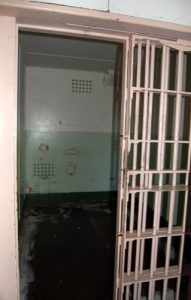
A cell in the “Hole,” by Kathy Alexander.
Five of the remaining six cells in D-Block were known as Strip Cells but were more often called the “Hole.” Reserved for the most severe offenders of prison rules, these cells were located on the bottom tier, the coldest place in the prison, and contained only a sink, a toilet, and a low-wattage light bulb that the guards could turn off. The prisoner’s mattresses were taken away during the day, and they were not allowed in the yard or showers at any time, or given reading materials. Inmates could be sentenced to as many as 19 days in the hole, completely isolated and in a state of constant boredom.
The last Strip Cell, known as the “Oriental,” was the prison’s most severe punishment. Ensuring complete deprivation of all peripheral senses, the dark steel-encased cell contained no sink or toilet, just a small hole in the floor for prisoner waste.
Inmates were placed naked in the cell, given a restricted diet, and confined in a pitch-black, cold environment. Although inmates were allowed a sleeping mattress at night, guards removed it at dawn each morning. Inmates were usually subjected to this punishment for only 1-2 days.
A former guard who worked at the prison in the 1940s reported that guards often saw the ghostly presence of a man in late-1800s prison attire walking the hallway next to the Strip Cells. On one occasion, when an inmate was locked in “the Hole,’ he immediately began to scream that someone with glowing eyes was in there with him. The 19th-century spectral prisoner had become such a practical joke among the guards that the convict’s cries of being “attacked” were ignored. The inmate’s screams continued well into the night when they were suddenly replaced by total silence. When the guards inspected the cell the following morning, the convict was found dead with a terrible expression on his face and noticeable handprints around his throat. The autopsy revealed that the strangulation was not self-inflicted.
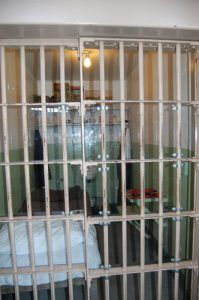
A cell in Alcatraz by Kathy Alexander.
At the time, many believed the inmate was strangled by a guard who had finally had enough of the inmate’s screaming. Though an investigation was made, no one ever admitted to the strangling. Most believed that the prisoner was killed by the restless, evil spirit of the 19th-century prisoner who was often seen wandering the corridors. Adding to the mystery, when the guards lined up the convicts for a daily count, one too many convicts were in the line-up. At the end of the row appeared the recently strangled convict. The ghostly figure vanished as guards and prisoners looked on in stunned silence.
Today’s visitors and staff often report cold spots within the hallways of D-Block, as well as sudden intense feelings. Cells 12 and 14 D are the most active. Cell 14-D is often reported to be almost 20 degrees colder than the rest of the cells on the block, and numerous psychics have felt emotionally charged impressions in the corners of the cells where punished prisoners were known to have crouched and suffered. These cells are so eerie that some park rangers refuse to go there alone.
When Richard Winer and Nancy Osborn, authors of Haunted Houses, visited Alcatraz, they also felt eerie feelings in cell 14-D. When the pair entered the cell with a park ranger, they all felt strong vibrations and tingling in their hands and arms. Convinced that something or someone was there with them, Osborn said she had never felt so much psychic energy in one spot.
Michael Kouri, co-author of the book Haunted Alcatraz, also described receiving psychic impressions when he visited cell 14-D. Also experiencing tingling sensations, he tells of “seeing” a small man with his head shaved who “told” of being beaten, his legs broken by guards, and left in solitary confinement.
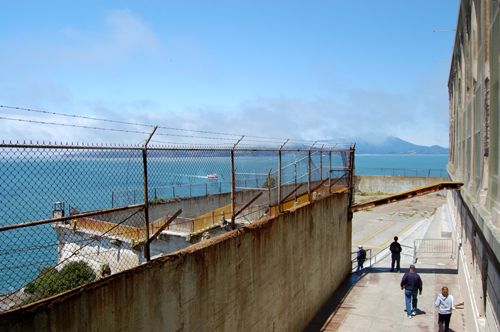
Overlooking the Recreation Yard by Kathy Alexander.
On another occasion, when renowned ghost hunter Richard Senate and a psychic spent the night on Alcatraz, Senate locked himself in cell 12-D, where an evil spirit is said to make his home. As the steel door was closed, the ghost hunter felt icy fingers wrap around his neck while he experienced psychic visions of the bodies of twisted and dismembered men.
In Cellblock C, many believe that the utility passageway where convicts Bernard Coy, Joseph Cretzer, and Marvin Hubbard were killed during their escape attempt in 1946 is haunted. Loud, clanging noises are often heard but stop when the door opens, then resume once it closes. Others have reported seeing the apparitions of men wearing fatigues and hearing disembodied voices at the riot site that left the three prisoners dead.
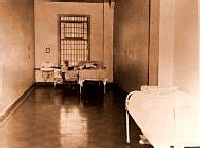
Alcatraz Hospital.
The laundry room in Cellblock C is also said to hold an unseen presence. When a CBS news team brought in celebrity psychic Sylvia Brown and ex-convict Leon Thompson, Sylvia immediately encountered the unseen presence and strong impressions of violence in the Laundry Room. As she described a tall man with a bald head and small beady eyes, Leon Thompson, the ex-convict, moved forward, stating: “I remember Butcher. He was a hitman with Murder Incorporated before they caught him. His name was Abie Maldowitz, but we called him Butcher. Another prisoner killed him here in the laundry room.” Prison records confirmed that another inmate in the laundry area of Cellblock C killed Maldowitz.
Park personnel have often heard voices and the screams of inmates in the old hospital ward, who were often secured to a table until they were calmed down. Voices are also heard in the old mess hall.
When Al Capone was imprisoned at Alcatraz, he was assigned to a cell on the outer West end of Cellblock B. Although the gangster was never allowed a musical instrument or a radio, many have reported hearing a phantom banjo strumming in his cell.
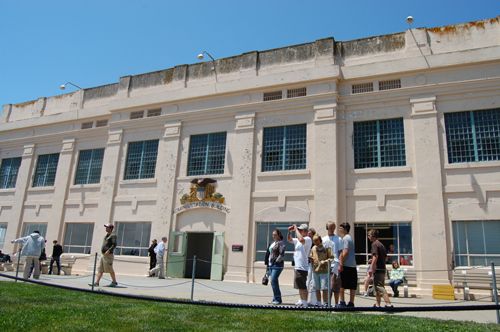
Alcatraz Administration Building by Kathy Alexander.
In 1992, Alcatraz was featured on the popular television program Sightings, where several Park Service staff confirmed the prison’s haunted history. The staff told stories of unexplainable crashing sounds, running footsteps, unearthly screams, cell doors that mysteriously closed of their own accord, moans, chains rattling, and constant feelings of being watched.
Sightings also enlisted the help of psychic investigator Peter James to get his impressions as he walked through the prison. James soon described hearing the voices of men who had been driven mad and experienced abuse, fear, and pain.
Tales of ghostly hauntings on Alcatraz Island have become so frequent that the legends have become as popular as the island’s long history. The paranormal prison seems destined to live up to its popular nickname, “Hellcatraz.”
© Kathy Alexander/Legends of America, updated September 2026.
See readers’ story below.
Also See:
San Francisco Photo Gallery
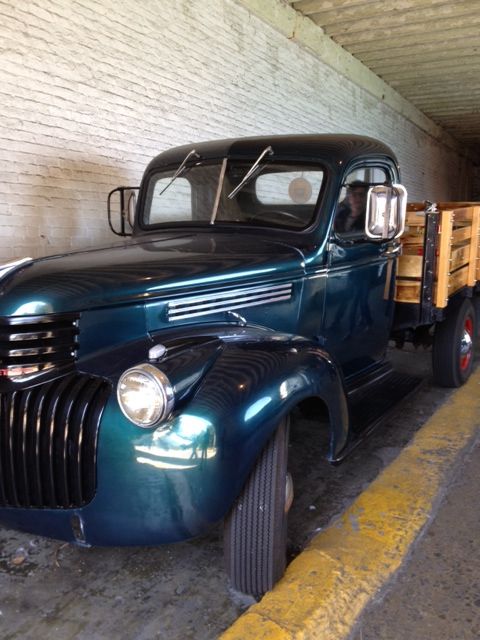
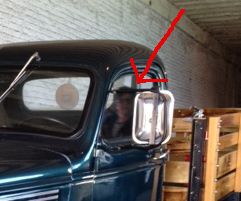
Was the woman real or a spirit from another time?
Reader’s Story – August 2012
My daughter, her college friend, and I toured Alcatraz in July. My daughter’s friend took the attached photo with a phone camera. She refused to keep it on her phone. If you look closely… a woman is sitting in the truck’s driver’s seat. When this picture was taken… there was NO ONE in that truck. I know because I love classic cars/trucks and was waiting my turn to take a photo. I was off to the rear left of the truck. A mother and daughter were directly to the left of the truck, and my daughter had gone ahead. The truck was a display, and I believe it belonged to one of the wardens. Have you ever heard of any female ghosts in Alcatraz? This photo shook me, my daughter, and her friend pretty badly.
Any info you have would be greatly appreciated.
Kristine Castillo, RN
The photo is attached… If you enlarge it, you can see this woman very clearly.