
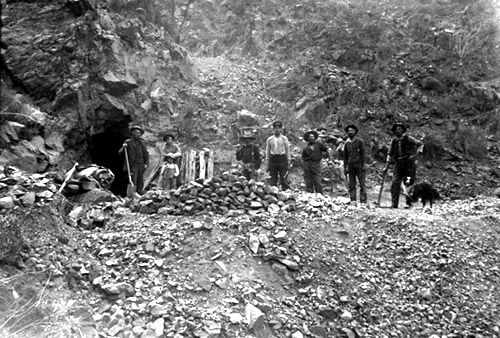
Arizona Miners.
By James Harvey McClintock in 1913
However rich Arizona mines have been, there is a suspicion that, before the days of copper, their net proceeds would hardly equal the money furnished by ignorant investors toward developing prospects that have never amounted to anything. Still worse, many of these enterprises have been obvious frauds, the money stolen from the unwary after advertising campaigns claimed enormous riches for the mine that happened to serve as bait. Perpetuated by schemers, these campaigns often found their victims in the eastern states of the Union.
Today, such work would hardly be done, for the United States authorities keep a close watch on extravagant advertising and investigate the basis of the claim.
One of the frauds in 1899 grew to such large proportions that Governor N.O. Murphy considered it his duty to issue a formal warning letter to outside investors in Arizona mines. This letter brought down a storm of protest, and Murphy was accused of a jealous desire to ruin Arizona mining. Within a few months, however, it was demonstrated that a true sense of local patriotism had dictated his action. The particular swindle to which he referred was the Spenazuma mining project, developed by “Doc” Flowers, who already had made an enormous fortune in selling proprietary medicines. The Spenazuma, exploited as the world’s greatest mine, was in Graham County and a very ordinary mine. Ore samples that were sent east and piled on the mine dump for the inspection of committees of stockholders were brought from other mines of far greater value in the Black Rock District.
The expose came through a newspaperman, George H. Smalley of Tucson, who gave Governor Murphy the information that led to the publicity. However, Flowers still sold stock at advanced prices, even after his methods had been published in Eastern journals. Flowers could not buy Smalley off and soon thereafter had to quit operations in the Southwest.
One amusing feature of Flowers’ operations on the Spenazuma was a fake stage hold-up, thoughtfully provided for the benefit of several prospective investors. He hired several cowboys to hold up the caravan of coaches, but the defenders succeeded in driving off the bandits. However, later, these “cowboy bandits” couldn’t keep from joyously telling their tale of “banditry.” Flowers was a man of true Wallingford stripe and found an opportunity to make money on every corner. In 1890, under indictment on a charge of selling fraudulent stock and under bond for $50,000, he promoted to Philadelphia investors a company that claimed to have found a method of making gold. He was arrested on several charges of grand larceny, but he succeeded in escaping to Canada. Slow-footed justice, at last, came to him as late as December 1914. After extradition from Canada, he went on trial in the east and, at the age of 70, was sentenced to two years in the penitentiary. If he had stolen a pie, his sentence would probably have been at least five years.
In 1892, Dr. H.H. Warner of Rochester, New York, an individual famed for his observatory, his bitters, and his pills, bought John Lawler and Judge Ed Avells, the Hillside group of mines in southwestern Yavapai County, paying $50.000 cash on the price of $450 000. The company then sold stock under the name of the Seven Stars Gold Mining Company. Ordinary stock was sold at $1 a share, but beyond this, was also issued a block of 100,000 shares at $5, on which Warner, then believed to be worth millions, personally guaranteed annual dividends at 13%. Warner failed soon afterward, and the mine, with much added development, went back to the sellers despite the protests of the stockholders.
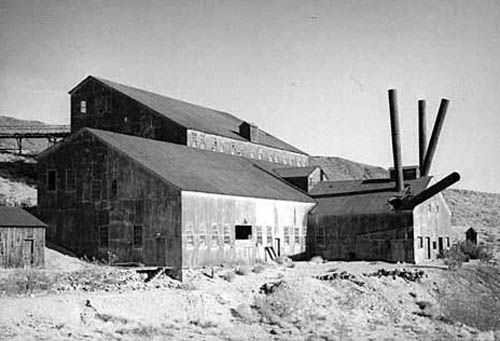
A mining mill in Arizona.
In clearing up the affairs of the George A. Treadwell Milling Company, which had a reduction plant near Humboldt, it was claimed by stockholders that the promoters of the company on stock sales aggregating about $1,000,000 had cleared up a “profit” of $500,000. In comparison, not more than $100,000 had been spent on the property. One of the promoters, a New York lawyer, was said to have been paid counsel’s fees of $36,000.
One Eastern firm of brokers secured bonds or options on several Yavapai County mines of the “has-been” class of former leaders in the silver production of Arizona. These old mine workings were cleaned out to an extent, and some of the cleverest of advertising, mainly beautifully printed circulars and letters, were sent to potential investors.
Though describing plans of reduction works that would make the miners of the entire country rich, little was done after the stock-selling campaigns. With a stock seller, it mattered little whether his mine had any worth. He never did more mining than was necessary to make a showing for his campaign. This condition was not peculiar to Arizona. Such schemes were worked much more generally and with even greater success by the promoters during mining activity in Alaska and Nevada.
One individual who had a mine near Prescott issued a unique prospectus full of quotations from the Bible and glittering generalities concerning the wealth to be secured in the marvelous mine exploited, which later seems to have dropped from the public eye. Within the prospectus appeared the following:
Come, little brother, and sit on my knee,
And both of us wealthy will grow, you see;
If you will invest your dollars with me,
I will show you where money grows on the tree.

Miners at the Grand Canyon.
Early in 1899, there was excitement along the Grand Canyon, where a large area of lime-carbonate capping had been staked, thought to have been valuable for platinum. The bubble was punctured by Professor W.P. Blake, Director of Mines of the Territorial University, who, after careful assays, reported that the “ore” sent him was a carbonate containing only silica, calcium, magnesia, iron, and a little alumina. No trace of platinum could be found, though similar rock elsewhere submitted was reported to have returned values of $300 a ton in platinum. While deploring the influence of his report upon the prospectors who thought they had found wealth, he said, “The people of Arizona generally do not propose to profit by ignorance, pretense or misrepresentation.” The excitement probably started through efforts to assure trail holdings down into Cataract Canon.
Another notable swindle was that of the Two Queens and Mansfield Mining companies. The former had several prospects near Winkelman, about 100 miles southeast of Phoenix. The latter had a mine in the Patagonia District of Santa Cruz County. The Post Office department secured the arrest of several Kansas City, Missouri stockbrokers, who had been selling shares in the two companies, using extravagant full-page advertising. As is usual in such cases, a strong defense was made based on testimony taken in Arizona. Still, the defendants were finally convicted and sent to jail in May 1909, though, as usual in such cases, they received relatively light sentences.
Another typical instance concerned a temporary Wickenburg, Arizona, resident who had bought a mining claim a few miles from town. He sold at least $100,000 worth of stock in several villages along the Hudson near West Point and, to show his good faith, brought out a Pullman carload of selected stockholders to view the wonderful mine from which he was to make their fortunes. The stock was quickly sold after showing the potential investors the mine, and the men returned to the East. The following day, Sheriff Hayden of Maricopa County appeared on the same ground with an attorney and formally sold all the property owned by the promoter or his company in that vicinity under a judgment of debt. Hayden afterward was filled with regret that he had permitted the attorney to delay him one day on the sale, or he would have been on the ground at the same time as the investors’ party.
The Great Diamond Swindle
A company with a capital of $10,000,000 was organized in San Francisco in 1872 to exploit a diamond field somewhere north of Fort Defiance in Northeastern Arizona. The reputed discoveries of the field were made by two miners named Arnold and Slack, who exhibited magnificent rough diamonds and very good rubies in New York and San Francisco. The San Francisco company included a number of the wealthiest men in the city with significant mining experience. They sent out some agents who returned with more diamonds, picked up from the ground’s surface. The location of the find was disputed; however, it was said that locations made north of Fort Defiance were merely to divert attention when, in reality, the field where the diamonds had come from was south of the Moqui villages.
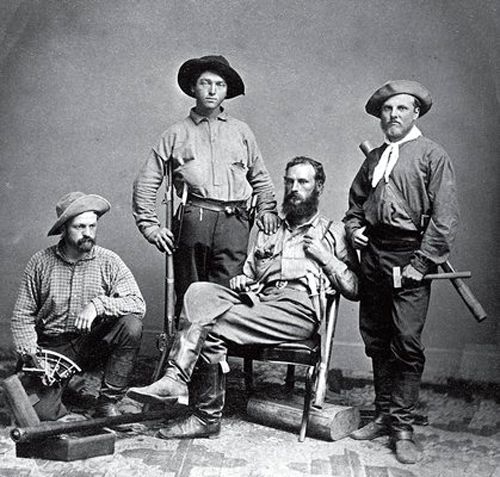
Clarence King (far right), who later became head of the U.S. Geological Survey, and his men helped foil the Great Diamond Swindle.
The whole scheme was a fraud on a gigantic scale. It was uncovered by Clarence King, the noted Western geologist, who first demonstrated that the diamonds were not of the same character, bearing characteristics of both the South African and Brazilian fields. King visited the Arizona field and confirmed his belief that it had been salted with stones from abroad. It is probable that the two “discoverers” were merely tools of wealthy men who expected to get back the gems that had been “planted” and sell stock to the unwary small investor. There was another fake diamond “discovery” down on the Gila, not far from Yuma, but this was on a much smaller scale, and excitement died even more quickly.
(Editors note: The Great Diamond Hoax was exposed on November 26, 1872, when the San Francisco Evening Bulletin published Clarence King’s findings. William Ralston, who formed the New York Mining and Commercial Company to invest in the reported Diamond Mine, had given $600,000 to Arnold and Slack but could never recover it. Arnold reported he lived his few remaining years in Kentucky, and Slack blew his money in New Mexico).
A Basket Soon Emptied
One of Arizona’s many short-lived boom camps was Quijotoa, located 65 miles west of Tucson, by the side of a mountain shaped like a basket. The name came from the Papago word “kiho,” meaning basket. The first mining locations were made early in 1879 at the bottom of the hill, renamed Ben Nevis by Alexander McKay, one of the pioneers of the boom camp. On May 11, 1883, Charles Horn or Alexander McKay discovered rich croppings at the hill’s summit, and the excitement began. It was claimed that five tons of the ore gave a return of .$2,500 at the Benson smelter. Tunnels were started into the hillside to cut the ledge at depth but failed, for there was no ledge. In the language of a San Francisco mining man, the deposit was “merely a scab on top of the mountain.”
McKay gave a bond on the property to the Flood-Fair-Mackey-0’Brien syndicate of San Francisco for $150,000, but the option was not taken up at maturity. A half-dozen companies were formed in San Francisco, each with ten million dollars in capitalization, for working the Quijotoa mines, and the news broadcasted that Arizona had found another Comstock Lode. As a result, thousands of men flocked in despite warnings that the mines were only in the development stage. Around the original Logan townsite was four or five additions. In January 1884, at Quijotoa, there were only a couple of tents ten miles from the water. Several thousand people came two months later, and there were many marks of a permanent town, including a weekly newspaper, “The Prospector,” published by Harry Brook. The time the boom broke is indicated best by the fact that the printing office was moved to Tucson in the fall of 1884. Soon thereafter, J.G. Hilzinger of Tucson bought the mines, a mill that had been moved over from Harshaw, and all the other property of the principal corporation for $3,000.
Written by James Harvey McClintock in 1913, compiled and edited by Kathy Alexander/Legends of America, updated January 2025.
Notes and Author: This article is primarily a tale by James Harvey McClintock between 1913 and 1916 when he published a three-volume history of Arizona called Arizona: The Youngest State. However, the article that appears here is far from verbatim. While the story remains essentially the same as initially published, heavy editing has occurred for spelling and grammar corrections, revisions for the modern reader, and updates. McClintock began his career working at the Salt River Herald (later known as the Arizona Republic). He later earned a teaching certificate, served as Theodore Roosevelt’s right-hand man in the Rough Riders, and became an Arizona State Representative. He died in California on May 10, 1934, at 70.
Also See:
Mining in the American West (main page)
Prospectors, Miners, and Mining Photo Gallery