
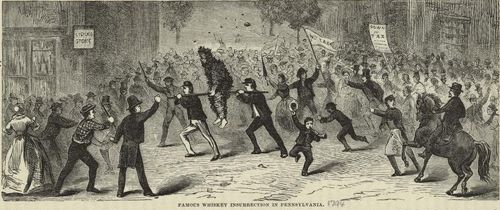
Illustration of the Whiskey Rebellion from “Our First Century,” by R.M. Devens, 1882.
What started as a tax in 1791 led to the Western Insurrection, better known as the Whiskey Rebellion of 1794, when protesters used violence and intimidation to prevent federal officials from collecting it.
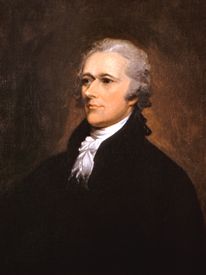
Alexander Hamilton by John Trumbull, 1806
On March 3, 1791, Congress instituted a tax on distilled liquors to help pay off the debt from the American Revolution. Treasury Secretary Alexander Hamilton initiated a program to increase central government power, and the tax was meant to fund his policy of assuming the war debt of states that failed to pay.
During this time, the Allegheny Mountains separated western Pennsylvania from the East. Farmers, the majority of the population, found a limited local market for their grain, and it was difficult to transport it to the East for sale. So, farmers instead converted their grain into whiskey, which was easier to transport and more marketable.
The excise tax, passed in 1791 on all distilled spirits, was based on the capacity of the still rather than the quantity of production. In addition, it had to be paid in cash, which was unusual at the time, since those in western Pennsylvania often used whiskey to pay for goods and services. The tax was also collected unevenly between small and large producers. Smaller still operations were required to pay the tax throughout the year at about nine cents per gallon. Larger producers in the East, who benefited from cheaper transportation costs, could reduce their tax by increasing volume and were allowed to make annual payments amounting to six cents per gallon.
The farmers of western Pennsylvania were already upset with the government over a lack of protection against Indian attacks. The tax added to their frustration, and they felt the government’s direct interference in their business was unjust and violated their rights. Many were war veterans and argued they were fighting for the principles of the American Revolution and against taxation without local representation. This immediately led to organized resistance to the tax in the summer of 1791, with many farmers refusing to pay. Collectors were ambushed and humiliated, and some were even tarred and feathered.
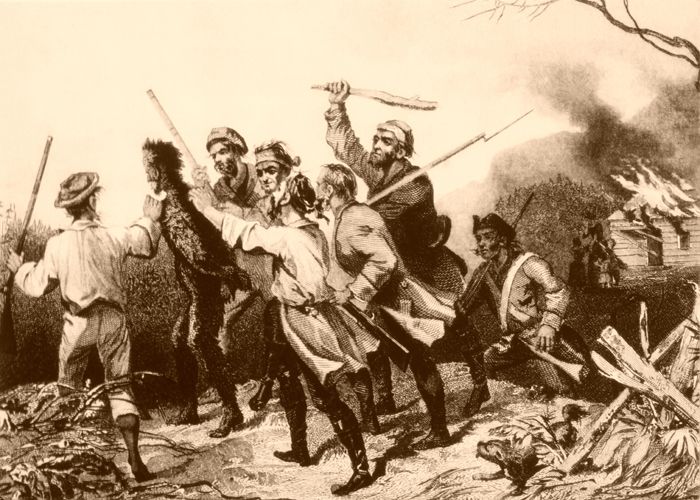
Rebels tarring and feathering a tax collector in western Pennsylvania during the Whiskey Rebellion
The violence continued to escalate over the next several years and spread to other counties until it came to a head in the summer of 1794. Subpoenas were issued for over 60 distillers who had not paid the tax in May. Under the law, those served with the subpoenas were obligated to travel to Philadelphia to appear in federal court, which burdened those on the western frontier and beyond beyond their means. So in June, Congress modified the law so that they could appear in local state courts. Still, by then, U.S. Marshal David Lenox, under Alexander Hamilton’s direction, was already serving writs requiring them to come to Philadelphia. Over the years, historians have argued that Hamilton intentionally did not wait for the law to change before serving the writs, to provoke violence that would justify federal military intervention. Others have called it a string of ironic coincidences.
Regardless, Federal Marshal Lenox had served most of the writs without incident by mid-July. However, on July 15, Lenox and Federal Tax Inspector General John Neville were fired upon at the farm of Oliver Miller, about 10 miles South of Pittsburg. The men split up, with Lenox retreating to Pittsburgh and Neville returning home to Bower Hill. The next day, around 30 Mingo Creek militiamen showed up at Bower Hill demanding the surrender of Lenox, who wasn’t there. Neville responded by firing a shot from his fortified home, mortally wounding Oliver Miller. The rebels then retreated to Couch’s Fort for reinforcements. By the time they returned the next day, they had 600 men and were now commanded by Major James McFarlane, a Revolutionary War veteran.
Neville also received reinforcements: 10 U.S. soldiers from Pittsburgh under Major Abraham Kirkpatrick, who, before the rebels arrived, had Neville leave the house for a nearby ravine. Meanwhile, Lenox and Neville’s son returned to the area but were captured by rebels. Historians say it is unclear how many casualties resulted. Still, after failed negotiations between the rebels and Kirkpatrick, shots were fired, and after an hour, rebel leader McFarlane called for a cease-fire. As he stepped into the open, a shot from the house killed him, which enraged the rebels, who then set fire to the house, forcing Kirkpatrick to surrender. Kirkpatrick, along with Lenox and Neville’s son Presley, were kept as prisoners but later escaped.
McFarlane’s death fueled rage among the rebels, whose leaders started urging more violent resistance. In late July, a group led by David Bradford robbed the U.S. mail as it left Pittsburgh so they could go through the letters and see who opposed them. After finding several, Bradford called for men to meet at Braddock’s Field on August 1.
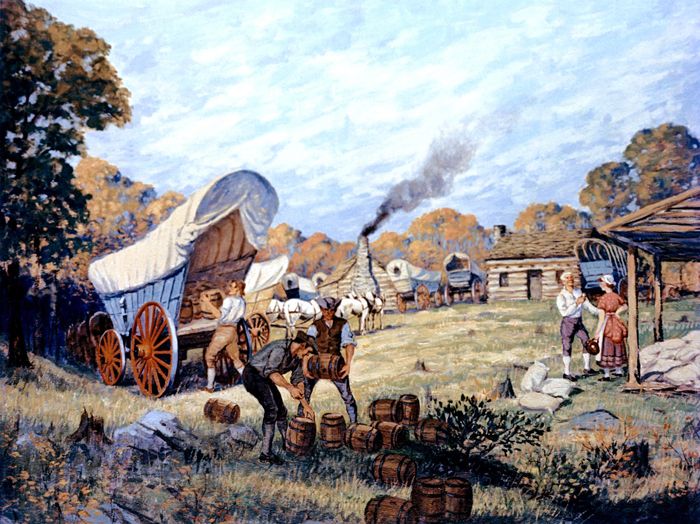
Whiskey Rebellion
Some 7,000 showed up, many of them not even landowners or distillers but upset over the tax and other economic issues. Much of the anger was directed at wealthy families without a connection to the tax. Some even talked about declaring independence from the United States. Some plans included marching through Pittsburgh and looting and burning the homes of the wealthy. Luckily, this was defused by Pittsburgh citizens who banished several men who opposed the rebels and expressed support for the rebellion.
Meanwhile, President George Washington did his best to confront the armed insurrection while maintaining positive public opinion. He decided to send a peace commission to meet the rebel committee, but at the same time, he tried to raise a militia through the states. Hamilton, writing under the name of “Tully” in Philadelphia newspapers, denounced the mob violence in western Pennsylvania and advocated military action.
On August 7, 1794, Washington issued a proclamation stating that, with the deepest regret, the militia would be called to suppress the rebellion. He called for the rebels to disperse by September 1. After Congress enacted the Militia Act of 1792, which allowed the President, with Federal court approval, to use State militiamen in cases like this, letters were sent to the governors of Maryland, New Jersey, Pennsylvania, and Virginia requesting almost 13,000 men. This also caused problems as few men volunteered, and a draft was used to fill the ranks. Protests and riots, along with draft evasion, were widespread.
In a last-ditch effort to avoid confrontation, the peace commission, consisting of Attorney General William Bradford, Pennsylvania Senator James Ross, and Pennsylvania Supreme Court Justice Jasper Yeates, met with rebels for several days in late August and early September. After the talks failed, they reported back on September 24 that the civil authority needed to be aided by military force to secure a due execution of the laws.”

Washington reviewing the Western Army at Fort Cumberland, Maryland during the Whiskey Rebellion. Painting by Frederick Kemmelmeyer.
During this time, Washington’s militia of 13,000 was gathered at Carlisle, Pennsylvania. On September 19, President Washington began leading the troops on a nearly month-long march West over the Allegheny Mountains to Bedford. On September 25, after getting the report from the peace commission, Washington proclaimed that he would not allow “a small portion of the United States to dictate to the whole union.” He called on all citizens not to aid the rebels. Washington remains the only sitting President to lead troops in the field personally. After reaching Bedford, Washington returned to Philadelphia and placed General Henry Lee in command. Alexander Hamilton also remained with the troops.
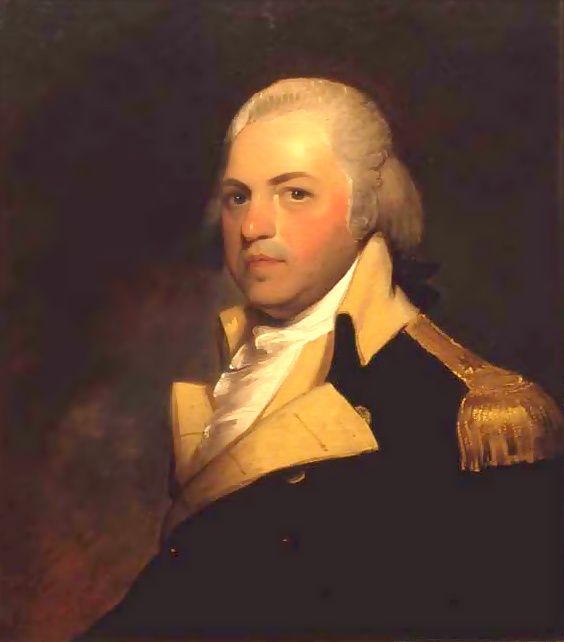
General Henry Lee, former Governor of Virginia, by William E. West, 1838
In late October, the Federalized militia began entering the western counties of Pennsylvania, and the rebel organization began falling apart. By mid-November, 150 rebels, including 20 of its leaders, had been arrested. On November 29, under the direction of President Washington, General Lee issued a general pardon for all but 33. Of those, only a few were tried, and two were convicted; they were also later pardoned. President John Adams would later pardon David Bradford in 1799. Bradford had escaped to Spanish-controlled New Orleans.
Although the physical and violent opposition to the tax ended, the political opposition continued. That opposition would help Thomas Jefferson defeat President Adams in the 1800 election. In 1802, Congress repealed the distilled spirits excise tax and all other internal Federal taxes, relying solely on import tariffs for revenue, which grew with the nation’s foreign trade.
The Whiskey Rebellion is significant in American history because it was the first test of federal authority in the United States and enforced the idea that the newly formed government had the right to levy taxes that would impact citizens in all states. It also ensured the government’s right to pass laws that impact all states.
©Dave Alexander/Legends of America, updated October 2026.
Also See:
American History Photo Galleries
Sources:
U.S. Department of the Treasury – Alcohol and Tobacco Tax and Trade Bureau
Library of Congress
Wikipedia