
By David Saville Muzzey, 1920.
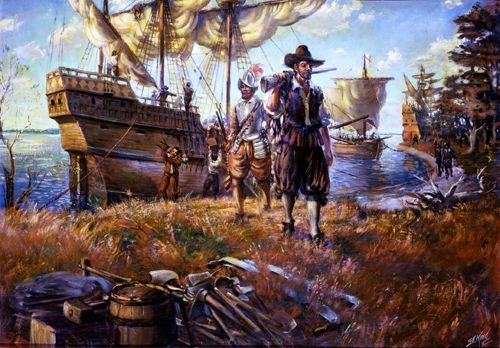
On May 13, 1607, the Jamestown colonists came ashore for the first permanent English settlement in North America. Painting by Sidney E. King, courtesy of Colonial National Historical Park
The gorgeous dreams of gold and empire that filled the minds of the 16th-century explorers slowly faded into the sober realization of the hardships involved in settling the wild and distant regions of the New World. The romantic age of discovery succeeded in the practical age of colonization. The motives that led thousands of Europeans to leave their homes in the 17th century and brave the storms of the Atlantic Ocean to settle on the shores of the James, Charles, Hudson, and St. Lawrence Rivers were those that have prompted migration in every age; namely, the desire to get a better living and the desire to enjoy fuller freedom. These desires were greatly stimulated by the events of the 16th century in Europe.
First, the masses who had lived as serfs on the great feudal estates of the nobles in the Middle Ages were finding increasingly diversified employment as citizens of national states—artisans and mechanics in the towns, free tenant farmers, merchants, and traders.
In other words, a middle class was emerging and was beginning to amass money. At the same time, the military and civil expenses of the kings, whose responsibilities were growing with their states, made taxes high and land dear. The limitless virgin lands of the New World offered a tempting relief for the hard-pressed.
In the second place, large parts of northern Europe had broken away from the ecclesiastical authority of the Roman Church in the 16th century in the movement known as the Protestant Reformation. State churches were established in England, Germany, Scandinavia, and the Netherlands, with rulers in authority rather than the Pope, and dissent from the doctrines of these established churches was treated not only as religious heresy but also as political treason. But, the spirit of free inquiry and religious innovation, which had destroyed the unity of the Roman Church, could not be held in check by rulers. Men claimed individual freedom of belief and worship. A great variety of religious sects appeared. Kings and princes tried to reduce them to submission, and European persecution sent many refugees to the New World as colonists.
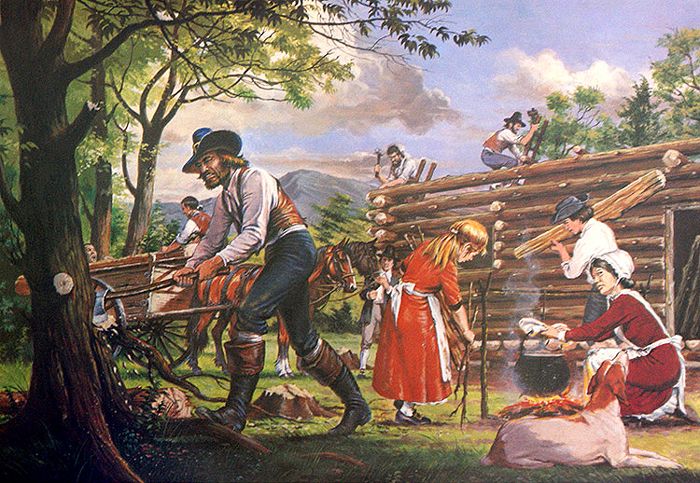
Early American Settlers.
From the 17th to the 20th century, the tide of immigration flowed from Europe to America until, by the early 1900s, fewer than half of the United States’ population was native-born with native-born parents. Yet, these immigrants did not transport their lands’ political and social institutions to the United States; instead, they adopted America’s speech, customs, and ideals with remarkable rapidity. Although Spain and France held or claimed the most significant part of North America, the English settlements were still confined to a narrow strip along the Atlantic coast; nevertheless, they absorbed the rest as they spread to the Pacific. They made the English civilization — English speech, English political ideals, English common law, English courts, local governments, English codes of manners, and standards of culture — the basis of American life. We severed our political connection with England through the American Revolution. Still, we could not lay aside the culture or destroy the institutions in which our forefathers had been trained for centuries. We still remained the daughter country, leaving the mother’s roof and setting up our own establishment.
Queen Elizabeth’s long and glorious reign ended in 1603, when she was succeeded on the English throne by James Stuart of Scotland. In the year 1606, King James permitted “certain loving subjects to deduce and conduct two colonies or plantations of settlers to America. The Stuart king began his reign with a pompous announcement of peace with all his European neighbors; consequently, though England claimed all of North America by Cabot’s discovery of 1497, James limited the territory of his grant so as not to encroach on the Spanish settlements of Florida or the French interests about the St. Lawrence River.
The powers of government bestowed on the new companies were as complicated as the territory grants. The companies were to have a council of 13 in England, appointed by the king and subject to his control. This English council was to appoint another council of 13 members to reside in each colony and, under the direction of a president, to manage its local affairs, subject always to the authority of the English council, which, in turn, was subject to the king.
In May 1607, about 100 colonists sent by the London Company reached the shores of Virginia and, sailing some miles up a broad river, started a settlement on a low peninsula. They named the river and settlement James and Jamestown in honor of the king. However, the colony did not thrive.
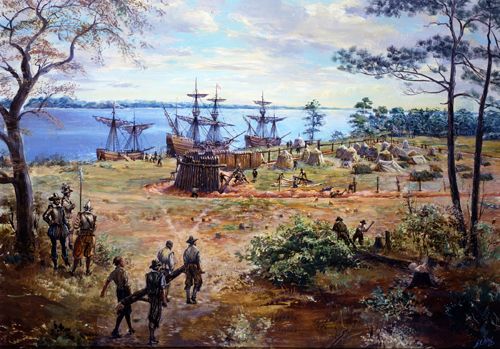
Colonists built the Jamestown fort.
The charter provided that the harvests should be gathered into a common storehouse and then dispensed to the settlers, thus encouraging the idle and shiftless to live at the expense of the industrious. Authority was hard to enforce with the clumsy form of government, and the proprietors in England were too far away to consult the colonists’ needs. Exploring the land for gold and the rivers for a passage to Cathay proved more attractive to the settlers than planting corn. In addition, the town’s unwholesome site caused fever and malaria.
Had it not been for the almost superhuman efforts of one man, Captain John Smith, the little colony could not have survived. Smith had come to Virginia after a romantic and worldwide career as a soldier of fortune. His masterful spirit, at once, assumed the direction of the colony despite its president and council. His courage and tact with the Indians got corn for the starving settlers, and his indomitable energy inspired the good and cowed the lazy and the unjust. In his vivid narratives of early Virginia in 1624, he gave himself and his services to the colony full credit, for he was not a modest or retiring man. But his self-praise does not lessen the value of his services. In the summer of 1609, he was wounded by an explosion of gunpowder and returned to England.
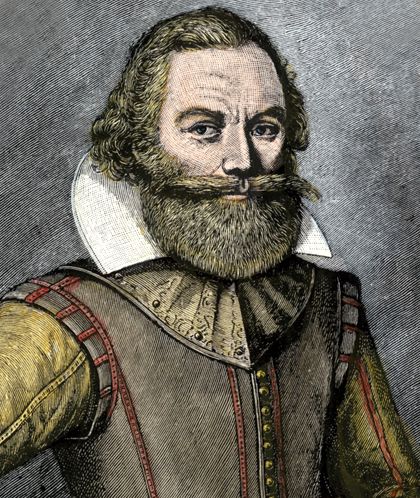
Captain John Smith.
The Winter following Captain John Smith’s departure was the awful “starving time.” Of five hundred men in the colony in October, only 60 were left in June. This feeble remnant, taking advantage of the arrival of ships from the Bermudas, determined to abandon the settlement. With but a fortnight’s provisions, which they hoped would carry them to Newfoundland, they bid a final farewell to the scene of their suffering and dropped slowly down the broad James River. But, on reaching the mouth of the river, they spied ships flying England’s colors. The new governor’s fleet of Lord de la Warre (Delaware) brought men and supplies. Thus, the Jamestown colony narrowly escaped the fate of Raleigh’s settlements. De la Warre brought more than food and recruits. The London Company had been reorganized in 1609, and the king granted a new charter, which altered the territory and Virginia’s government.
Henceforth, a large and wealthy corporation in England was to conduct the company’s affairs without the king’s intervention. Virginia was to have a governor sent out by the company. Under the new regime, the colony picked up; Order was enforced under Governor Dale’s harsh but salutary rule. The colonists, losing the gold fever, turned to agriculture and manufacturing.

Slaves were brought to Virginia in 1619.
Tobacco became the colony’s staple product, and experiments were conducted to produce soap, glass, silk, and wine. A better class of emigrants came over, and in 1619, a shipload of “respectable maidens” arrived, who were auctioned off to the bachelor planters for so many pounds of tobacco apiece. At the same time, sharing harvests in common was abandoned, and the settlers were granted full ownership of their lands.
In 1619, when the Virginians’ wives were brought in, it was memorable for two events of great significance for slavery and the later history of the colonies and the nation. In that year, the government’s first cargo of black slaves was brought to the colony, and the first representative assembly convened on American soil. On July 30, two citizens from each plantation met with the governor and his six councilors in the little church at Jamestown. This tiny legislature of 27 members, after enacting various laws for the colony, adjourned on August 4. Spanish, French, and Dutch settlements existed in America at the time of this first Virginia assembly, but none of them had, or later copied, the system of representative government. Democracy was England’s gift to the New World.
The man to whom Virginia owed this great boon of self-government and whose name should be known and honored by every American was Sir Edwin Sandys, treasurer of the London Company. Sandys belonged to the country party in Parliament, making James’ life miserable by their resistance to his arbitrary government based on “divine right,” or responsibility to God alone for his royal acts. In the meantime, Gondomar, the Spanish minister in London, whispered in James’s ear that assemblies like that in Virginia were “hotbeds of sedition.”
But James had let the London Company get out of his hands by the new charter, and when he tried to interfere in their treasurer election, they rebuked him by choosing one of the most prominent of the country party, the Earl of Southampton. Unable to dictate to the company, James resolved to destroy it. In a moment of great depression for the colony, just after a horrible Indian massacre in 1622 and a famine, James commenced suit against the company, which a subservient court declared had overstepped its legal rights and forfeited its charter. James then took the colony into his own hands and sent over men to govern it, who were responsible only to his Privy Council. Virginia thus became a “royal province” in 1624 and remained so for 150 years until the American Revolution.

Virginia Colony Government.
James intended to suppress the “seminary of sedition” and rule the colony by a committee of his courtiers. But he died before he had a chance to extinguish the liberties of Virginia, and his son, Charles I, hoping to get the monopoly of the tobacco trade in return for the favor, allowed the House of Burgesses to continue. So, Virginia furnished the pattern that, sooner or later, nearly all the American colonies reproduced: a governor with a small council appointed by the English king and a Legislature, or assembly, elected by the colony’s people.
The people of Virginia were very loyal to the Stuarts. When the quarrel between the King and Parliament in England reached the stage of the civil war in 1642, and Charles I was driven from his throne and beheaded in 1649, many of his supporters in England immigrated to Virginia, giving the colony a decidedly aristocratic character. And, when Charles II was restored to his father’s throne in 1660, the Virginian citizens recognized his authority so promptly and enthusiastically that he called them “the best of his distant children.”
He even elevated Virginia to the proud position of a “dominion” by quartering its arms (the old seal of the Virginia Company) on his royal shield with the arms of England, Scotland, and Ireland. The Virginians were very proud of this distinction, and remembering they were the oldest and most faithful of the Stuart settlements in America, they adopted the name “The Old Dominion.”
Though there were many occasions of dispute between the governors sent over by the king and the Legislature elected by the people, only one incident of prime importance disturbed the peaceful history of the Old Dominion under its royal masters. In 1675, the Susquehannock Indians were harassing the upper settlements of the colony, and Governor William Berkeley, profiting largely by his private interest in the fur trade, refused to send a force of militia to punish them. He was supported by an “old and rotten” House of Burgesses, which he had kept in office, doing his bidding, for 14 years.
A young and popular planter named Nathaniel Bacon, who had seen one of his overseers murdered by the Indians, put himself at the head of 300 volunteers and demanded an officer’s commission from Governor Berkeley. Berkeley refused, and Bacon marched against the Indians without any commission, utterly routing them and saving the colony from tomahawk and firebrand.
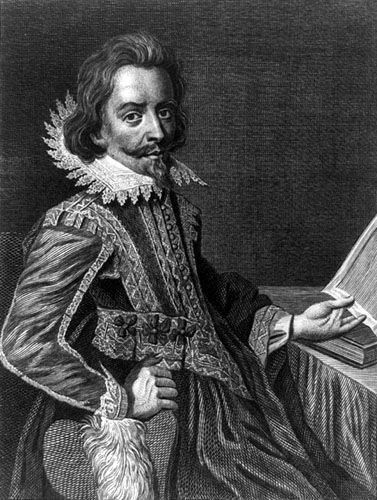
Nathaniel Bacon.
The governor proclaimed Bacon a rebel and set a price on his head. In the distressing civil war that followed, the governor was driven from his capital, and Jamestown was burned by the “rebels.” But Bacon died of dysentery shortly after his victory, and his party, made up only of his personal following, fell to pieces. Berkeley returned and took grim vengeance on Bacon’s supporters until the citizens petitioned him to “spill no more blood.”
Bacon’s Rebellion, despite its deplorable features, did good work. It showed that the colonists dared to act for themselves. It forced the dissolution of the “old and rotten” assembly and the election of a new one to represent the people’s will. It led to the recall of Governor Berkeley by King Charles II, who explained indignantly when he heard of the governor’s cruel reprisals: “That old fool has taken away more lives in that naked country than I did here for the murder of my father.” And finally, it showed that the people of the Old Dominion, though loyal to their king, had no intention of submitting to an arbitrary governor in collusion with a corrupt assembly.
Today, historic Jamestown is part of Colonial National Historic Park. The park provides views of Old Towne, where English settlers constructed a triangular fort in the spring of 1607, and New Towne, east of the fort, which was first surveyed in the 1620s. Jamestown served as the capital of Virginia until 1699, when it was moved to Williamsburg.
The site, which the Association jointly administers for the Preservation of Virginia Antiquities and the National Park Service, is located at 1368 Colonial Parkway, Jamestown, Virginia.
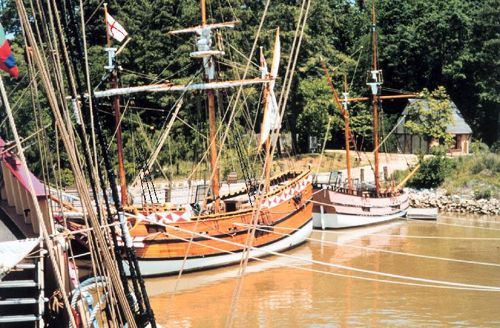
Replicas of the three ships that carried settlers to the Virginia settlement in 1607 are docked in the harbor. Photo courtesy National Oceanic & Atmospheric Administration.
By David Saville Muzzey, 1920. Compiled and edited by Kathy Alexander/Legends of America, updated August 2026. Source: An American History, Boston, Ginn and Company, 1920.
Also See:
Jamestown – First Successful English Settlement
Nathaniel Bacon — First American Rebel
See Sources.