
By Andy Adams in 1906
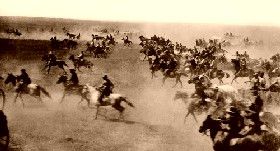
Oklahoma Land Run.
The evening before the Cherokee Strip was thrown open for settlement, several old-timers met in the little town of Hennessey, Oklahoma.
On the next day, the Strip would pass from us and our employers, the cowmen. Some boys had spent five to 15 years on this range. But we realized that we had come to the parting of the ways.
This was not the first time the government had taken a hand in cattle matters. Some of us in former days had moved cattle at the command of black soldiers, with wintry winds howling an accompaniment.
The cowman was never a government favorite. If the Indian wards of the nation had a few million acres of idle land, “Let it lie idle,” said the guardian. Some of these civilized tribes maintained a fine system of public schools from the rental of unoccupied lands. Nations, like men, revive the fable of the dog and the ox. But the guardian was supreme — the cowman went. This was not unexpected to most of us. Still, this country was a home to us. It mattered little if our names were on the payroll or not; it clothed and fed us.
We were seated around a table in the rear of a saloon, talking of the morrow. A former cowboy ran the place. It, therefore, became a rendezvous for the craft. Most of us had decided to quit cattle for good and take claims.
“Before I take a claim,” said Tom Roll, “I’ll go to Minnesota and peon myself to some Swede farmer for my keep for the balance of my life. Making hay and plowing fireguards for the last few years has given me all the taste of farming that I want. I’m going to Montana in the spring.”
“Why don’t you go this winter? Is your underwear too light?” asked Ace Gee. “Now, I’m going to make a farewell play,” continued Ace. “I’m going to take a claim, and before I file on it, sell my rights, go back to old Van Zandt County, Texas, this winter, rear up my feet, and tell it to them scary. That’s where all my folks live.”
“Well, for a winter’s stake,” chimed in Joe Box, “Ace’s scheme is all right. We know some good ones, we can get $500 out of a claim for simply staking it. That sized roll ought to winter a man with modest tastes.”
“You didn’t know that I just came from Montana, did you, Tom?” asked Ace. “I can tell you more about that country than you want. I’ve been up the trail this year and delivered our cattle on the Yellowstone, where the outfit I worked for has a northern range. When I remember this summer’s work, I sometimes think that I will burn my saddle and never turn or look a cow in the face again nor ride anything but a plow mule and that bareback.”
“The people I was working for have a range in Tom Green County, Texas, and another one in Montana. They send their young steers north to mature–good idea, too!–but they are not cowmen like the ones we know. They made their money in the East in a patent medicine–got scads of it, too. But that’s no argument that they know anything about a cow.”
“They have a board of directors–it is one of those cattle companies. Looks like they started in the cattle business to give their income a healthy outlet from the medicine branch. They operate on principles similar to those of the soap factories people did here in the Strip a few years ago. About the time they learn the business, they go broke and retire.”
“Our boss this summer was some relation to the wife of some of the medicine people Down East. As they had no use for him back there, they sent him out to the ranch, where he would be useful.”
“We started north with the grass. Had 3,400 heads of twos and threes, with a fair string of saddle stock. They run the same brand on both ranges–the broken arrow. You never saw a cow boss have so much trouble; a married woman wasn’t a circumstance to him, fretting and sweating continually. This was his first trip over the trail, but the boys were a big improvement on the boss, as we had a good outfit of men along. My idea of a good cow boss is a man that doesn’t boss any; just hires a first-class outfit of men, and then there is no bossing to do.”
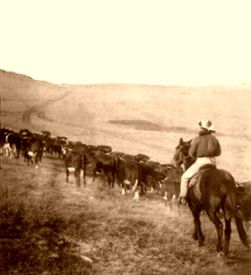
Cattle Trail
“We had to keep well to the west getting out of Texas; kept to the west of Buffalo Gap. From there to Tepee City is a dry, barren country. To get water for a herd the size of ours was some trouble. This new medicine man got badly worried several times. He used his draft book freely, buying water for the cattle while crossing this stretch of desert; the natives all through there considered him the softest snap they had met in years. Several times, we were without water for the stock for two whole days. That makes cattle hard to hold at night. They want to get up and prowl–it makes them feverish, and then’s when they are ripe for a stampede. We had several bobbles crossing that strip of country; nothing bad, just jump and run a mile or so and then mill until daylight. Then our boss would get great action on himself and ride a horse until the animal would give out–sick, he called it. After the first little run we had, it took him half the next day to count them; then he couldn’t believe his own figures.”
“A Val Verde County lad who counted with him said they were all right – not shy. But the medicine man’s opinion was the reverse. At this, the Val Verde boy got on the prod slightly and expressed himself, saying, ‘Why don’t you have two of the other boys count them? You can’t come within a hundred of me, or yourself either, for that matter. I can pick out two men, and if they differ five head, it’ll surprise me. The way the boys have brought the cattle by us, any man that can’t count this herd and does not have his figures differs. More than a hundred had better quit riding, get himself some sandals, and a job herding sheep. Let me give you this pointer: if you are not anxious to have last night’s fun over again, you’d better quit counting and get this herd full of grass and water before night, or you will be cattle shy as sure as hell’s hot.”
“‘When I ask you for an opinion,’ answered the foreman, somewhat indignant, ‘such remarks will be in order. Until then, you may keep your remarks to yourself.'”
“‘That will suit me all right, old sport,’ retorted Val Verde, ‘and when you want anyone to help you count your fat cattle, get some of the other boys–one that’ll let you doubt his count as you have mine, and if he admires you for it, cut my wages in two.'”
“After the two had been sparring with each other some little time, another of the boys advised that it would be easy to count the animals as they came out of the water, so the order went forward to let them hit the trail for the first water. We made a fine stream, watering early in the afternoon. As they grazed out from the creek we fed them through between two of the boys. The count showed no cattle short. In fact, the Val Verde boy’s count was confirmed. It was then that our medicine man played his cards wrong. He still insisted that we were cattle out, thus queering himself with his men. He gradually became a lone minority, though he didn’t have sense enough to realize it. He would even fight with and curse his horses to impress us with his authority. Very little attention was paid to him after this, and as grass and water improved right along, nothing of interest happened.”
“While crossing ‘No-Man’s-Land’ a month later –I was on herd myself at the time, a bright moonlight night–they jumped like a cat shot with No. 8’s and quit the bed-ground instanter. There were three of us on guard at the time, and before the other boys could get out of their blankets and into their saddles, the herd had gotten well under headway. Even when the others came to our assistance, it took us some time to quiet them down. As this scare came during the last guard, daylight was on us before they had quit milling, and we were three miles from the wagon. As we drifted them back towards camp, for fear that something might have gotten away, most of the boys scoured the country for miles about, but without reward. When all had returned to camp, had breakfasted, and changed horses, Mr. Medicine ordered the counting act. Our foreman naturally felt that he would have to take a hand in this count, evidently forgetting his last experience in that line. He was surprised when he asked one of the boys to help him by receiving a flat refusal.”
“‘Why won’t you count with me?'” he demanded.
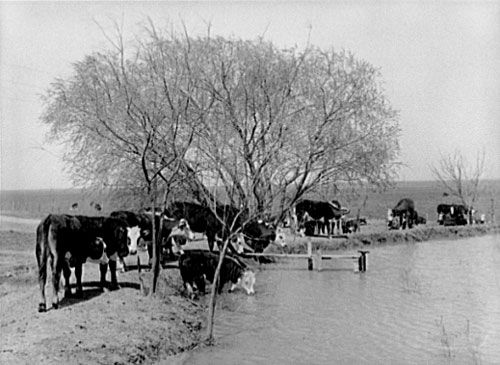
Cattle at waterhole
“‘Because you don’t possess common cow sense enough, nor is the crude material in you to make a cow hand. You found fault with the men the last count we had, and I don’t propose to please you by giving you a chance to find fault with me. That’s why I won’t count with you.’
“‘Don’t you know, sir, that I’m in authority here?’ retorted the foreman.
“‘Well, if you are, no one seems to respect your authority, as you’re pleased to call it, and I don’t know of any reason why I should. You have plenty of men here who can count them correctly. I’ll count them with any man in the outfit but yourself.’
“‘Our company sent me as their representative with this herd,’ replied the foreman, ‘while you have the insolence to disregard my orders. I’ll discharge you the first moment I can get a man to take your place.’
“‘Oh, that’ll be all right,’ answered the lad as the foreman rode away. He then tackled me, but I acted foolish, ‘fessing up that I couldn’t count a hundred. Finally, he rode around to a quiet little fellow with pox marks on his face, who always rode on the point, kept his horses fatter than anybody, rode a San Jose saddle, and was called Californy. The boss asked him to help him count the herd.
“‘Now look here, boss,’ said Californy, ‘I’ll pick one of the boys to help me, and we’ll count the cattle to within a few head. Won’t that satisfy you?’
“‘No, sir, it won’t. What’s got into you boys?’ questioned the foreman.
“‘There’s nothing the matter with the boys, but the cattle business has gone to the dogs when a valuable herd like this will be trusted to cross a country for two thousand miles in the hands of a man like yourself. You have men that will pull you through if you’ll only let them,’ said the point-rider, his voice mild and kind as though he were speaking to a child.”
“‘You’re just like the rest of them!’ roared the boss. ’Want to act contrary! Now let me say to you that you’ll help me count these cattle, or I’ll discharge, unhorse, and leave you afoot here in this country! I’ll make an example of you as a warning to others.'”
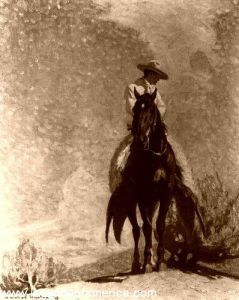
Range Rider.
“‘It’s strange that I should be signaled out as an object of your wrath and displeasure,’ said Californy. ’Besides, if I were you, I wouldn’t make any examples as you were thinking of doing. When you talk of making an example of me as a warning to others,’ said the pox-marked lad, as he reached over, taking the reins of the foreman’s horse firmly in his hand, ‘you’re a simpering idiot for entertaining the idea, and a cowardly bluffer for mentioning it. When you talk of unhorsing and leaving me here afoot in a country a thousand miles from nowhere, you don’t know what that means, but there’s no danger of your doing it. I feel easy on that point. But I’m sorry to see you make such a fool of yourself.
Now, you may think momentarily that I’m afraid of that ivory-handled gun you wear, but I’m not. Men wear them on the range, not so much to emphasize their demands with, as you might think. If it were me, I’d throw it in the wagon; it may get you into trouble. One thing certain: if you ever so much as lay your hand on it when you are making threats as you have done today, I’ll build a fire in your face that you can read the San Francisco “Examiner” by midnight.
You’ll have to revise your ideas a trifle; in fact, change your tactics. You’re off your reservation bigger than a wolf when you try to run things by force. There are lots of better ways. Don’t try to make talk stick for actions, nor use any prelude to the real play you wish to make. Unroll your little game with the real thing. You can’t throw alkaline dust in my eyes and tell me it’s snowing. I’m sorry to have to tell you all this, though I have noticed that you needed it for a long time.'”
“As he released his grip on the bridle reins, he continued, ‘Now ride back to the wagon, throw off that gun, tell some of the boys to take a man and count these cattle, and it will be done better than if you helped.’
“‘Must I continue to listen to these insults on every hand?’ hissed the medicine man, livid with rage.
“‘First remove the cause before you apply the remedy; that’s in your line,’ answered Californy.’ Besides, what are you going to do about it? You don’t seem to be gifted with enough cow-sense to even use a modified amount of policy in your everyday affairs,’ said he as he rode away to avoid hearing his answer.
“Several of us, who were near enough to hear this dressing-down of the boss at Californy’s hands, rode up to offer our congratulations when we noticed that old Bad Medicine had gotten a stand on one of the boys called ‘Pink.’ After leaving him, he continued his ride towards the wagon. Pink soon joined us, a broad smile playing over his homely florid countenance.
“‘Some of you boys must have given him a heavy dose for so early in the morning,’ said Pink, ‘for he ordered me to have the cattle counted and report to him at the wagon. Acted like he didn’t aim to do the trick himself. Now, as I’m foreman,’ continued Pink, ‘I want you two point-men to go up to the first little rise of ground, and we’ll put the cattle through between you. I want a close count, understand. You’re now working under a boss that will shove you through hell. So if you miss them over a hundred, I’ll speak to the management and see if I can’t have your wages raised or have you made a foreman or something with big wages and nothing to do.’
“The point-men smiled at Pink’s orders, and one asked, ‘Are you ready now?’
“‘All set,’ responded Pink.’Let the fiddlers cut loose.’
“Well, we lined them up and got them strung out in shape to count, and our point men picked out a favorite rise. We lined them through between our counters. We fed them through, and as regularly as a watch, you could hear Californy call out to his partner ‘tally!’ Alternately, they would sing out this check on the even hundred head, slipping a knot on their tally string to keep the hundreds. It took a full half hour to put them through, and when the rear guard of crips and doggies passed this impromptu review, we all waited patiently for the verdict. Our counters rode together, and Californy, leaning over on the pommel of his saddle, said to his pardner, ‘What you got?’
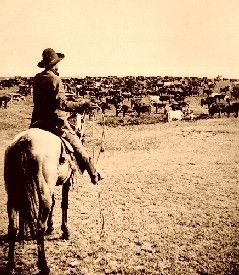
Cattle Roundup
“‘Thirty-three six,’ was the answer.
“‘Why, you can’t count a little bit,’ said Californy. ’I got thirty-three seven. How does the count suit you, boss?’
“‘Easy suited, gents,’ said Pink.’But I’m surprised to find such good men with a common cow herd. I must try to appoint you by the government on this commission to investigate Texas fever. You’re altogether too accomplished for such a common calling as claims you at present.’
“Turning to the rest of us, he said, ‘Throw your cattle on the trail, you vulgar peons, while I ride back to order forward my wagon and saddle stock. By rights, I ought to have one of those centre-fire cigars to smoke, to set off my authority properly on this occasion.’
“He jogged back to the wagon and satisfied the dethroned medicine man that the cattle were there to a hoof. We soon saw the saddle horses following, and an hour afterward, Pink and the foreman rode by us, big as fat cattle buyers from Kansas City, not even knowing anyone, so absorbed in their conversation that they rode on by and up the trail, looking out for grass and water.
“It was over two weeks afterward when Pink said to us, ‘When we strike the Santa Fe Railway, I may advise my man to take a needed rest for a few weeks in some of the mountain resorts. I hope you all noticed how worried he looks, and, to my judgment, he seems to be losing flesh. I don’t like to suggest anything, but the day before we reach the railroad, I think a day’s curlew shooting in the sandhills along the Arkansas River might please his highness. In case he’ll go with me, if I don’t lose him, I’ll never come back to this herd. It won’t hurt him any to sleep out one night with the dry cattle.’
“Sure enough, the day before we crossed that road, somewhere near the Colorado state line, Pink and Bad Medicine left camp early in the morning for a curlew hunt in the sandhills. Fortunately, it was a foggy morning, and within half an hour, the two were out of sight of camp and herd. As Pink had outlined the plans, everything was understood. We were encamped on a nice stream, and instead of trailing along with the herd, layover for that day. Night came, and our hunters failed to return, and the next morning, we trailed towards the Arkansas River. Just as we went into camp at noon, two horsemen loomed up in sight, coming down the trail from above. Every rascal of us knew who they were, and when the two rode up, Pink grew very angry and demanded to know why we had failed to reach the river the day before.
“The horse wrangler, a fellow named Joe George, had been properly coached and, stepping forward, volunteered this excuse: ‘You all didn’t know it when you left camp yesterday morning that we were out the wagon team and nearly half the saddle horses. Well, we were. And what’s more, less than a mile below on the creek was an abandoned Indian camp. I wouldn’t be left behind with the cook to look for the missing stock and tell the “Segundo” so. We divided into squads of three or four men each and went out and looked up the horses, but it was after six o’clock before we trailed them down and got the missing animals. If anybody thinks I’m going to stay behind to look for missing stock in a country full of lurking Indians–well, they don’t know me.’
“The scheme worked all right. On reaching the railroad the next morning, Bad Medicine authorized Pink to take the herd to Ogalallaon the Platte while he took a train for Denver. Around the campfire that night, Pink told us about his experience losing Mr. Medicine. ‘Oh, I lost him late enough in the day so that he couldn’t reach any shelter for the night,’ said Pink. ‘At noon, when the sun was straight overhead, I asked him about directions and found that he didn’t know straight up or east from west. After giving him the slip, I kept an eye on him among the sandhills, at the distance of a mile or so, until he gave up and unsaddled at dusk. The next morning, when I overtook him, I pretended to be trailing him up, and I threw enough joy into my rapture over finding him that he never doubted my sincerity.’
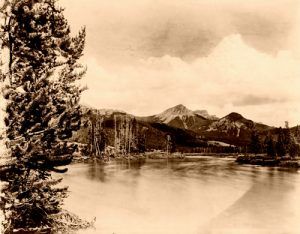
Yellowstone River.
“On reaching Ogallala, a man from Montana appeared in company with poor old Medicine, and as they did business strictly with Pink, we were left out of the grave and only council of medicine men. Well, the upshot of the whole matter was that Pink was put in charge of the herd and a better foreman than I had ever worked under. We reached the company’s Yellowstone range early in the fall, counted over, bade our doggies goodbye, and rode into headquarters. That night, I talked with the regular men on the ranch, and it was there that I found out that a first-class cowhand could get in four months’ haying in the summer and the same feeding it out in the winter. But don’t you forget it; she’s a cow country, all right. I always was such a poor hand afoot that I passed up that country, and here I am, a ‘boomer.'”
“Well, boom, if you want,” said Tom Roll, “but do you all remember what the governor of North Carolina said to the governor of South Carolina?”
“It is quite a long time between drinks,” remarked Joe, rising, “but I didn’t want to interrupt Ace.”
As we lined up at the bar, Ace held up a glass two-thirds full and, looking at it meditatively, remarked: “Isn’t it funny how little of this stuff it takes to make a fellow feel rich! Why, four bits’ worth under his belt, and the President of the United States can’t hire him.”
As we strolled into the street, Joe asked, “Ace, where will I see you after supper?”
“You will see me, not only after supper but all during supper, sitting right beside you.”
Compiled and edited by Kathy Alexander/Legends of America, updated January 2025.
About the Author: Bad Medicine was written by Andy Adams in 1906 and included in his book Cattle Brands: A Collection of Western Camp-Fire Stories. The text as it appears here, however, is not verbatim, as it has been edited for clarity and ease for the modern reader.
Also See: