
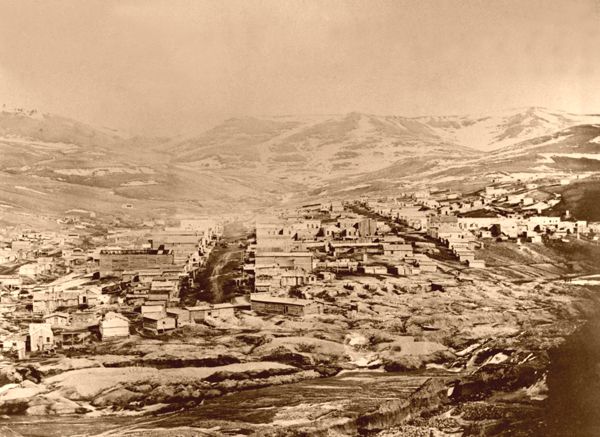
Virginia City, Montana, 1866.
By definition, Virginia City, Montana, is a ghost town, yet it is very much alive. Frozen in time, this historic city provides one of the best-preserved examples of the many mining camps of the American West.
Perched high in the Rocky Mountains in a bowl along Alder Gulch, Virginia City got its start when gold was discovered in Alder Gulch in 1863. Planning on keeping their discovery a secret, the men traveled to Bannack, Montana, some 60 miles to the southwest, for supplies. However, several sharp-eyed prospectors noticed their gold-filled sacks, and when the men returned to Alder Gulch, some 200 miners followed them. News spread quickly, and before long, the area was flooded with prospectors living in makeshift shacks, tents, caves, or simply sleeping beneath the trees.
In the meantime, the nation was in the midst of the Civil War, and though the gold brought emigrants from all over the world, overwhelmingly, the influx of miners was “rebels” from the South. Just weeks later, on June 16, a town company began to plat the settlement. They intended to name the town “Verona,” a misspelling of “Varina,” the wife of Jefferson Davis, President of the Confederate States of America. However, the newly elected miners’ court judge, Dr. G.G. Bissell, was an equally stubborn Unionist who submitted the name Virginia instead.
The majority of avowed secessionists living in the camp, which was then part of Idaho Territory and therefore “belonging” to the Union, made it primarily a “southern” town, with its residents’ sympathies lying with the Confederates. Furthermore, the camp produced enough gold to win the Civil War for whoever could capture it. Due to this strategic position, President Abraham Lincoln sent northern emigrants into the mining camp to help hold the gold for the North. This caused all kinds of tension in the new city, which quickly became one of the most lawless places in the American West.
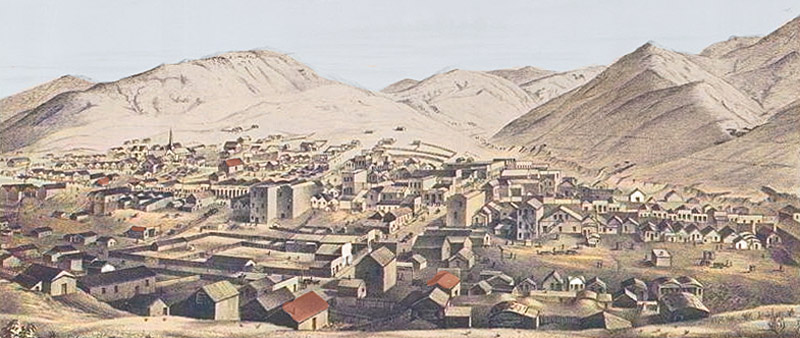
Virginia City, Montana, 1868.
Within a year, some 10,000 people were living in several mining camps lining the gulch, and in 1864, Congress created the new territory of Montana, separating it from Idaho Territory. Bannack, the site of the first gold strike in the area, became the territory’s first capital. However, just a year later, Virginia City had gained so much influence that the capital was moved. It was also made the county seat of Madison County. Rapidly becoming the territory’s social center and transportation hub, the shanties and tents were replaced by permanent buildings. Virginia City became home to Montana’s first public school, newspaper, and telegraph.
The first county courthouse was held in a wooden structure in what is now the Bonanza Inn.
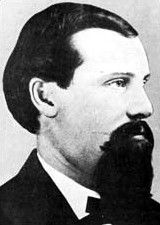
Henry Plummer.
Virginia City and nearby Nevada City became known as the site of the richest placer gold strike in the Rocky Mountains. In the first three years alone, an estimated $30 million worth of gold was removed from the gulch.
Though a few miners made their fortunes on the goldfields, and even more businessmen became wealthy, another group planned to gain riches another way. These were the many road agents operating in the area. Though historians dispute this today, the robbers and thieves were said to have been led by the Sheriff himself, Henry Plummer.
Time after time, miners, freight haulers, and stagecoaches lost anything of value to the bandits lurking about the trails to and from Virginia City. As a result, a secret society of vigilantes was formed to stop the outlaws. Lynchings became a common event of the day as the vigilantes hunted down the road agents, one by one, and strung them up in the streets of Virginia City and Bannack. Though history now questions whether the many crimes were committed by highwaymen or perhaps the vigilantes themselves, there is no question that the settlement was extreme in its lawlessness and violence.
No sooner had Virginia City begun to boom than it began its gradual decline. When gold was discovered in Last Chance Gulch in Helena, the fickle miners began to move. Though gold continued to be found in the area, by the early 1870s, Virginia City’s population had been reduced to only a few hundred.
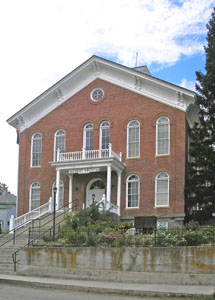
Madison County Courthouse in Virginia City, Montana, by Kathy Alexander.
In 1875, a new county courthouse was built. The historic courthouse continues to house Madison County offices today. That year, the territorial capital was moved to Helena, and Virginia City was on its way to becoming a ghost town.
Though lode mining continued for years, it was never as profitable as placer mining. From 1898 through 1922, floating dredges destroyed several of the small mining camps along Alder Gulch, leaving, in their wake, mounds of tailings and dredge ponds. The dredging operations destroyed the original settlement in nearby Nevada City. However, Virginia City was spared because it had not been established upon gold-bearing gravel. During the decades of dredge mining, the area produced approximately $7 million in gold.
As the amount of gold played out, so did the dredging operations. However, when the price of gold rose significantly in the 1930s, dredge mining was revived, only to be halted in the next decade with the advent of World War II.
Today, a few small mining operations continue in the Virginia City area, but primarily, hobbyists search for any remaining gold.
Virginia City is now one of the most preserved “ghost towns” in the American West, thanks to the efforts of Charles and Sue Bovey. Mr. Bovey, a Montana rancher and state legislator, and his wife, Sue, first visited Virginia City in 1944. Though suffering from neglect and weather, the town still stood largely intact thanks to the absence of significant fires and later development.
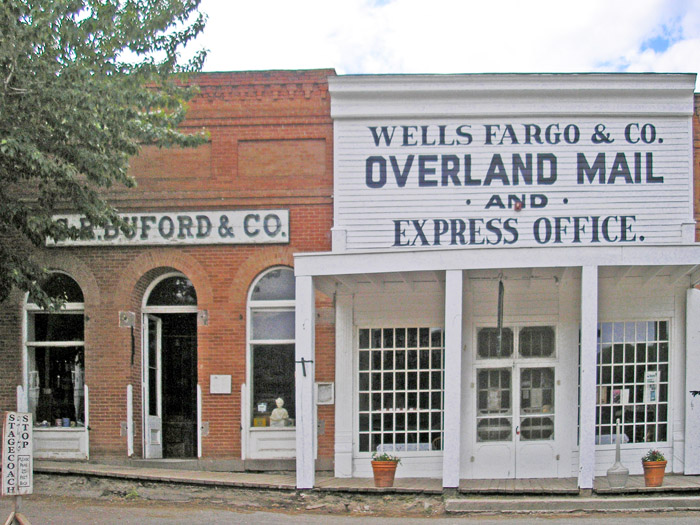
Wells Fargo, Virginia City, Montana, by Kathy Alexander.
Captivated by the historic city, the Boveys began raising money for preservation, collecting artifacts, buying buildings they preserved, and reconstructing others that had been destroyed. Nevada City, which had been almost totally obliterated by dredge mining, was entirely rebuilt. Today, Nevada City is an outdoor historical museum with numerous historic buildings, artifacts, and furnishings.
Another project taken on by the Boveys was a tourist court called “Daylight Village.” Lodging was badly needed in the up-and-coming revived ghost town at the time, and the lodging facility was established in 1946 on the eastern edge of Virginia City to meet the demand.
Daylight Village in Virginia City, Montana, by Kathy Alexander.
The “village” was comprised of false-fronted motel units, their fronts weather-beaten. The painted signs represented businesses advertised in the 19th-century editions of the Montana Post. The motel units were hidden behind false fronts. Like other Virginia City buildings, Daylight Village transported visitors back in time. The village, which included some 40 buildings, no longer operates. Falling into disrepair, the buildings have not been maintained, as they are not considered “historic,” and there are no funds for renovation. Still, they are an interesting view and make for great photo opportunities.
By 1978, the Boveys owned one-third of the town, but the same year, Charlie Bovey passed away. His wife, Sue, died in 1988. Just one year later, many of the Bovey-owned properties were put up for sale.
In 1997, the Montana Legislature voted to purchase the Bovey properties in Virginia and Nevada City, along with most of the artifacts. Today, the state owns about half of the historic structures in Virginia City and all of the community of Nevada City. The Montana Heritage Commission was formed to manage the properties.
In addition to the more than 200 historic buildings preserved for tourists, Virginia City offers several events for visitors, including the Heritage Days & Victorian Ball in August, the Virginia City Players’ variety productions at the Opera House, a narrow-gauge railroad, and the Brewery Follies at Montana’s first brewery. Also available to the approximately 70,000 visitors who come to Virginia City each year are museums, shops, restaurants, and accommodations.
Virginia City was designated a National Historic Landmark in 1961 and listed on the National Register of Historic Places in 1976. Today, Virginia City boasts a population of 150 year-round residents and about 300 summer residents. It is located about 65 miles southwest of Bozeman, Montana.
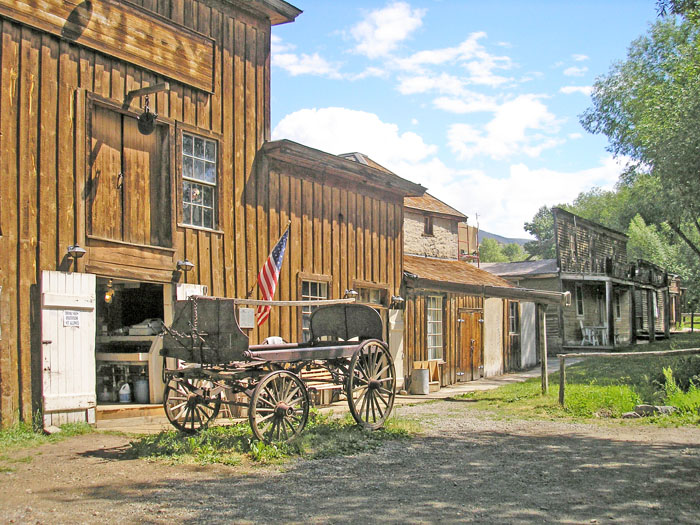
Gilbert’s Brewery in Virginia City, Montana, by Kathy Alexander.
Contact Information:
Montana Heritage Commission
300 W. Wallace St, upstairs
Virginia City, Montana 59755
406-843-5247
Virginia City Chamber of Commerce
P.O. Box 218
Virginia City, Montana 59755
800-829-2969
©Kathy Alexander/Legends of America, updated November 2025.
Also See:
Ghost Town Ghosts in Bannack, Montana
Henry Plummer – Sheriff Meets A Noose
Nevada City – Outdoor History Museum
See Sources.