
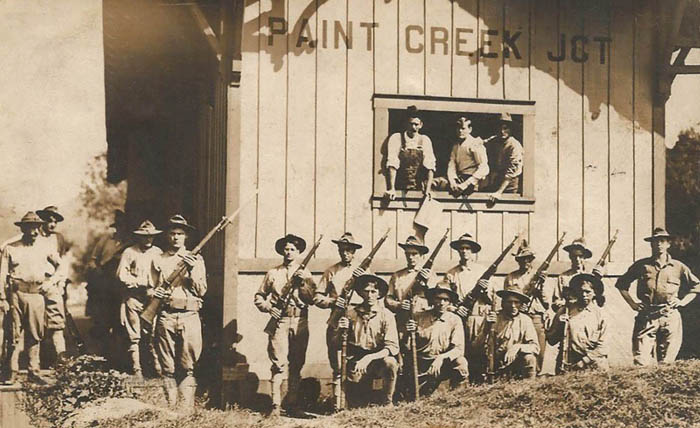
Paint Creek, West Virginia Strikers.
Hawk’s Nest Strike – First Strike in West Virginia
Paint Creek & Cabin Creek Strikes of West Virginia
Matewan Massacre
Battle of Blair Mountain
The West Virginia mine wars, also known as the “coal wars,” arose from disputes between coal companies and miners.
Coal mining began in West Virginia in the mid-1800s. Bituminous coal soon became the fuel of choice for industrial production across America and surged by the century’s end. By the early 1900s, coal powered many industries, including railroads, streetcars, and home and business heating.

Coal Miner and Horse in West Virginia Mine.
With coal becoming indispensable, mine owners and operators often set record revenues. However, the industry was disorganized, decentralized, and often ruled by boom-and-bust cycles.
While the mine owners were focused on market competition, they ignored the plight of the workers who generated their revenue. Below ground, the miners withstood some of the worst working conditions in America and suffered some of the highest fatality rates among industrial workers. Some West Virginian coal miners joined the United Mine Workers (UMW) after wage reductions following the Panic of 1893.
During the early 1900s, scores of miners died each year from roof collapses, explosions, and fires, along with frequent large-scale disasters. Mine safety laws in West Virginia were the weakest in the country, and the laws that did exist had few, if any, provisions to ensure enforcement. Between 1890 and 1912, West Virginia mines had the highest miner death rates in the country.
By 1902, UMW membership in West Virginia had reached 5,000 miners. However, union membership among West Virginia coal miners remained low, especially in southern parts of the state.
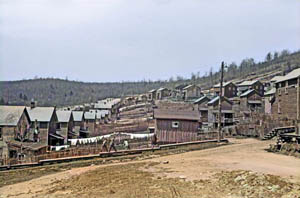
Kempton, West Virginia Company Coal Mining Town.
Above ground, miners faced brutal mine guards and a guard system that controlled the region’s politics and economy. They also faced low pay, long hours, and exploitation from living in company-owned towns. These towns required their workers to rent and live in company-owned houses, and the miners were often paid in “coal scrip,” paper notes issued by mining companies that could only be redeemed at company-owned stores.
At this time, mineworkers first began organizing and unionizing. However, the mine owners and coal operators fiercely resisted any attempts at unionization. This led to a series of escalating conflicts known as the Mine Wars, which pitted miners against the powerful forces of mining companies and their hired agents.
At the outset of what became known as the West Virginia Mine Wars, trouble centered in the towns along Paint and Cabin Creeks in Kanawha County in 1912-1913. This strike demanded better pay and working conditions, the right to trade where they pleased rather than being forced to buy from company-owned stores, and recognition of the United Mine Workers (UMW).
However, the mining companies refused to meet the workers’ demands and hired Baldwin-Felts agents to guard the mines and act as strikebreakers. Once the Agents arrived, carrying high-powered rifles, many miners either moved out or were evicted from the company houses they had been renting from the coal companies and moved into coal camps supported by the Union. The strike resulted in machine-gun warfare and a state of martial law declared by the West Virginia governor.
The Battle of Matewan took place in 1920 after hundreds more miners unionized, prompting the mining company to send agents to Matewan to evict the miners’ families. The town mayor and the police chief took the miners’ side, and in the end, a shootout resulted in ten men’s deaths.

West Virginia Miners with guns.
In 1921, the mine wars came to a bloody climax in the Battle of Blair Mountain. After mine company agents assassinated Sid Hatfield on the steps of the McDowell County Courthouse, thousands of armed pro-union miners marched into Logan County in late August. Marching from the town of Marmet, the men planned to march 60 miles to Mingo County, where they sought to free-striking miners arrested after the governor declared martial law. However, they had to cross Blair Mountain, a mountain ridge defended by the notorious anti-union Logan County Sheriff Don Chafin. When they arrived in Logan County, they were met by militia, police, and company agents with machine guns and makeshift “bombs” dropped from rented aircraft. The guerrilla warfare claimed the lives of about 100 men and only ended when President Warren Harding sent 2,500 federal troops in. Once the military intervened, the miners laid down their weapons, and the fighting ended. Blair Mountain is the largest armed insurrection in American history outside the Civil War.
While the Battle of Blair Mountain ended open violence, it did not end the miners’ struggles. In the Spring of 1922, the state of West Virginia, working in collaboration with private coal companies, indicted over 500 pro-union marchers on charges of treason against the state of West Virginia, murder, accessory to murder, and conspiracy to commit murder. Extensive national newspaper coverage of the first trial of defendant Bill Blizzard revealed the lengths to which coal operators and state officials went to prevent workers from organizing.

Battle of Blair Mountain Newspaper Article.
Though hundreds of miners were later acquitted on charges of murder and treason, the Battle of Blair Mountain stalled the United Mine Workers’ (UMV) efforts in southern West Virginia and caused membership to plummet. The message of the mine wars treason trials was clear: if workers fighting for their rights could be found guilty of treason against the state of West Virginia, a similar fate could befall workers anywhere. These trials also marked the last gasp of the push to unionize the coalfields.
It wouldn’t be until President Franklin D. Roosevelt granted workers a guarantee to collectively bargain in 1933 that miners began to join the Union again. UMW membership peaked in 1946, then spiraled downward as unions lost government support and the industry waged an all-out war on union mines. The numbers kept falling as the Appalachian coalfields declined.
©Kathy Alexander/Legends of America, updated October 2026.
Also See:
Mining on the American Frontier
West Virginia Coal Mine Disasters
West Virginia – The Mountain State
Sources:
Associated Press
National Park Service
West Virginia Mine Wars Museum
Wikipedia