
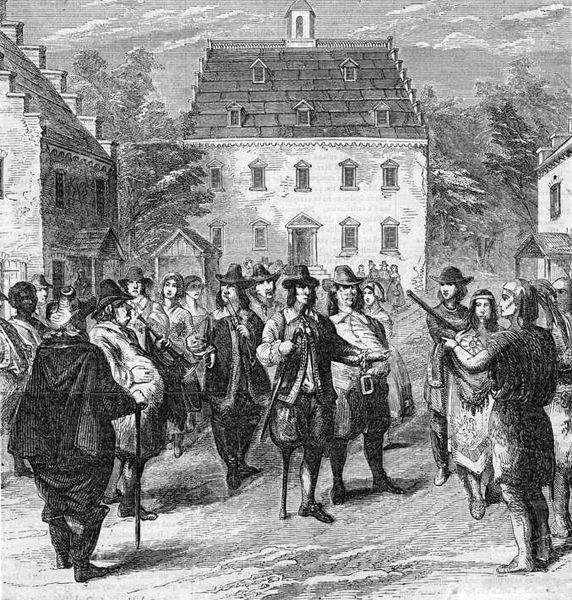
By Daniel Curry in 1853.

New Amsterdam by Nicolaes Visscher in 1656.
For the first 20 years after they discovered New York, the Dutch possessions on the Hudson River had more the character of a trading post than a colony. Holland was becoming a nation of merchants at that time, and trade in New Amsterdam grew so much that in 1632 exports amounted to a considerable sum of $57,000. In 1629, a grand scheme for colonizing the Dutch territories in America was formed in Holland. The Dutch West India Company granted members the right to establish colonies in New Netherland under certain favorable conditions. It was decreed that whoever should, within four years after giving notice of his purpose to do so, form a settlement of not less than 50 people 15 years old and over should be entitled to occupy and possess a tract of land 16 miles in extent, along the seashore, or the bank of any navigable river, (or 8 miles when both banks were occupied,) with an indefinite extent inland. The persons who formed colonies under this provision were called patroons and were entrusted with extensive powers within their respective manors, serving as both proprietors and civil magistrates.

Dutch Fur Trade with the Indians
Under this system of colonization, the lands about the bay and on both sides of the Hudson River were speedily taken up by the more enterprising Dutch West India Company members. The company, however, wisely reserved the island of Manhattan for its own use. To secure the lands they had appropriated, the patroons made great efforts to obtain the requisite number of colonists. Some came from Holland, while others came from the English colonies. To further this purpose, the patroons offered liberal conditions, and, following the example of the home government, the colonial authorities granted complete tolerance to all Christian sects.
In 1633, the little colony of New Netherland received a governor from the fatherland—Wouter Van Twiller. The scattered settlements and trading posts on the Hudson River were erected into a province of the United Netherlands. The new governor brought a company of 104 soldiers, a schoolmaster, and a minister. But because trade with the Indians was an all-engrossing matter of interest, little was done to introduce permanent settlers into the province. The governor, however, applied himself vigorously to his public duties, and several improvements were undertaken. The fort was rebuilt, with barracks for the soldiers; a church and parsonage were erected, a house for the governor, and mills and other buildings necessary for the welfare of the settlement. The island of Manhattan was divided into farms, called “boweries,” and on the one nearest to the fort, the governor had a dwelling, barn, brewery, and boat house built. Buildings were also erected on some of the other “boweries” of the company.
Throughout Van Twiller’s administration, the small colony remained in disquiet and alarm. To the East, the English steadily encroached on the company’s territory, and on the Delaware River, the Indians waged a destructive war against the feeble settlements. The government’s internal affairs were no less troublesome. Between the government and the patroons, continual disputes arose regarding their respective rights, especially the privilege of trading with the Indians, which both parties claimed as a monopoly. At the same time, the governor did not forget his private interests.
Along with several others, he purchased from the Indians a fertile tract of land on Nassau or Long Island, on which the new proprietors established farms. For his use, he also purchased the tiny island just South of the fort, initially called Nutten Island because of the many nut trees on it; however, since it was the property of Governor Van Twiller, it has since been known as Governor’s Island. However, the discontent that prevailed in the colony eventually came to the company’s notice, and, from the nature of the complaints, it was deemed best to recall the governor after a four-year administration.

The judgment of Wouter Van Twiller.
The new governor, William Kieft, did not arrive in the colony until March 1638. He then found the company’s affairs much neglected and the public property in a ruinous condition — the buildings going to decay, — the boweries or farms untenanted and stripped of their stock, and the purchase of furs, which constituted the principal objective in the colony, engrossed by private traders, and conducted most extravagantly. The new governor endeavored to remedy these evils through orders and proclamations, but with only partial success. A few additional settlers were brought into the province about this time, and further land purchases from the Indians were made. Still, the growth of the settlements was as yet inconsiderable.
About this time, Peter Minuets, the former director of New Amsterdam, with a company of Swedes under the patronage of Queen Christina, entered the Delaware River, purchased from the Indians a tract of land on the western side of the bay, and built Fort Christina. Kieft was intensely dissatisfied with this intrusion upon territory claimed by the Dutch West India Company and, by repeated and violent protests, to which Minuets paid no attention, forbade the intended settlement. However, the Dutch governor deemed it unsafe to attempt to dislodge the intruders by force, and Sweden’s power in European affairs was such that it forbade the home government from interfering in the matter. So, the little Swedish colony was left to pursue its course in peace.
The colony’s slow progress, at length, led the directors of the West India Company to ease some of the rigors of their policy. The trade monopoly was modified to allow anyone who chose to do so to engage in it, although only the company’s ships could be used for transportation. Free passage was given to all who wished to move from Holland to the colony, and emigrants were offered land, houses, cattle, and farming tools at an annual rent, plus clothes and provisions on credit. The patroons’ authority was defined and somewhat diminished. Each person who brought six people into the colony would receive 200 acres of land, and towns and villages would have their own magistrates. Other provisions of a similar nature were made, regulating trade with the Indians and providing for the people’s religious and educational needs.
New Amsterdam in 1660.
Under the new arrangements, several emigrants were drawn from Holland, including some men of considerable property. Some English indentured servants, who had served out their time in Virginia, also settled in New Netherland. Additionally, some Anabaptists and others, who had been driven out of New England by religious intolerance, sought a place of safety here. The settlements were now rapidly extended in every direction around New Amsterdam. In addition to the settlements at Wallatout and Flatlands on Long Island, another commenced in 1639 at Breukelen [Brooklyn]. Patrons were granted Staten Island and the region West of Newark Bay, and settlements began. New Amsterdam only indirectly shared these improvements, but its progress was slow, though steady, in the future. “A fine stone tavern,” says an old chronicler, was built, and the “mean old barn” that had served for a church was replaced by a new stone building, erected within the enclosure of the fort and paid for partly by the company, and partly by subscription.
New Netherland’s foreign relations became increasingly complicated and embarrassing over time. Encroachments from the New England colonies became genuinely alarming, and in the South the Swedes were firmly seated and threatened to exclude the Dutch entirely from their possessions on the Delaware River. The growing importance of the colony of Eensselaerwick (Albany) in the North, which began to assume a kind of independence, further caused uneasiness. However, these difficulties, though sufficiently embarrassing, were not the worst that the governor had to oppose. A more terrible calamity than any of these presently threatened the colony from a nearer and much more implacable enemy.
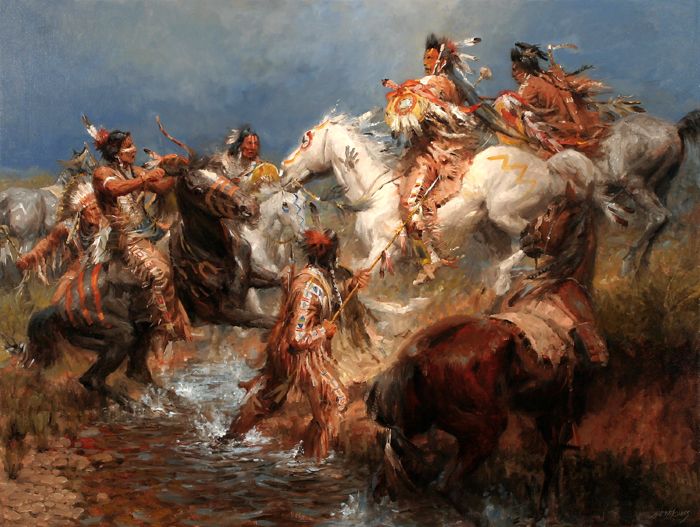
Iroquois in War.
The Indian tribes of the regions about New Amsterdam became incensed against the whites by a thousand petty provocations arising from the thoughtlessness and greed of the colonists and, in return, committed such acts of revenge as seemed to demand chastisement from the government. The Raritan, a tribe residing on the West side of the Hudson River, was the first to feel the prowess of the white man. Both parties were victims of the conflict, and the Indians readily accepted the offered peace terms. Soon afterward, a Dutchman was killed by an Indian belonging to a tribe located near Tappan Bay, and the murderer was protected by his tribe, which resulted in the government sending 80 men to punish them. Alarmed at the threatened invasion, the Indians promised to give up the murderer. The expedition returned to New Amsterdam, but the promise was never fulfilled. A quarrel subsequently broke out between the colonists and the Hackensack tribe, and two white men were murdered. The chiefs offered wampum (sacred shell beads) in atonement, which the governor refused and demanded the murderers. Just before this time, the Tappan Indians, fearing an attack from the powerful Mohawk tribes, moved down into the neighborhood of New Amsterdam and mingled with the neighboring tribes, especially the Hackensack. Soon after, these united bands came and encamped in two bodies not far from the fort. Their design was not hostile, but the enemies of the Indians seized the occasion at New Amsterdam, and the governor, under the influence of wine at a holiday feast, ordered an attack. The attack was wholly unexpected by the Indians, and very little resistance was made. A terrible slaughter ensued. About 80 Indians, including old men, women, and children, perished miserably in the conflict or were murdered in cold blood afterward. The battle’s noise and the shrieks of women and children could be heard at the fort. The next day, the war party returned to the town, bringing 30 prisoners.
These atrocities, with others of a like character, soon after perpetrated, aroused the Indians to a high pitch of exasperation. Eleven small tribes united to make war against the Dutch, whose unprotected boweries, reaching in every direction many miles from New Amsterdam, offered easy prey to the Indians. Many houses were burned, the cattle were killed, the men were slain, and several women and children were made prisoners. The terrified and ruined colonists fled in all directions to New Amsterdam and all who could sail for Holland. The expeditions sent against the Indians were only partially successful in subduing them, and, worse still, discontent and mutual recriminations distracted the governor’s councils. The Indians, at length, satiated with blood, offered terms of peace, which were gladly accepted by the whites, and a respite was given from the bloody and ruinous conflict.

Treaty with the Indians at New Amsterdam.
But the peace was short-lived. A new Confederacy of seven tribes again spread consternation and ruin among the frontier boweries; the settlements beyond Newark Bay and those on the West end of Long Island were laid in ruins, and only three boweries were left on Manhattan Island. The colonists were clustered in straw huts about the fort, which was in a ruinous and hardly tenantable condition — themselves short of provisions and their cattle in danger of starving. A barrier was erected to the North of the town, which remained in place for half a century and is still commemorated in the name of the street (Wall Street) that eventually replaced it. The following year, in 1644, was occupied by an expensive and harassing Indian war. The Indians’ villages on Staten Island were burned, their corn destroyed, but they eluded their pursuers. An expedition against a small village near Stamford produced nearly the same results. Not so, however, with an expedition of nearly 200 men under the command of Captain John Underhill sent against a hostile band near Hempstead on Long Island, where more than 100 Indians were killed and more made prisoners. But the greatest slaughter took place later in the season when a second expedition, under the same commander, was made against the Indians in the neighborhood of Stamford. The villages were reduced to ashes, and fearful destruction of life occurred, with all the accompanying horrors that distinguished the famous Pequot War.
At about this time, 130 soldiers arrived in the colony from the West Indies and were quartered in New Amsterdam. The Indians had suffered dramatically during the summer and autumn, but soon ceased active hostilities and asked for peace. Treaties were made with the principal tribes during the ensuing year, by which the Indians agreed to remove to considerable distances from New Amsterdam and not to approach any of the settlements with their war parties. So, the colony was once more freed from the horrors of savage warfare.
These protracted wars almost ruined the settlements around New Amsterdam, and at their close, they could number scarcely 100 men. Five or six of the 30 flourishing boweries remained, and everything bore marks of ruin and disorder. Complaints were freely uttered against the governor’s administration, which induced the directors to recall him. He accordingly sailed for Holland in a vessel laden with furs valued at nearly $100,000. However, the vessel was wrecked on the coast of Wales, and about 80 people, including Governor Kieft, perished. Kieft’se successor was Peter Stuyvesant, the late governor of the Dutch West Indies—a soldier by profession and a man of good parts and much energy of character. Several considerable concessions of popular privileges distinguished the beginning of his administration. The company relinquished its transportation monopoly, and trade opened to free competition—though New Amsterdam remained the only port of entry.

Peter Stuyvesant’s army entered New Amsterdam.
The population of the entire province of New Netherland at this time (1647) could not have been more than about 2,000 people— nearly half of whom were within the patroonship of Van Eensselaer. New Amsterdam was a village of wooden huts, with straw roofs and chimneys of mud and sticks, abounding in grog shops and places to sell tobacco and beer. At the West end of Long Island were six plantations, governed by a local magistracy, partly self-elected, but New Amsterdam was still governed by the governor’s sole authority and policies. At about this time, Breukelen (Brooklyn) first received a village charter.
In 1652, the inhabitants of New Amsterdam obtained enlarged municipal privileges by petitioning the authorities at home. A board of magistrates, or city court, was created, composed of two principal magistrates and five civic officers, annually selected by the governor from twice that number nominated by the magistrates of the preceding year. A movement was also made toward a more popular form of government by calling a convention of two delegates from each village to fight against a threatened war with New England. But the governor dissolved the convention as irregular and sneeringly called it a New England invention with which he had nothing to do.
For several years, Governor Stuyvesant was chiefly occupied with the colony’s foreign relations. After protracted negotiations, he resolved all difficulties with the New Englanders to the East and the Swedes to the South. The province of New Netherland rested in quiet and safety. However, the Dutch governor did not obtain all he wished in these negotiations; for a while, he claimed both the Connecticut and the Delaware Rivers as parts of his province, and he obtained peace only by relinquishing both and their territories. The governor would likely lose his capital while engaging in these transactions with the neighboring colonies. The Indians, taking advantage of the absence of the soldiers from the town, made a descent upon it with 60 canoes, causing great alarm and doing some inconsiderable damage. Still, they dispersed and disappeared as soon as the forces returned.

Peter Stuyvesant.
The colony’s affairs now took on a more encouraging aspect. Settlers arrived from various quarters; among them, several Jews, exiles from various parts of Europe, and fugitives from New England driven out by religious intolerance. New Amsterdam already included people from almost every European country and nearly every religious creed. This leniency in matters of religion did not suit the governor, who liked the Lutherans and the Quakers as little as his neighbors in New England. Still, he was overruled by his superiors at home, who commanded that the same indulgence that made the parent city a general asylum for the oppressed should also prevail in its namesake on the Hudson River; so, though quite contrary to his wishes, the governor permitted them to remain in peace.

New Amsterdam, New York People by Karl R. Free.
Meanwhile, the Dutch West India Company focused mainly on the slave trade. The company gave special permission to certain merchants to send two or three ships to the coast of Africa to purchase slaves and promote settlement by importing them into New Netherland. Most of the slaves introduced this way remained the company’s property. After a certain period of labor, the more trustworthy and industrious were allowed small farms, paying a certain amount of produce in return. Thus, early was the African race introduced among the colony’s population, and the system of African slavery was incorporated among its institutions to remain a scourge and reproach for nearly 200 years.
Unquestionably, as was the Dutch’s right to the country they occupied on the Hudson River, that right had never been acknowledged by Great Britain; but, on the contrary, the whole region was claimed as a portion of the possessions of that kingdom. Several faint attempts to assert that claim had been made at different times, but without success. Soon after the restoration of Charles II, this whole territory was granted to his brother, the Duke of York, who proceeded immediately to take measures to seize the colony. The Dutch knew nothing of these transactions before the ships bearing the duke’s forces had sailed. Rumors of the intended invasion reached New Amsterdam before the hostile fleet arrived, but no adequate provisions were made for public defense. Governor Stuyvesant would have fought the invaders or endured the rigors of a siege, but his feelings did not match those of most colonists. The Dutch cared little whether they were under a Dutch or an English yoke, and the English, who constituted nearly half of the entire population, favored rather than opposed their countrymen’s claims. Accordingly, after several days of negotiations, the entire colony was surrendered to the English on September 8, 1664, on terms entirely satisfactory to the inhabitants.
With a change of masters came a change of name for the conquered colony, and from that time, both the province and the chief town were called New York, in compliment to the duke, who now became their proprietor and ruler. Though Governor Stuyvesant vastly improved it, the fledgling city consisted of a few narrow streets near the southern extremity of Manhattan Island. A few handsome buildings were covered with tiles from Holland, but most houses were thatched cottages.
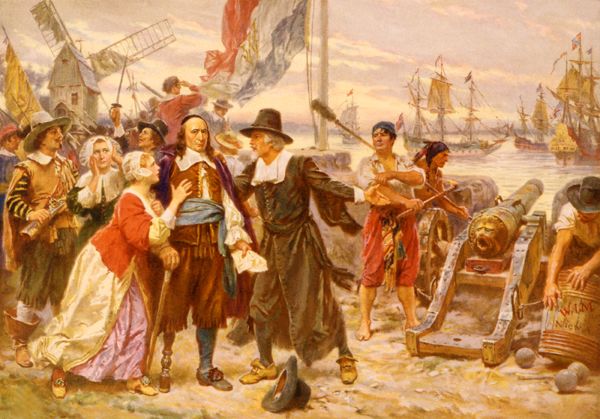
The Fall of New Amsterdam
Soon, the water line was extended far beyond its original location, so what was once outside the streets was now a considerable distance from the water. The fort occupied the southernmost point, which did not lie immediately upon the water’s edge, as a ledge of sunken rocks extended off this point, rendering it inaccessible to all kinds of watercraft. Within the fort were the governor’s residence, the public offices, and the Dutch Calvinist church. Between the beach and this area was an irregular, unoccupied space used by townspeople for outdoor exercise.
Just above the fort was a triangular space devoted to no particular purpose, ready to be occupied in any way that public convenience might require. This was the campus where the field sports of the men and boys of New Amsterdam took place. In an early period, it was used by the garrison soldiers for their manual exercises; hence, it was called the Parade. It also served as a cattle market, and in 1659, town authorities issued an ordinance regulating how cattle were kept here for sale. Much later, it was enclosed and devoted to the purpose that gave it its name—the Bowling Green, where residents played lawn bowls.

Fort Amsterdam, New York.
From the fort and beyond the triangle of the Bowling Green, a broad and straight roadway led back toward the cultivated boweries farther up the island. From the beginning, this was the town’s principal street, though residents did not favor it because it was far from the water. The Dutch called it “De Heere-straat,” or Main Street. In 1665, when an enumeration of all the town’s houses was made, this street had only 21 dwellings. The English renamed it Broadway. Running along the South side of the fort, the street extended along the East River to the great swamp, where it turned North, leading to the boweries. The Dutch called the western portion of this street “Perel-straat,” and the more easterly “Hooghstraat,” or High Street. This was a favorite place for Dutch settlers— about one-quarter of all the houses in the town at the time of the conquest were on this street. A short distance East of the fort was a small stream that ended in a deep, marshy inlet, just East of the rocky point of Manhattan Island. In the colony’s early days, colonists excavated this stream and inlet and turned it into a drain and canal called “De Graft.” Houses were later built along its banks, in the manner of Amsterdam in Holland, and as several smaller “grafts” were made, it came to be called “De Heere Graft,” or the central canal. All vessels trading to New Amsterdam were accustomed to entering this canal to load and unload. The customs house stood here; of course, the “graft” held little interest for the government. Twenty dwellings were located on its banks in 1665.
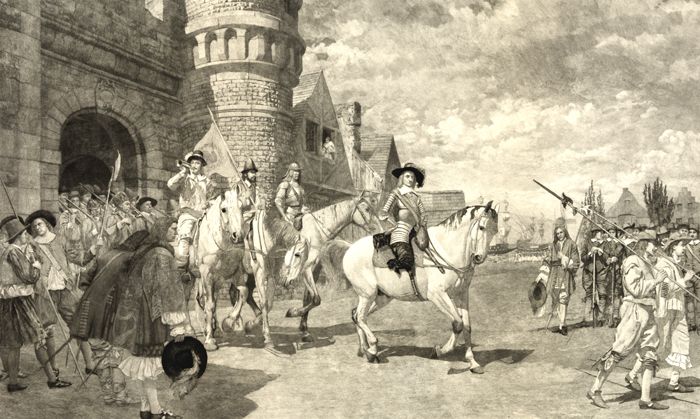
Surrender of New Amsterdam in 1664 by Charles Harris.
Immediately under the fort’s East wall and reaching down to the nearby water, the rocks formed a little street that seemed as old as the town itself. The Dutch called it “Winchel-straat,” or Shop Street, and paved it as early as 1658, before any other street, though it had five houses. In the subsequent period, a battery called Whitehall was erected near the foot of this street, and that name was later given to the street. A street was opened leading eastward from the Southeast angle of the fort and, passing the “Heere graft” by a bridge, ending in “De Hoogh-strata.” The name Bridge Street was naturally given to it and has never been changed. Above this, abutting the East side of the fort, was another small street called “Brewer’s Street,” as it was the site of Van Cortlandt’s brewery. Later, it was renamed Stone Street. Opposite the Parade, eastward, a drain was opened leading into the central canal, called “Beaverdrain.” On the opposite side of the canal, another drain called “Prince’s” entered from the East. On the banks of these drains, the Dutch had erected about thirty houses before the conquest. Beaver Street would later occupy the place of those canals. Below the Beaver drain, and parallel with it, was a narrow and inconsiderable street called Marketfield Lane, along which eight dwellings were erected. On the eastern side of the town was a street leading to and beyond the city wall, known to the Dutch as the “Valley” and to the English as Smith’s Valley, which later became William Street. About twenty houses stood on this road when the town fell into English hands.
At the time of the capture, the town had fewer than 250 dwellings, including several outside the barrier, and a population of fewer than 2,000. Such was the famous city of New Amsterdam when it became the capital of the Anglo-American colony of New York City.
Compiled by Kathy Alexander/Legends of America, updated October 2026.
About the Author & Article: The Discovery of what would become New York City is excerpted from the book New York: A Historical Sketch of the Rise and Progress of the Metropolitan City of America by Daniel Curry, published by Carolton and Phillips in 1853. However, the text here is far from verbatim, as it has been heavily edited, truncated, and updated for modern readers.