
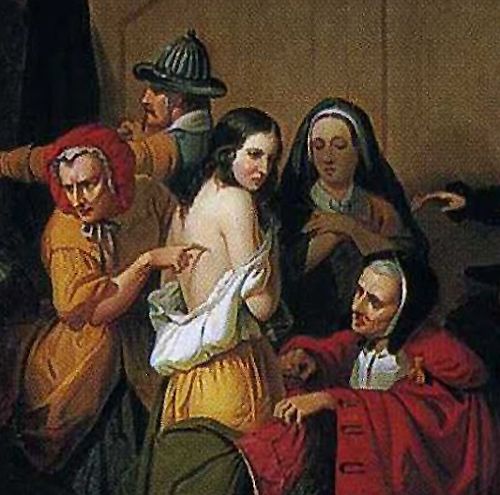
Close-up of Examination of a Witch, by Thompkins Matteson, 1853
By Josh Hutchinson.
Mary Johnson was the second person known to be hanged for witchcraft in colonial Connecticut. Mary was a servant who lived in Wethersfield, a community you may know from reading The Witch of Blackbird Pond by Elizabeth George Speare. While that book is entirely fiction, eight real-life Wethersfield residents are known to have been accused of witchcraft in the 17th Century.
Nothing is known of Mary Johnson’s early life, such as when and where she was born or when she came to Wethersfield. She seems to have died single, as she is never referred to as Goodwife, the usual title for married women in colonial New England.
In 1646, Mary Johnson was convicted of theft. To punish her, the court ordered she be whipped immediately in Hartford and a month later in Wethersfield. Sadly, this was not the end of her troubles.

The Public Records of the Colony of Connecticut, Volume I, page 143
On December 7, 1648, Mary was convicted of witchcraft. The jury found her guilty because she confessed.


More than 40 years later, Cotton Mather wrote in Memorable Providences that Samuel Stone, a minister, pressured Mary Johnson to confess. Mather claimed Mary confessed not only to witchcraft but also to murdering a child and to “uncleanness with men and devils.”
According to Mather, Mary said that she was unhappy with the work her employer assigned her, so she asked a devil to help, and it swept the hearth and drove hogs out of her boss’s field.
Mather wrote that Mary had a conversion experience in jail. And she, quote, “went out of the world with many hopes of mercy through the merit of Jesus Christ.” She “died in a frame extremely to the satisfaction of them that were spectators of it.” She went out humble and repentant. In the introduction to his section on Johnson:

Memorable Providences by Cotton Mather, pages 62 and 63 (click for larger image)
Now we’d like to clear up some longtime confusion about Mary Johnson.
In 1885, in the article “Witchcraft in Connecticut,” Charles Herbert Levermore wrote that Mary Johnson’s execution was delayed due to pregnancy. This article was published in the New Englander and Yale Review’s November 1885 issue (Volume 44, Issue 189). Levermore added that Johnson’s child was later given to the jailkeeper’s son. A remark in an 1886 essay by Charles Dudley Warner, printed in James Hammond Trumbull’s Memorial History of Hartford County, further fueled the misinformation. Warner stated, “Familiar with the ways of the Devil she doubtless was, for she was tried for another offense a year afterward.”
The story of the pregnancy has been handed down from one historian to another ever since. This was included in one of the most significant works on witchcraft accusations in Connecticut, John M. Taylor’s 1908 book, The Witchcraft Delusion in Colonial Connecticut, 1647 to 1697. The pregnancy and the transfer of the child have even been reported as fact in works published in recent years, and the tale is often retold on the internet. Unfortunately, the story is associated with the wrong woman.
In a 1974 essay, William K. Holdsworth writes that the confusion came about because two Johnsons were convicted of crimes in Connecticut within a relatively short time. As Holdsworth points out, the original records do not state anything about a delay in Mary Johnson’s execution or that she was pregnant. Cotton Mather also did not include an account of pregnancy or a delay in his telling of Mary Johnson’s trial.
One pregnant Goodwife, Elizabeth Johnson of Fairfield, however, was convicted of a crime in May 1650.
That last sentence contains several clues. In this second trial, the Johnson was called Goodwife, making it clear that she was married. In fact, the records state that she was the wife of Peter Johnson. The woman in this case is named Elizabeth rather than Mary. This Elizabeth Johnson was from Fairfield, not Wethersfield, where Mary lived. Even by modern roads, these two towns are 56 miles apart. In addition, this Johnson was convicted in May 1650, whereas Mary Johnson was convicted in December 1648 and most likely was hanged within days of her conviction. However, the record does not state this explicitly.
We conclude that this is a tale of two different women. Mary Johnson was not pregnant when she was tried and did not leave a baby for the jailer. Elizabeth Johnson did. In addition, we do not know what crime Elizabeth Johnson was tried for. It is theorized that she may have been tried for adultery, because there is a reference to a Thomas Newton paying out of his account for the upkeep of the child, which was born to Elizabeth while she was in jail for 24 weeks.
Mary Johnson of Wethersfield, Connecticut, died tragically, convicted for a crime that is impossible to commit: familiarity with the devil. She and 11 others convicted of witchcraft were absolved by the Connecticut General Assembly on May 25, 2023.

Josh Hutchinson.
©Josh Hutchinson, for Legends Of America. Submitted February 2025, updated September 2026.
Author Bio: Josh Hutchinson co-hosts the Witch Hunt podcast and is a co-founder of the Connecticut Witch Trial Exoneration Project, the Massachusetts Witch-Hunt Justice Project, and End Witch Hunts, a 501(c)3 nonprofit organization dedicated to the elimination of harmful practices related to accusations of witchcraft and ritual attacks (a.k.a. modern witch hunts).
Also See:
Salem, Massachusetts Witchcraft Hysteria
Sources:
Hall, David D., Witch-Hunting in Seventeenth Century New England (Durham, NC: Duke University Press Books, 2005), pp. 23-24.
Holdsworth, William K., “Adultery or Witchcraft? A New Note on an Old Case in Connecticut.” The New England Quarterly, vol. 48, no. 3, 1975, pp. 394–409. JSTOR, https://doi.org/10.2307/364866. Accessed November 16, 2024.
Levermore, Charles Herbert, “Witchcraft in Connecticut.” New Englander and Yale Review, vol. 44, no. 184, 1885, p. 792. HathiTrust, https://babel.hathitrust.org/cgi/pt?id=mdp.39015066914394&seq=806. Accessed November 16, 2024.
Mather, Cotton, Memorable Providences Relating To Witchcrafts And Possessions (Boston: R.P., 1689), pp. 61-63.
Trumbull, J. Hammond, ed., Memorial History of Hartford County (Boston: E.L. Osgood, 1886), vol. 1, p. 352.
Trumbull, J. Hammond, transc., The Public Records of the Colony of Connecticut (Hartford: Brown & Parsons, 1850), vol. 1, pp. 171.