
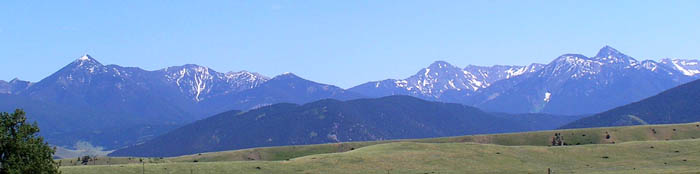
The Absaroka Range in Montana.
High in the Absaroka Range in Park and Sweet Grass Counties, gold was first discovered in the Independence Mining District in the 1860s. However, it took two decades before significant mining began, as the land was part of the Crow Indian Reservation. The federal government drove prospectors out of the area. Still, after receiving pressure from numerous mining interests, the government reversed itself and forced the Crow to cede the land in 1882. Almost immediately, miners returned to the area.
Though several small finds were made in the upper Boulder River and at the head of Basin Creek, no work began on a significant scale until 1888, after a pack trail was cut through the timber to the high-elevation veins at 9,000-11,000 feet. The same year, the first stamp mill was hauled up the steep, rugged road. Between 1889 and 1891, several mines were opened, including the Poorman, Hidden Treasure, Daisy, King Solomon, and Independence. The camp that grew up around them, located at the fork of Basin Creek in Park County, about three miles below the head of the Boulder River, took the name of the Independence Mine, which in 1892 was running at full capacity. Independence eventually boasted about 500 people, four saloons, two general stores, and numerous cabins. Other camps, like Solomon City and Horseshoe Basin, also developed nearby.

Independence, Montana, ghost town, courtesy of Discovering Montana.
Independence soon became the mining district’s service center and hosted seven stamp mills, a sawmill, and several concentrators. Because of the mining activity, Independence had both telephone and electricity by 1893. However, the mining district was a challenging trek, requiring five days by wagon to reach Big Timber, about 50 miles to the northeast.
Production in the district peaked between 1890 and 1893, with the Independence mill producing about $42,000 in gold bullion. However, the mining boom ended with the depression of 1893, the exhaustion of easily accessible ore, difficult transportation, and poor management. The Independence Mine closed but was leased out in August 1894, reopened, and operated until 1897. At that time, the Independence, the Daisy, the Hidden Treasure, and other properties were sold and consolidated, and continued to operate until 1904, when the Hidden Treasure Mill burned down. From 1890 to 1905, the district reportedly produced gold and silver ore valued at about $120,000.
Workings were revived intermittently over the next several decades, but all proved unprofitable and were quickly abandoned. Today, all that remains of Independence and the other area mining camps are a few tumbling cabins and mining remnants.
What little is left of Independence is about 53 miles Southwest of Big Timber, Montana. Head Southeast towards McLeod on Montana Highway 298 for about 27 miles, then continue on Main Boulder Road and Forest Road 6639 for about 26 miles to the old townsite. A high-clearance vehicle is recommended.
©Kathy Alexander/Legends of America, updated September 2026.
Also See:
See Sources.