

By Thomas L. Vaultonburg
Every small town in America seems to have at least one road that acquires a different identity after dark. By daylight, it is an ordinary stretch of pavement connecting farms, houses, and neighboring communities. At night, it becomes the place where somebody saw something, where somebody heard something, or where somebody insists you should never stop your car. In the countryside around Byron, Illinois, one of those places was Kennedy Hill Road, where the story of a mysterious woman in white circulated during my childhood.
The story was simple enough. Drivers traveling Kennedy Hill Road after dark sometimes reported seeing a woman dressed in white moving along the roadside. She might appear suddenly in the headlights, visible just long enough to startle whoever was behind the wheel before disappearing into the surrounding darkness. Depending on who told the story, she was a ghost, a wandering spirit, or simply something that nobody had managed to explain. As with many local legends, the details were less important than the warning: if you drove that road at night, you might encounter the woman in white.
I grew up in Byron, a small northern Illinois community surrounded by the agricultural landscape that characterizes much of the region. Country roads were familiar territory. They were the routes people took to visit friends, drive between towns, or simply spend an evening riding around with nowhere particular to go. For young people, those roads offered a certain freedom. They also provided an ideal setting for frightening one another. A road that seemed entirely unremarkable in the afternoon could become considerably more interesting once somebody in the car began telling a ghost story.
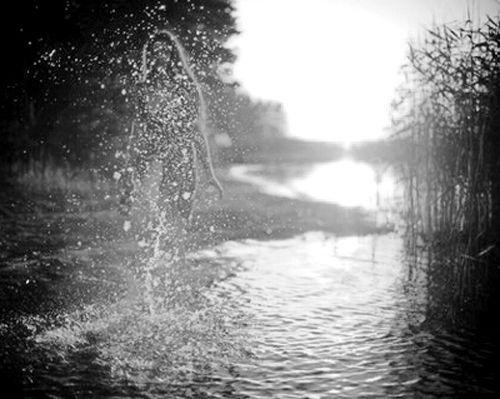
Ghostly woman along a creek.
The geography did much of the work. A car’s headlights illuminate only a narrow section of the road ahead. Beyond that illuminated space, the landscape becomes uncertain. Trees, fences, mailboxes, and roadside vegetation appear briefly and vanish again. A pale object glimpsed at the edge of the light can look remarkably like a person. If a passenger has just told you that a dead woman walks the road, the possibilities become even more suggestive.
That is one of the remarkable things about local folklore. A story changes the way people experience a familiar place. The road itself remains exactly where it has always been, but it is no longer simply a road. It has acquired a second existence in the imagination of the community. People who have never seen anything unusual there may nevertheless know the story. Some repeat it as entertainment. Others believe it. Still others drive out after dark hoping to discover something for themselves.
The woman in white is an especially durable figure in American ghost lore. Versions of her appear along highways, near bridges, beside cemeteries, and on lonely rural roads. Sometimes she is said to have died in an accident. Sometimes she waits for a lover who never returned. Sometimes she is searching for a child. The explanations differ from place to place, but the image remains recognizable: a solitary female figure, pale against the darkness, whose presence seems to demand a tragic history.
What interested me about the Kennedy Hill Road story, even as a young person, was that its power did not depend on a particularly elaborate history. I do not remember hearing a consistent account of who the woman had been, when she supposedly died, or why she continued to appear. The apparition itself was the story. People knew where to look and what they were supposed to see. That was enough.
Before the internet made local legends easy to collect, compare, and circulate, stories like this traveled largely through conversation. Somebody heard about the woman from an older sibling. Somebody repeated the account at school. Somebody else claimed a friend had seen her. A group of teenagers drove out to investigate, returned with an ambiguous experience, and contributed another version. In that environment, the absence of documentation was not necessarily a weakness. Uncertainty gave the story room to grow.
There was also a certain pleasure in the investigation. You did not need special equipment, permission, or much money. You needed a car, a dark road, and a few people willing to scare themselves. The possibility of finding nothing was part of the entertainment. So was the possibility that a perfectly ordinary object might produce several seconds of genuine terror.

Shipley Hollow Road in Tennessee is said to be haunted.
I cannot tell you when the Kennedy Hill Road legend began. I cannot identify its first storyteller, and I do not have a historical record establishing the number or dates of reported sightings. What I can document firsthand is that the story existed in the local folklore of my childhood. I remember hearing it, remember the supposed apparition, and remember the particular stretch of northern Illinois countryside to which the tale belonged.
I also remember discovering a detail that substantially changed my interpretation of the mystery.
When I was in grade school in Byron, I developed my first serious childhood crush on a girl who attended school with me. At some point, I learned something about her mother that was interesting for reasons having nothing to do with romance. Her mother enjoyed jogging. She sometimes jogged after dark. One of the places she went jogging was Kennedy Hill Road.
And when she went jogging, she wore a white outfit.
This struck me as a rather important development in the investigation of the Ghost of Kennedy Hill Road.
Consider the circumstances. A driver has heard stories about a woman in white who appears along a lonely country road. One evening, while traveling that road, the driver sees a female figure dressed in white moving through the darkness at the edge of the headlights. The sighting lasts only a moment. The driver is startled. By the time the experience is described to friends, it has become another encounter with the mysterious woman.
Meanwhile, the woman in white has continued down the road, presumably concerned with her pace, her breathing, and the ordinary business of getting some exercise.
I have no way to establish that this particular jogger was responsible for every reported sighting, or even for any specific sighting. The information came to me through childhood acquaintance, not a formal investigation. It remains a plausible explanation rather than a proven solution. But it was enough to make me reconsider the supernatural possibilities.
Perhaps the woman was not searching eternally for a lost lover. Perhaps she had not emerged from an abandoned cemetery or returned to the scene of some forgotten tragedy. Perhaps she was not attempting to warn motorists about an approaching disaster.
Perhaps she was exercising.
That possibility has stayed with me for decades, partly because it is funny and partly because it says something interesting about the way legends are made. The explanation does not require anyone to have lied. A driver might sincerely believe that something extraordinary had appeared in the headlights. A listener might sincerely repeat the story. With each telling, the experience becomes a little more firmly attached to the place, until the road itself seems to possess a supernatural history.

Seven Sisters Road southeast of Nebraska City, Nebraska.
And once a place has acquired such a reputation, ordinary events can begin to reinforce it. The person who sees a white shape beside the road is not simply seeing a white shape. That person is seeing the woman everyone has been talking about.
There is a temptation to regard the discovery of a possible natural explanation as the end of a ghost story. I have come to think it is often the most interesting part. Whether the figure was supernatural or entirely human, the story reveals something about the community that preserved it. It shows how people transformed an ordinary rural road into a destination for nighttime adventure, how a shared narrative altered their perception of the landscape, and how a few seconds of uncertainty could become a memory passed from one generation of young people to another.
I do not know whether people around Byron still tell the story of the Ghost of Kennedy Hill Road. Local legends can disappear as quietly as they arrive. The people who remember them grow older, the roads change, and the circumstances that sustained the stories pass away. Sometimes all that survives is somebody’s recollection of what people used to say.
But I remember Kennedy Hill Road. I remember the woman in white. And I remember the rather extraordinary possibility that one of the local ghosts of my childhood was the mother of the first girl I ever had a crush on.
Somewhere along the way, somebody may have driven home convinced that they had seen an apparition.
And somebody’s mother went home having gotten her miles in.
Haunted Theorosa’s Bridge in Kansas. Photo by Beth Golay/KMUW.
©Thomas L. Vaultonburg for Legends Of America. Submitted October 2026.
About the author: Thomas L. Vaultonburg is an American poet, author, and editor from northern Illinois. He writes about local history, folklore, forgotten places, and American culture at The Rockford Blog.
Also See:
The White Lady of Spring Canyon, Utah
La Llorona – Weeping Woman of the Southwest
Pitty Pat Hollow – Tennessee Lore