

John Quincy Adams.
John Quincy Adams was an American statesman, diplomat, lawyer, and diarist who served as the sixth president of the United States from 1825 to 1829.
He was the worthy son of a worthy sire, the elder President John Adams, and was born at the family mansion at Quincy, Massachusetts, on July 11, 1767, to John and Abigail Smith Adams. One of six children, he was named after his mother’s maternal grandfather, Colonel John Quincy, after whom Quincy, Massachusetts, is named. Private tutors educated young Adams. Until the age of ten, Adams grew up on the family farm in Braintree, largely in the care of his mother. Though frequently absent because he participated in the American Revolution, his father, John Adams, maintained correspondence with his son and encouraged him to read.
At the age of eleven, he accompanied his father to Europe, where he served as minister of the newly declared independent United States of America. In Paris, he was much in the society of Dr. Benjamin Franklin and other distinguished men. It may be said that he entered upon the duties of a long public life before he was 12 years old, for he learned the useful rudiments of diplomacy and statesmanship. He attended school in Paris and Amsterdam and spent time at the University of Leyden. During this period, Adams studied law, French, Greek, and Latin. In 1779, he started a diary that he kept until just before he died in 1848.
In 1781, at only 14, he accompanied United States minister Francis Dana to St. Petersburg, Russia, as a private secretary. During the Winter of 1782-73, he traveled alone through Sweden and Denmark and reached The Hague safely, where his father was the resident minister for the United States. He accompanied his father to Great Britain in 1784. He returned to the United States in 1785 and earned admission to the junior class of Harvard College the following year. He joined Phi Beta Kappa and excelled academically, graduating second in his class in July 1787.

John Quincy Adams at age 29, by John Singleton Copley.
At age 20, young Adams began studying law with Judge Theophilus Parsons in Newburyport, Massachusetts, and entered practice in Boston. Politics engaged his attention, and he wrote much on topics of public interest, especially the necessity of neutrality on the part of the United States in relation to the quarrels of other nations. On the recommendation of Thomas Jefferson, President George Washington introduced him to public service by appointing him resident minister in the Netherlands in 1794. He was afterward sent to Portugal in the same capacity, but on his way, he received a new commission from his father, then President, as a resident minister in Berlin.
Adams initially opposed the ratification of the United States Constitution. However, he ultimately accepted the document, and in 1789 his father was elected the first Vice President of the United States. In 1790, Adams opened his own legal practice in Boston. Despite early struggles, he became an attorney and achieved financial independence.
Adams spent the Winter of 1795-1796 in London, where he met Louisa Catherine Johnson from Maryland, then living there with her father, American merchant Joshua Johnson. In April 1796, Louisa accepted Adams’s marriage proposal. Adams’s parents disapproved of his decision to marry a woman who had grown up in England, but he told them he would not reconsider. The couple married in All Hallows-by-the-Tower, London, on July 26, 1797, and would eventually have four children. Shortly after the wedding, Joshua Johnson fled England to escape his creditors, and Adams did not receive the dowry Johnson had promised him, much to Louisa’s embarrassment.

Louisa Cathrine Adams by Charles Leslie.
Adams returned to Boston in 1801 and was elected to the Massachusetts Senate the following year. In 1803, he was sent to the Federal Senate, where he uniformly supported the measures of Thomas Jefferson, his father’s old political opponent. Because of his obedience to his conscience and judgment, the Massachusetts Legislature censured him, and he resigned his seat in 1806. His republican sentiments increased with age, and in 1809, James Madison appointed him minister to the Russian court. Multilingual, Adams held diplomatic posts throughout Madison’s presidency and served on the American delegation that negotiated an end to the War of 1812.
In 1815, he was appointed minister to the English court. He remained there until 1817, when President James Monroe called him to his cabinet as Secretary of State. In that role, Adams negotiated the Adams-Onís Treaty, which provided for the American acquisition of Florida and arranged with England for the joint occupation of the Oregon country. He also helped formulate the Monroe Doctrine, which became a key tenet of U.S. foreign policy. He filled that office for eight years and then succeeded Monroe as president of the United States.
The first President, the son of President John Quincy Adams, paralleled his father’s career, temperament, and viewpoints in many respects. Upon becoming President, Adams appointed Henry Clay as Secretary of State. Well aware that he would face hostility in Congress, Adams nevertheless proclaimed a spectacular national program in his first Annual Message. He proposed that the Federal Government bring the sections together with a network of highways and canals and develop and conserve the public domain, using funds from the sale of public lands. In 1828, he broke ground for the 185-mile Chesapeake & Ohio Canal. Adams also urged the United States to lead the development of the arts and sciences by establishing a national university, financing scientific expeditions, and erecting an observatory. His critics declared such measures transcended constitutional limitations.
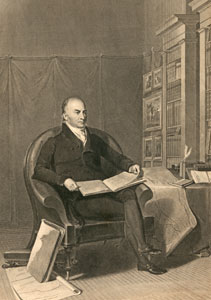
John Quincy Adams by Thomas Sully, 1826.
Adams also became increasingly critical of slavery and the Southern leaders he believed controlled the Democratic Party. He was particularly opposed to the annexation of Texas and the Mexican-American War, which he saw as a war to extend slavery and its political grip on Congress. During Adams’s presidency, the Democratic-Republican Party split into two major camps: the National Republican Party, which supported President Adams, and Andrew Jackson’s Democratic Party. In 1828, Andrew Jackson and his angry followers charged that a “corrupt bargain” had taken place, and immediately began their campaign to wrest the Presidency from Adams. Adams did not bear this ordeal easily, and the Democrats proved more effective political organizers. Jackson soundly defeated Adams in the 1828 presidential election.
After his defeat, he retired to private life in Massachusetts, more honored and respected by all parties than any retiring president since George Washington left the chair of state. Andrew Jackson began to serve as president in the Spring of 1829.
Adams’ four-year administration was remarkable for its calm and the country’s general prosperity. The country enjoyed unbroken peace with foreign nations and friendly domestic relations until the end of his term, when party spirit became rampant.

John Quincy Adams before death by Sarony & Major, 1848.
However, his countrymen would not allow him to remain in repose; in 1830, they elected him a representative in Congress. In December 1831, he took his seat, and from then until his death, he remained a member of the House of Representatives through consecutive re-elections. In 1836, southern Congressmen passed a “gag rule” providing that the House automatically table petitions against slavery. Adams fought the rule tirelessly for eight years until he finally secured its repeal. In Congress, he was distinguished for wise, enlightened, and liberal statesmanship. Above all, he fought against the circumscription of civil liberties.
On February 21, 1848, he collapsed on the floor of the House from a stroke and was carried to the Speaker’s Room, where he died the next day. His last words were, “This is the end of the earth.” He was 81 years old.
He was buried, as were his father, mother, and wife, at First Parish Church in Quincy, Massachusetts.
Historians concur that Adams was one of the greatest diplomats and secretaries of state in American history. They typically rank him as an average president, as he had an ambitious agenda but could not pass it through Congress.
©Kathy Alexander/Legends of America, updated October 2026.

The “Old House” was home to two presidents: John and John Quincy Adams. As of this notation in the early 21st Century, it has passed out of family hands. Photo by Carol Highsmith.
Also See:
Sources:
Lossing, Benson John; Eminent Americans, Volume II; American Publishers Corporation, New York, 1890.
Whitehouse.gov (archived)
Wikipedia