
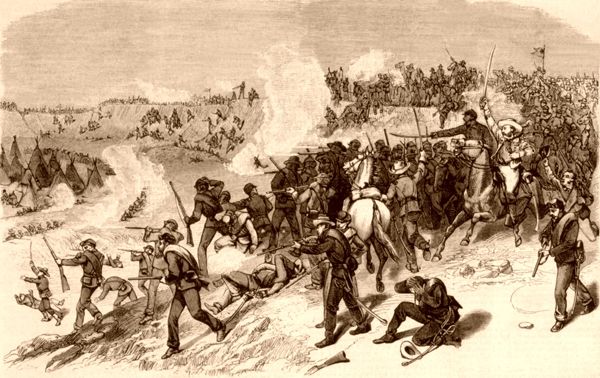
Nez Perce War, Frank Leslie’s Newspaper, 1877.
The Nez Perce War was an armed conflict between several bands of the Nez Perce tribe and an allied band of Palouse against the United States Army. It was fought between June and October 1877 and stemmed from several bands of the Nez Perce refusing to give up their ancestral lands in the Pacific Northwest and move to an Indian reservation in Idaho.
When white men began invading Nez Perce lands, the tribe maintained peaceful relations with them for many years. In 1804, the Nez Perce resupplied and aided the Army expedition of Captain Meriwether Lewis and William Clark, which probably saved the expedition from inevitable failure. In the 1830s, the Nez Perce also aided Captain Benjamin Bonneville’s expedition, which took a leave of absence from the Army to proceed West.
In 1855, Chief Joseph’s father, Old Joseph, signed a treaty with the U.S. that allowed his people to retain much of their traditional lands. However, less than ten years later, in 1863, a second treaty severely reduced Nez Perce lands, taking seven million acres as white settlers continued to move westward. Left with only 138,000 acres, Old Joseph maintained throughout his lifetime that his people never agreed to this second treaty.

Chief Joseph’s band of warriors, 1877.
Hostilities between settlers and the Nez Perce in the 1870s turned into violent conflict in mid-June 1877. The first engagement between the Army and the Nez Perce warriors was at White Bird Canyon, Idaho Territory, on June 17. For the Nez Perce, it was a significant victory. At White Bird Canyon, they proved to be an effective fighting force.
Throughout the summer and early fall of 1877, the fighting skill of the Nez Perce warriors and the military tactics of Nez Perce leaders such as Chief Looking Glass and Chief White Bird enabled the Nez Perce to evade almost certain defeat by superior U.S. Army forces. The Nez Perce strength during the 1877 war was estimated at a few hundred warriors with no formal military training, and they traveled with many non-combatants. The Army, however, would use several thousand soldiers during the 1877 Nez Perce campaign. Civil War veterans commanded these troops, bringing years of military training and experience.
The Nez Perce and the Army engaged several times as the Nez Perce traveled from their homeland in the Wallowa Valley through the Idaho and Montana Territories toward their goal of Canada. By October 1877, however, approaching Winter weather, lack of supplies, and the effects of traveling more than 1,500 miles over rough western territory had begun to take their toll.
The last engagement between the Nez Perce and the Army was fought at Bear Paw Mountain in Montana Territory between September 30 and October 5, 1877. After Bear Paw Mountain, when continuing to fight seemed futile, Chief Joseph surrendered his remaining forces to General Nelson A. Miles and General Oliver Otis Howard.
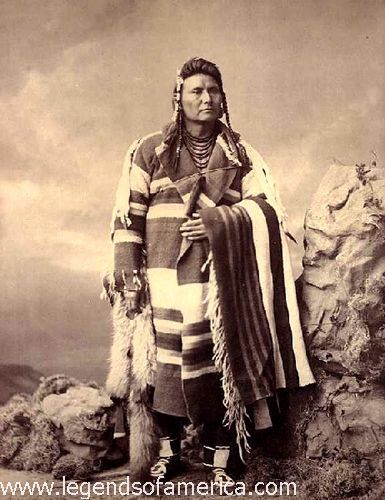
Chief Joseph of the Nez Perce Tribe
In his surrender speech, Chief Joseph concluded with:
“I am tired. My heart is sick and sad. From where the sun now stands, I will fight no more forever.”
Captains Edward S. Godfrey and Myles Moylan would be awarded the Medal of Honor for their actions against the Nez Perce at Bear Paw Mountain.
General Miles promised the Nez Perce a safe return to the Wallowa Valley. However, General Miles was overruled, and the Nez Perce were sent to Kansas and Oklahoma instead, where the survivors of 1877 endured many more years of hardship. The Nez Perce were not allowed to return to their homelands until the mid-1880s. Joseph and the other remaining tribal leaders spent their remaining years on the Colville Indian Reservation in Washington.
The Nez Perce War would not be the last conflict in which battlefield commanders’ decisions and promises were influenced by higher political forces and a physically distant command structure.
The Nez Perce War included the following battles:
Battle of White Bird Canyon, Idaho – June 17, 1877
Battle of Cottonwood, Idaho – July 3–5, 1877
Battle of the Clearwater, Idaho – July 11–12, 1877
Battle of Big Hole, Montana – August 9–10, 1877
Battle of Camas Meadows, Idaho – August 20, 1877
Battle of Canyon Creek, Montana – September 13, 1877
Battle of Cow Island, Montana – September 23, 1877
Battle of Bear Paw, Montana – September 30 – October 5, 1877
©Kathy Alexander/Legends of America, updated October 2026.
Also See:
Chief Joseph – Leader of the Nez Perce
Native Americans – First Owners of America
Nez Perce – A Hard Fight For Their Homeland
Nez Perce National Historic Trail
Sources: