
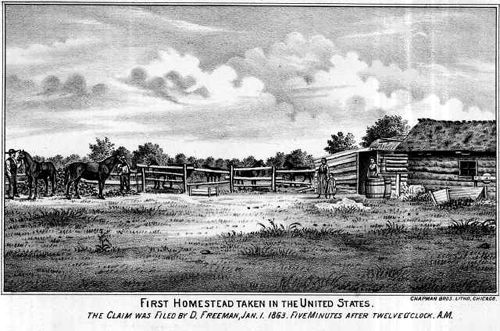
Sketch of the first homestead.
By Addison Erwin Sheldon, 1913.
The free homestead law has been called the most important act ever passed in the United States for the welfare of the people. Under this law, any man or woman 21 years old, or the head of a family, could claim 160 acres of land by living on it for five years and paying about $18 in fees. No free homesteads existed for the first 80 years of United States history. Settlers had to buy their land. The price was low, but many were very poor and, in many cases, lost their land after living on and improving it because they had no money to pay for it.
In 1852, the Free Soil Party demanded free homesteads for the people. In 1854, Congressman Galusha A. Grow of Pennsylvania introduced the first free homestead bill in Congress. People in the West and poor people everywhere supported the bill. However, many strongly opposed it.
The first Homestead Act, passed in 1860, required settlers to pay 25¢ an acre for their land. President Buchanan vetoed this bill. It was not until May 20, 1862, that President Abraham Lincoln finally signed the Free Homestead Act into law. The law took effect on January 1, 1863.
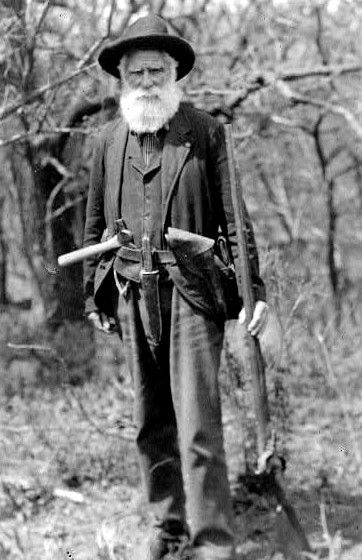
Daniel Freeman, when older.
Daniel Freeman took the first free homestead in the United States on Cub Creek in Gage County, Nebraska, about five miles northwest of Beatrice. Daniel Freeman was born in Ohio in 1826 and moved to Illinois with his parents in 1835. He was intensely interested in the Free Homestead Bill when it was first introduced in Congress. Year after year, he watched its progress and hoped for its passage, and many times, he said that he wished to be the first man to take a homestead.
When Congress signed the Free Homestead Act, Daniel Freeman was a soldier in the Union Army. A few months later, he was given a brief leave and came to Nebraska to look over the beautiful country, then lay vacant, for a home. He found a place that suited him and headed to the nearest United States land office, then to Brownville, Nebraska, arriving on December 31, 1862.
The little town thronged with settlers coming there to take the land. All attended a New Year’s Eve party at the hotel that night. The new Homestead Act was to take effect the next day, but because New Year’s was a holiday, the land office would not open until January 2.
Mr. Freeman was ordered to join his regiment and expected to leave the next day. He told his story about his great desire to be the first homesteader in the United States. The others agreed he should have the first chance, and they persuaded a clerk in the land office to open the office a few minutes past midnight on January 1 for Daniel Freeman alone.

The Palmer-Epard Cabin, built in 1867, was originally located 14 miles northeast of Freeman’s homestead. It was moved to Homestead National Monument in June 1950. Photo by Kathy Alexander.
Daniel Freeman made homestead entry number one and later received homestead patent number one for 160 acres on Cub Creek near Beatrice. Thus, Nebraska is honored to have the first homestead in the United States. Since then, over 1,000,000 homesteaders have followed Daniel Freeman’s example, receiving over 120,000,000 acres of land as a gift from our government. Of these homesteaders, over 100,000 live in Nebraska. Nothing has helped so much in settling the West as its free lands. One of the songs sung everywhere after the passage of the Homestead Act had for its refrain these words:
“Come along, come along, make no delay,
Come from every nation, come from every way,
Our lands are broad enough, have no alarm
For Uncle Sam is rich enough to give us all a farm.”
Daniel Freeman served his country in the Union Army until the Civil War ended in 1865. Then, he brought his bride and settled on his Nebraska homestead. This has remained the family home ever since. Here, their seven children grew to manhood and womanhood, and Mrs. Freeman lived with children and grandchildren.
Mr. Freeman died on December 30, 1908. This first homestead is a beautiful farm in the valley where the prairie meets the timberland. The old log cabin with a sod roof, the Freeman family’s first home, has long since disappeared.

The Freeman School, sometime in the 1880s. Photo courtesy of the National Park Service.
A brick house and orchard stand, and an old freighting road from the Missouri River to the mountains runs nearly a mile through the place, with rows of giant cottonwoods planted by Mr. Freeman on either side. On the hill at one corner of the farm, overlooking the valley and the freighting road, is the grave of Daniel Freeman. It is proposed that the United States purchase this first homestead from the Freeman family and make it a public park to commemorate what is regarded as the most important law passed by the United States and the place where that law was first applied.
By Addison Erwin Sheldon, 1913. Compiled and edited by Kathy Alexander/Legends of America, updated March 2024. Excerpted from the book History and Stories of Nebraska by Addison Erwin Sheldon, 1913. (now in the public domain.) Addison Erwin Sheldon (1861-1943) directed the Nebraska Historical Society and wrote numerous books on Nebraska’s history. Sheldon also took and drew many of the photographs and illustrations in his many texts.
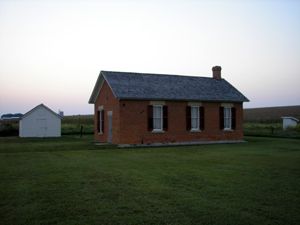
The Freeman School is recognized as Nebraska’s longest-running one-room schoolhouse, open from 1872 to 1967. The National Park Service has restored the interior to resemble what it looked like in the 1880s. Photo by Kathy Alexander.
A follow-up to Sheldon’s Historic Tale:
Agnes Suiter Freeman lived on the homestead until shortly before she died in 1931. In 1936, by an act of the United States Congress, the site of Freeman’s homestead was recognized as the “first” homestead in the United States when it was designated the Homestead National Monument of America. The national monument includes Daniel Freeman’s original homestead claim, the Freeman School (constructed in 1872), one other historic cabin, Freeman’s grave, and tree plantings. The National Park Service administers the property. Homestead National Monument of America is located in southeastern Nebraska, 40 miles South of Lincoln and four miles West of Beatrice on NE Highway 4.
Contact Information:
Homestead National Monument
8523 W. State Highway 4
Beatrice, Nebraska 68310
402-223-3514
Also See:
The Homestead Act – Creating Prosperity in America
See Sources.