
By Charles M. Skinner in 1896
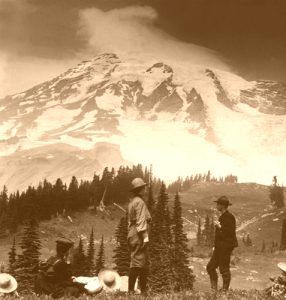
Mount Tacoma, around 1900.
Mount Tacoma has always been a place of superstitious regard among the Siwash (Sauvage) of the Northwest. In their myths, it was the place of refuge for the last man when the Whulge was so swollen after prolonged rain that its waters covered the earth. All other men were drowned. The waves pursued the one man as he climbed, rising higher and higher until they came to his knees, his waist, his breast. Hope was almost gone, and he felt that the next wave would launch him into the black ocean that raged about him when one of the tamanouses of the peak, taking pity on him, turned his feet to stone.
The storm ceased, and the waters fell away. The man still stood there, his feet a part of the peak, and he mourned that he could not descend to where the air was balmy and the flowers were opening.
The Spirit of all Things came and bade him sleep, and, after his eyes were closed, tore out one of his ribs and changed it to a woman. When lifted out of the rock, the man awoke, and, turning with delight to the woman, he led her to the seashore. There, in a forest bower, they made their home. There, the human race was recreated.
On the shore of the Whulge in after years lived an Indian miser–rare personage–who dried salmon and jerked the meat that he did not use, and sold it to his fellow men for hiaqua–the wampum of the Pacific tribes. The more of this treasure he got, the more he wanted–even as if it were dollars. One day, while hunting on the slopes of Mount Tacoma, he looked along its snow fields, climbing to the sky, and, instead of doing homage to the tamanous, or divinity of the mountain, he only sighed, “If I could only get more hiaqua!”
Sounded a voice in his ear: “Dare you go to my treasure caves?”
“I dare!” cried the miser.
The rocks and snows and woods roared back the words so quick in echoes that the noise was like that of a mountain laughing. The wind came up again to whisper the secret in the man’s ear, and with an elk-horn, for pick and spade, he began the ascent of the peak. The next morning, he had reached the crater’s rim, and, hurrying down the declivity, he passed a rock shaped like a salmon, next, one in the form of a kamas-root, and presently a third in the likeness of an elk’s head. “Tis a tamanous has spoken!” he exclaimed as he looked at them.
At the foot of the elk’s head, he began to dig. Under the snow, he came to crusts of rock that gave a hollow sound, and presently, he lifted a scale of stone that covered a cavity brimful of shells more beautiful, more precious, more abundant than his wildest hopes had pictured. He plunged his arms among them to the shoulder–he laughed and fondled them, winding the strings of them about his arms and waist and neck and filling his hands. Then, heavily burdened, he started homeward.
In his eagerness to take away his treasure, he made no offerings of hiaqua strings to the stone tamanouses in the crater, and hardly had he begun the descent of the mountain’s western face before he began to be buffeted by winds.
The angry god wrapped himself in a whirling tower of cloud and fell upon him, drawing darkness after. Hands seemed to clutch at him out of the storm: they tore at his treasure, and, in despair, he cast away a cord of it in sacrifice. The storm paused for a moment, and when it returned upon him with scream and flash and roar, he parted with another. So, going down in the lulls, he reached timber just as the last handful of his wealth was wrenched from his grasp and flung upon the winds. Sick in heart and body, he fell upon a moss-heap, senseless. He awoke and arose stiffly, after a time, and resumed his journey.
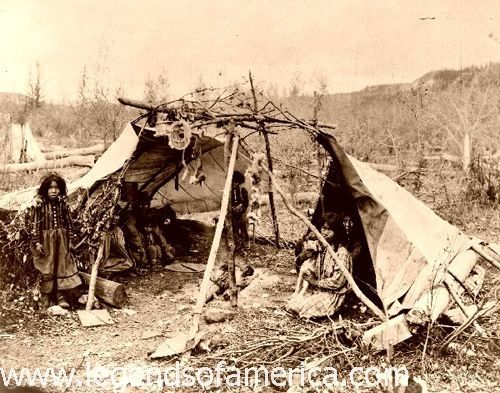
Siwash Wiki-up, 1903.
In his sleep, a change had come to the man. His hair was matted and reached to his knees; his joints creaked; his food supply was gone, but he picked kamas bulbs and broke his fast, and the world seemed fresh and pleasing to him. He looked back at Tacoma and admired the splendor of its snows and the beauty of its form, but he never cared for the riches in its crater. The wood was strange to him as he descended, but at sunset, he reached his wigwam, where an aged woman was cooking salmon. The wife and husband recognized each other, though he had been asleep and she had been a-sorrowing for years. In his joy to be at home, the miser dug up all his treasure that he had secreted and gave of his wealth and wisdom to whoso needed them. Life, love, and nature were enough, he found, and he never braved the tamanous again.
Compiled and edited by Kathy Alexander/Legends of America, updated March 2025.
Also See:
Historical Accounts of American History
Native American Mythology & Legends
Washington – The Evergreen State
About the Author: Charles M. Skinner (1852-1907) authored the complete nine-volume set of Myths and Legends of Our Own Land in 1896. This tale is excerpted from these excellent works, which are now in the public domain.