
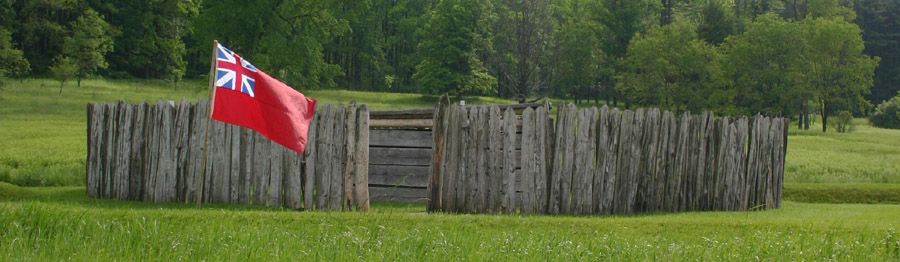
Fort Necessity, Pennsylvania, today
Fort Necessity was a small stockade in Fayette County, Pennsylvania, built at the beginning of the French & Indian War by the Virginia Militia led by George Washington in 1754.
In the spring of 1754, the French and Indian War, also called the Seven Years’ War, was imminent. The cause of the conflict was the desire of the British and French colonies to expand into the land each empire claimed. Once the war broke out between the two powers, the American Indian tribes had to decide whom to support. Throughout the conflict, varying tribes allied themselves with the French or the British to better suit their individual goals.
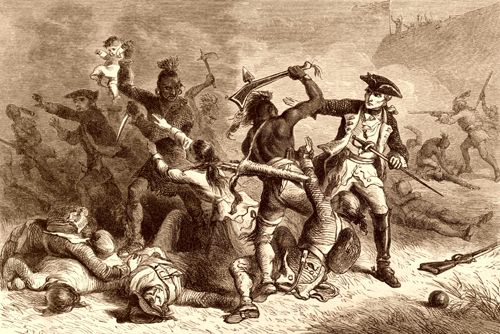
French Indian War, Felix Carr, about 1870.
During the mid-1700s, British colonies along the Atlantic coast began to move westward onto land claimed by the French in the interior. With support from the mother country, the British colonies fought to establish their dominance in North America. The shared experience of fighting together helped encourage the colonies to band together later in the 1770s and start their own country, the United States of America.
Hoping to defend against an imminent attack by French soldiers, a young, newly commissioned British lieutenant colonel, George Washington, built a ‘fort of necessity in late May and early June 1754. Not a typical military fort, it was small and simple, even by wilderness standards. Consisting of a small storage shed in the center of a round stockade, about 53 feet in diameter, it was located in a natural meadow. Earthworks were constructed outside the stockade.
When Washington arrived at the Great Meadows, he intended to set up a camp to base his operations while waiting for other militia and British regulars. However, after encountering and dispatching the French party led by Joseph Coulon de Jumonville, Washington returned to the Great Meadows. It fortified his position by building the small fort, which was completed on June 4. At that time, he had approximately 160 men, but by mid-June, that had grown to around 400.

Battle of Fort Necessity, Pennsylvania.
By late June, the French, seeking revenge, returned in significant numbers, along with their Indian allies, to attack Washington at the Great Meadows. The July 3rd battle resulted in heavy losses for the British forces, culminating in Washington’s surrender to the French under Louis Coulon de Villiers. In signing the surrender document, Washington agreed to having assassinated Coulon de Jumonville, though Washington said that his English translation of the documents did not use this term. The British returned to Virginia after the surrender, and the French burned Fort Necessity.
Washington engaged with the French along the Ohio River again when he returned under General Edward Braddock’s command the following year. Braddock’s forces were part of a larger British plan to attack multiple French forts simultaneously across North America. Braddock’s troops tried to move quickly through the mountains to attack Fort Duquesne using the road Washington had built earlier, but the roadbed was too narrow for the heavy armament and the roughly 2,400 men. To increase his speed, Braddock made the fatal mistake of splitting up his troops.
As Braddock and the first of his troops approached Fort Duquesne, the French and allied Indians attacked. Braddock and more than half of the 1,200 British men with him died. The remaining soldiers retreated, and British troops buried the general near Fort Necessity, concealing the grave within the roadbed by marching over it to prevent the desecration of the general’s body. Braddock’s final resting place lay hidden until 1804, when workmen discovered a body reported to be the general’s. A monument constructed in 1913 marks the site over the re-interred bones of General Braddock.
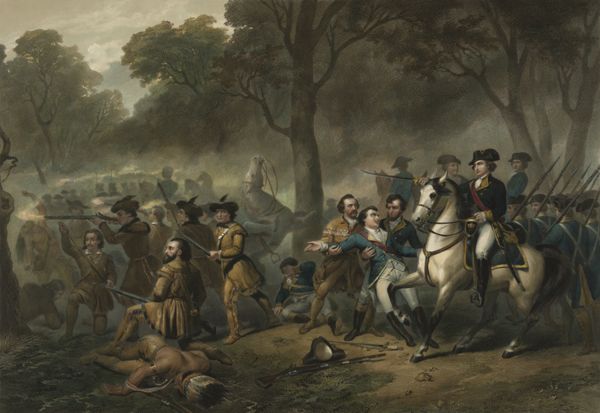
George Washington in the French and Indian War
The confrontation at Fort Necessity in the summer of 1754 was the prelude to the war fought by England and France for control of the North American continent. The struggle, known in the United States as the French and Indian War, spread worldwide as the Seven Years’ War. It ended in 1763 with the removal of French power from North America and India. The action at Fort Necessity was also the first significant event in George Washington’s military career. It was the only time he ever surrendered to an enemy.
Today, the Fort Necessity National Battlefield in Farmington, Pennsylvania, preserves the site of the Battle of Fort Necessity. Visitors can go inside a reconstructed version of the fort and see remnants of the original earthworks that Washington’s men built in preparation for the battle. A visitor center provided information about the battles and associated sites with an orientation film and guided tours. During the summer, there are historic weapon demonstrations and various other interpretive programs.
The Battle of Jumonville Glen site is approximately seven miles from the visitor center, and the grave of General Braddock is located one mile west of the visitor center off US Route 40. Visitors can also walk the roadbed built for Washington and Braddock in their campaigns against the French.
The site also includes the Mount Washington Tavern, once one of the many inns along the National Road. The tavern, which served wealthier men and women along the National Road, was named for George Washington, who once owned the land on which the tavern sits. It was built in the 1830s and operated until 1855, when rail transportation supplanted much of the wagon traffic along the Road.
More Information:
Fort Necessity National Battlefield
One Washington Parkway
Farmington, Pennsylvania 15437
724-329-5512
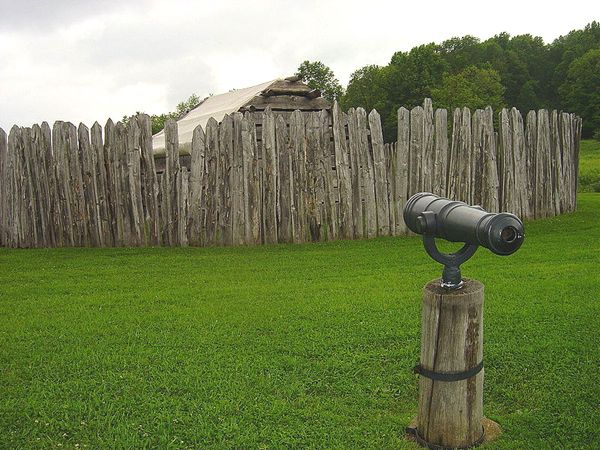
Fort Necessity, Pennsylvania
Compiled by Kathy Alexander/Legends of America, updated December 2025.
Also See:
Pennsylvania – The Keystone State
See Sources.