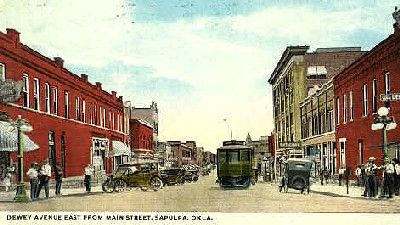
Vintage Sapulpa, Oklahoma.
Some 15 miles West of Tulsa, Route 66 travelers will arrive at Sapulpa, Oklahoma, a city proud of its Route 66 and Native American heritage. Five countries have flown their flag over this area over the centuries: Spain, France, England, Mexico, and the United States of America. During the Civil War, the Choctaw Indian Nation also flew its flag over the territory. Sapulpa’s history is rich in Indian and early American folklore.
Sapulpa began in 1850, when Jim Sapulpa, a Creek Indian, came to the area from Alabama. He established a farm on Rock Creek, about one mile southeast of the present city, and soon operated a store in his home, hauling supplies from Fort Smith, Arkansas.
By the treaty of 1865, the Creek Indians gave the right-of-way to the St. Louis-San Francisco Railroad, which extended its line to the present site of Sapulpa in 1886. Although the terminus initially had no official name, railroad men called it Sapulpa after the area’s first settler, and it soon became known as Sapulpa Station.

Sapulpa Harvey House Depot postcard.
Before long, the city became a crucial cattle-shipping center, and a Fred Harvey Hotel operated at the railroad station. In 1889, a post office was opened, and the town was incorporated in 1898.
Although oil was found at Chelsea in 1889, Muskogee and Bartlesville in 1897, and Red Fork in 1901, the territory was not recognized as a major oil reserve until the opening of the Glenpool Field, four miles Southeast of Sapulpa, in November 1905. This oil boom fostered Sapulpa’s most significant period of growth.
The oil boom, the Frisco Railroad, and the addition of several brick-and-glass plants transformed Sapulpa from a sleepy little village into a bustling community of 20,000 by the mid-1920s. Most buildings in downtown Sapulpa were built during this boom period.
Sapulpa has long been known as “The Crossroads of America,” where U.S. Highway 66 and U.S. Highway 75 intersect. Before interstate highways were constructed, Route 66 was the main East/West highway of the western United States, and U.S. 75 was the main North/South highway, running from Canada to the Gulf Coast at Galveston, Texas. Today, the city remains a major crossroads, with five significant highways converging in town.
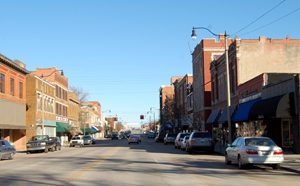
Sapulpa, Oklahoma Main Street, Kathy Alexander.
Today, this Main Street City of some 20,000 people prides itself on its character shaped by three historic factors: Indians, railroads, and oil. The town has received ten statewide awards for its preservation and architectural rehabilitation efforts. As you pass through this beautifully preserved community, you will also find several artistic advertising displays on its many vintage buildings.
Special events are held throughout the year, including summer concerts on Main Street and the popular Route 66 Blowout, an annual event held in downtown Sapulpa since 1990. The event celebrates the nostalgia of the Mother Road with a well-attended car, motorcycle, and truck show; art show and sale; historic walking tours; live music; crafts; and commercial vendors.
Sapulpa was perhaps best known as home to the globally recognized Frankoma Pottery. For decades, visitors could take free factory tours to watch skilled artisans make pottery as they had since the 1930s. However, after years of decline, Frankoma Pottery closed in 2010, and its contents were auctioned a year later. You can still find Frankoma pottery in antique stores and homes across Oklahoma and even the nation.
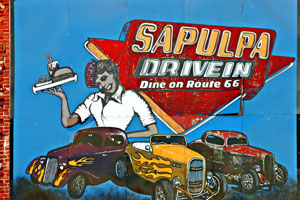
Mural in Sapulpa, Oklahoma by David Fisk.
While visiting this Main Street City, be sure to see the Waite Phillips Filling Station Museum. Built in 1922 by Waite Phillips, the Sapulpa Historical Society restored the building, which houses automobiles from the 1920s. It is located one block off historic Route 66 at 26 E. Lee Avenue. For more history, visit the Sapulpa Historical Museum. This old 1910 hotel features exhibits, dioramas of the early-day Frisco Railroad and 1894 Sapulpa townsite, a 100-year pictorial history of Sapulpa, Native American and African-American photo histories, and much more. The museum is located at 100 E Lee Avenue.
Three miles West of Sapulpa, an old alignment of Route 66 follows what was once called the Ozark Trail and is today sometimes called the “Father of the Mother Road.” This old concrete ribbon once carried 3.3 miles of Route until the early 1950s. To access this old alignment, travel 1.2 miles West of the Oklahoma 66-Oklahoma 97 intersection in Sapulpa. The old trail begins at the 1921 steel-truss Rock Creek Bridge. Still complete with its old red brick pavement, this 12-foot-wide rusting hulk can still be driven across. Just beyond the bridge are the remains of the long-abandoned TeePee Drive-In Theater. The old pavement continues to meander beneath an old 1925 railroad trestle, through wooded areas dotted with just a few secluded houses, before merging back into Oklahoma Route 66.
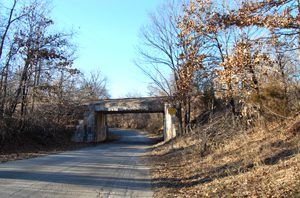
An old alignment of Route 66, which was once part of the Ozark Trail, is just West of Sapulpa, Kathy Alexander.
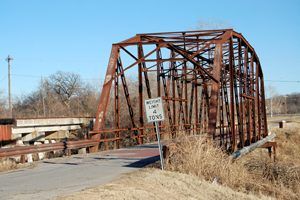
The old 1921 Rock Creek Bridge is still drivable, Kathy Alexander.
Sapulpa is also home to two lakes: Pretty Water, which provides excellent trout fishing, and Lake Sahoma, where camping, fishing, and boating are available.
Continue your journey on the Mother Road beyond Sapulpa to Kellyville, Oklahoma.
More Information:
©Kathy Alexander/Legends of America, updated October 2026.
Also See:
Oklahoma Route 66 Photo Gallery
See Sources.