
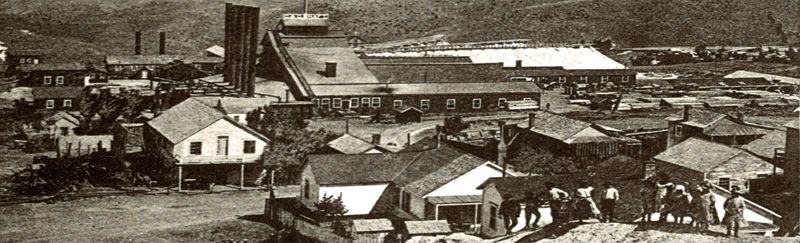
C&C Hoisting Works, Virginia City, Nevada by James H. Crockwell, 1890.
One of the most important mining discoveries in American History, the Comstock Lode in Nevada, was the first significant silver discovery in the United States and virtually ended the California Gold Rush.
Discovered under what would become one of the most important gold camps in the West – Virginia City on the eastern slope of Mt. Davidson, the mines would yield more than $500,000,000 of silver and gold ore during the first decades.
Mormon emigrants discovered gold in the area in the spring of 1850 on their way to the California Gold Rush. After arriving far too early to cross the Sierra Nevada range, they camped on the Carson River near present-day Dayton to wait for the snow to melt.
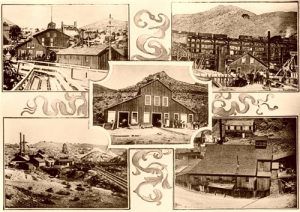
Hoisting Works Virginia City NV 1890.
While waiting, some men began prospecting the area and discovered gold in Gold Canyon. Even though they found some gold, they crossed the mountains, which were passable, and they were sure they would discover larger finds at the end of their route. Mining continued in the area, but a camp was not established until the winter and spring of 1852–53 when there were about 200 prospectors in the area. Though miners continued to work their way upstream, the amount of gold found at the time wouldn’t result in a huge rush for several years.
More ore deposits were discovered in the fall of 1857 by brothers Ethan Allen and Hosea Ballou Grosh, sons of a Pennsylvania minister and veterans of the California goldfields. However, before they could work or file the claim, both would die tragically. Hosea Grosh ran a pick through his foot, which eventually resulted in lockjaw (septicemia), and he died on September 2, 1857. His brother, Allen, while traveling to Last Chance, California, in November 1857, got caught in a snowstorm and suffered severely from exposure. Though he was found before his death and taken to Last Chance, his legs were utterly frostbitten, and refusing to have them amputated, he died on December 19, 1857.
Henry Tompkins Paige Comstock, known familiarly as “Old Pancake, ” was also working in the area. He had befriended the Grosh brothers, and though they had not shared the location of their find with him when Comstock heard of Allen’s death in the spring of 1858, he took possession of their cabin and went in search of their claim.
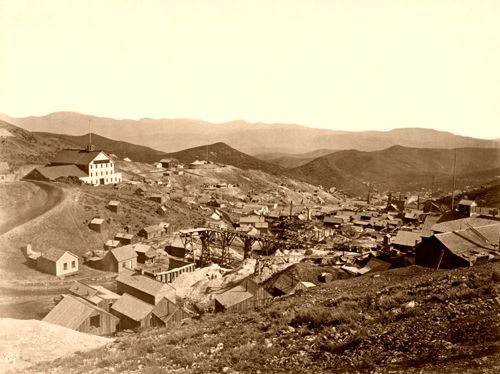
Gold Hill, Nevada, by Timothy H. O’Sullivan, 1867.
He and several others claimed several sections of the Comstock Lode in 1859. A miner named James Finney, better known as “Old Virginny,” discovered the Gold Hill outcropping; “Big French John” Bishop, Aleck Henderson, and Jack Yount discovered a vein that would later become part of the Comstock Lode, but not the main one. These four men are often re-credited with the “rediscovery” of the original Grosh brothers’ find.
In the spring of 1859, two miners named Peter O’Riley and Patrick McLaughlin began working around the head of Six-Mile Canyon. By June, they had hit “pay-dirt,” but when Henry Comstock learned of the find, he claimed the men were working on land he had already claimed for “grazing purposes.” Unhappy with his current claim on Gold Hill, Comstock threatened to take it, but the miners finally agreed to give him an interest in the gold find.
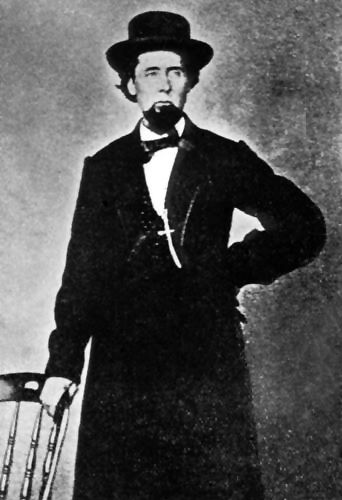
Henry T. Comstock.
Comstock’s and others’ claims started the “Rush to Washoe,” which would be the dominating event in Nevada history for the next two decades.
Having few resources to develop these claims and unsure of the size of the strikes, all of the original discoverers would soon sell out without ever making the vast fortunes that would come later for men such as George Hearst, William Chapman Ralston, William Sharon, Alvinza Hayward, and several others.
Henry Comstock left the area broke in 1862 and went to Oregon, where he continued prospecting. From there, he traveled to Montana, where he killed himself on September 27, 1870, by putting a gun to his head. Though Comstock died poor and unhappy, the rich lode he had an early part of was named for him.
Western Nevada quickly became a center of mining activity, with numerous trading posts and mining camps established, such as Virginia City, Silver City, and Gold Hill. Virginia City, established in 1859, quickly became a prosperous boomtown. For several decades, it reigned as the “capital” of the lode and one of the most influential political, financial, and social hubs in the American West.
In the earliest days, the ore was extracted through surface diggings, but these were quickly exhausted, forcing the miners to tunnel underground.
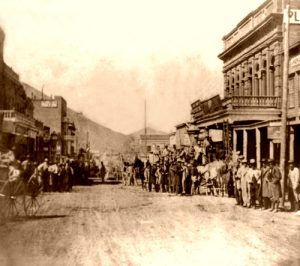
Virginia City, Nevada – Pioneer Stage is leaving Wells Fargo, photo by Lawrence and Houseworth. 1866.
The ore, however, was so soft that the tunnels were often subject to deadly cave-ins, which were later solved by square-set timbering. Heavy flows of water required for pumping machinery also hamper mining activities.
Unfortunately, little was known about silver mining then, but the miners and investors quickly adapted, creating new technology to bring out large amounts of ore. These first few years were also filled with litigation as miners and corporations fought over mining claim boundaries. However, during the first six years, from 1859 to 1865, an estimated $50 million in ore was taken from the claims, even though some 20% was spent on litigation. The litigation and the cost of equipment and improved technology virtually pushed out all of the small miners and began to make fortunes for the would-be Silver Kings.
Over the next decade, representatives of the Bank of California, based in San Francisco, acquired most of the Comstock claims and mines when the market began to decline. Represented by William Sharon, the bank’s representative in Virginia City, Sharon gambled on the district’s future and won. Eventually, they took over the other area banks and became the controlling influence in Virginia City, even building the Virginia and Truckee Railroad, dramatically reducing transportation costs. They also built and controlled the Virginia City and Gold Hill Water Company, the first non-mining incorporation on the Comstock Lode.
Before the railroad broke ground in February 1869, all ore, freight, and passengers were transported by “bull teams” of 10 to 16 horses or mules. Supplies, machinery, merchandise, and goods were required to haul everything over the Sierra Nevada Mountain range in large wagon loads, some of which lined up as far as three miles. Transportation improved when the Central Pacific Railroad line was completed to Reno when the wagons had a far shorter and easier road.
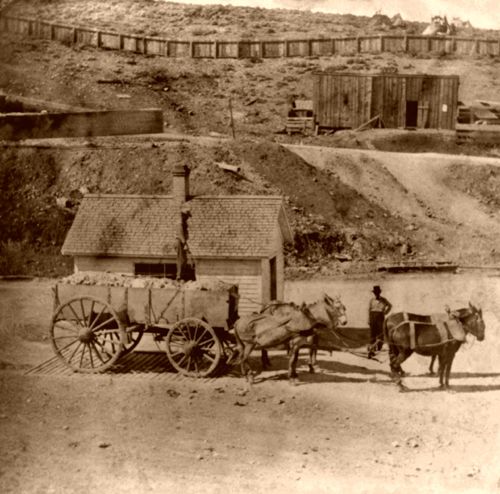
Weighing the load at the Gould & Curry Mine in Virginia City, Nevada, by Lawrence & Houseworth, 1866.
The bank’s Virginia and Truckee Railroad completed the most challenging section from Virginia City to Carson City by October 1869. The rails were soon extended across the Washoe Valley from Carson City to Reno, where they connected to the Central Pacific Railroad.
During this time, however, the bank could not buy out one man named John William Mackay, who had arrived in the area in 1859 from the California goldfields.
MacKay partnered with fellow Irishmen James Graham Fair, James C. Flood, and William S. O’Brien, whose business dealt in mining stocks and operated silver mines on the Comstock Lode. In 1873, they discovered the richest ore body in the Comstock Lode, known as the “Big Bonanza” of the Consolidated Virginia and California Mine.
Over the next few years, Mackay imitated the Bank of California’s policies, parlaying their investments into a fortune. Between 1873 and 1882, the Comstock Lode and its “Big Bonanza” yielded more than $100,000,000, and during the same time, two adjacent mines of the Bonanza Group produced the same amount. The group produced nearly $400,000,000 in ore by 1882 — half of the silver in the United States during the period. Though the “Big Bonanza” ores began to decline after 1878, it continued to produce ore until the 1940s.

Virginia City, Nevada Savage Works Mill, by Timothy H. O Sullivan, 1867.
During its heyday years, the entire mining region was a melting pot of various ethnic groups, including Chinese, Irish, English, Welsh, Canadians, Germans, and Italians. Though this was typical throughout the mining camps of the American West, in Nevada, many of these men of European descent were able to reach “nobility,” unlike other mining regions. In many other areas, anti-immigrant and anti-Catholic attitudes were prevalent. But this was not the case in the Comstock Lode, except for the Chinese, who were discriminated against intensely. Many of the most important Comstock leaders and politicians were European by birth, including Adolph Sutro, born in Prussia; John P. Jones, from Wales; and three of the four leaders of the Bonanza Group were born in Ireland.
From the beginning, there was no “social elite” of American-born citizens in Nevada, which provided foreigners with opportunities little seen in the East and South. The Chinese, however, suffered from universal racism from both American-born and European-born citizens.
Like other mining regions, the area also had a significant imbalance between the sexes. Males far outnumbered females, many working in “less than desirable” occupations.
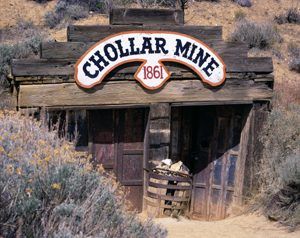
An old silver mine in Virginia City, Nevada, that dates back to 1860 by Carol Highsmith.
Though the Comstock Lode took out more than $700,000,000 in gold and silver between 1859 and 1919, it couldn’t last. Inevitably, the mines began to play out, and by 1880, all of Nevada’s mines, except for Delamar, were beginning to decline. Storey County, which encompassed the Comstock Lode and boasted as many as 25,000 people at its height, would fall to only about 3,500 people by the turn of the century.
When the ore was gone, the owners and leaders of the mines left the area, almost none of whom remained in Nevada.
Silver determined the economy and development of Nevada, nicknamed the “Silver State,” until the exhaustion of the mines and the demonetization of silver started a decline in the 1870s. Though several men were incredibly wealthy, the vast majority of the companies in the area did not prove profitable for their owners. In fact, out of more than 100 mining companies, only 14 were responsible for the large payouts.
The Comstock Lode has a glamorous and romantic history; however, its mines were criticized for stock manipulation in San Francisco, profit skimming by owners and insiders, and poor accounting, which resulted in losses to common shareholders.
In addition to its rich history, immense fortunes generated, and the significant role those fortunes played in the growth of Nevada and San Francisco, the Comstock Lode is also noted for the advances in mining technology it spurred, including the Sutro Tunnel, a brilliantly conceived scheme for draining the excess water found in the mines.
Since those lucrative heydays, Nevada has been a relatively minor silver producer, but later mining activities have produced gold.
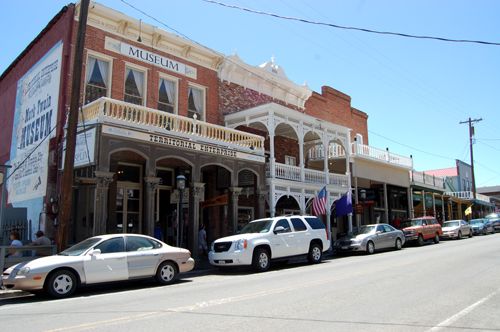
Virginia City’s Main Street is lined with historic buildings by Kathy Alexander.
The rich history of the Comstock Lode can still be found in the historic community of Virginia City, Nevada, designated a National Historic Landmark in 1961. Though a shadow of its former self, Virginia City draws more than two million visitors annually, flocking to see its historic buildings and museums and enjoy the specialty shops, restaurants, bed and breakfast inns, and casinos.
©Kathy Alexander/Legends of America, updated January 2025.
See The Comstock Foundation for History and Culture for more information and preservation.
Also See:
Early Mining Discoveries in Nevada
Virginia City and the Comstock Lode
Mary Jane Simpson – The Lady and the Mule
See Sources.