
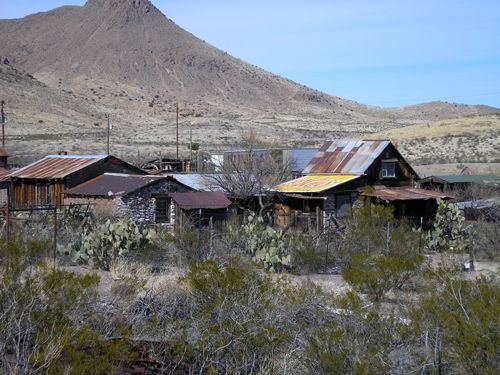
Steins, New Mexico Town Site by Kathy Alexander.
Called the Kimball Mining District, several mining camps, with names like Kimball, Pocahontas, and Beck, sprang up along the base of the Peloncillo Range in the late 1870s after the discovery of mixed deposits of gold, silver, lead, and copper, at which time the area began to crawl with prospectors. Steins, however, would be known as a railroad town.
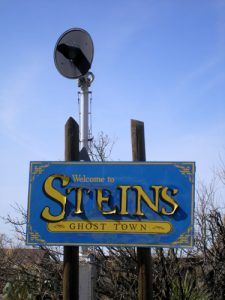
Steins, New Mexico Sign by Kathy Alexander.
In 1878, the Southern Pacific Railroad began blasting away at the area’s rock bluffs, developing a quarry and removing tons of rock for a new railroad bed. During this time, some 1,000 Chinese railroad workers lived at the foot of Steins Peak.
By 1880, the railway was completed through the area, and the railroad established a station near what would become the town of Steins at Steins Pass. For more than a decade, the area was dotted with little more than ramshackle cabins and prospector tents, though Beck’s Camp sported a store and a hotel, with buckboard service to the Southern Pacific Station. A Post Office was established at Steins Pass to serve the area in January 1888.
On December 9, 1897, the mining camps were bursting with excitement when the Southern Pacific Sunset Limited was held up at Steins Pass by the Black Jack Ketchum Gang. In the robbery attempt, a trainman named Edward Cullen was killed, and the bandits could escape; however, they made off with no money.
There has been confusion over whether a Stage Station for Butterfield’s Overland Mail Company (1858-1861) was located in Steins. According to research by Gerald T. Ahnert, an authority on the history of this famous line, that confusion probably stems from a “Steins Stage Station” at the foot of Stein’s Peak, a few miles from the town. The Overland Mail Company ran through Doubtful Canyon, three and a half miles North of town. To confuse things further, the town of Steins is by Steins Mountain and Steins Pass, not Steins Peak.
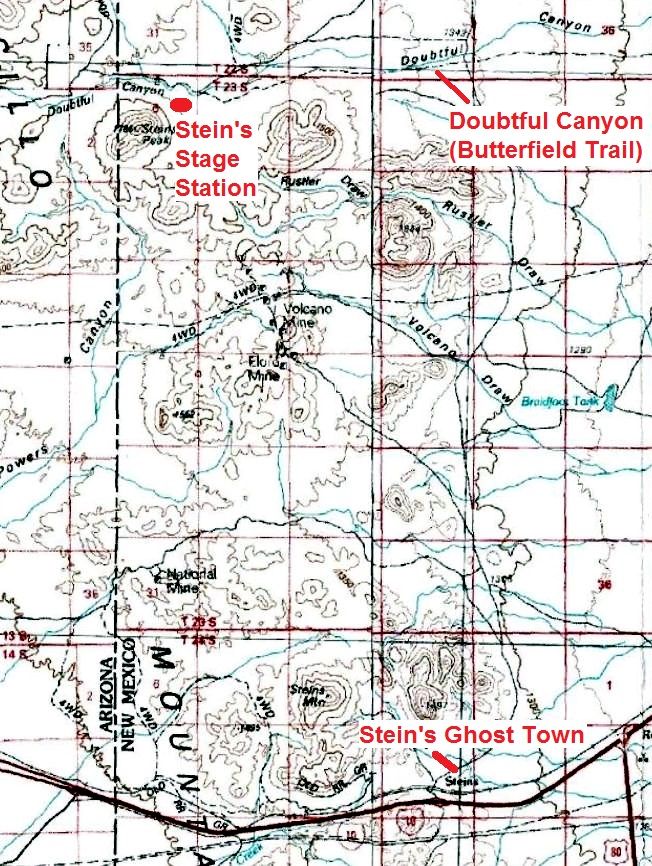
Steins Area Map, Gerald Ahnert
Although there are many government records from 1858 to 1861 published in Senate Documents by the Postmaster General and reports from newspaper correspondents who were passengers on a Butterfield stage that describe the route and stations, one of the best Ahnert recommends is The Butterfield Overland Mail, Only Through Passenger on the First Westbound Stage, by Waterman L. Ormsby, The Huntington Library, San Marino, California. Ormsby was a correspondent for the New York Herald.
It is also alleged that the San Antonio & San Diego Mail Route (a.k.a. the Jackass Mail or Birch Stage), operated by James E. Birch, also had a station at the same location where Steins would develop. However, it also ran through Doubtful Canyon North of town starting in July 1857, and for a brief time during Overland Mail service in 1858, it had no station in the area.
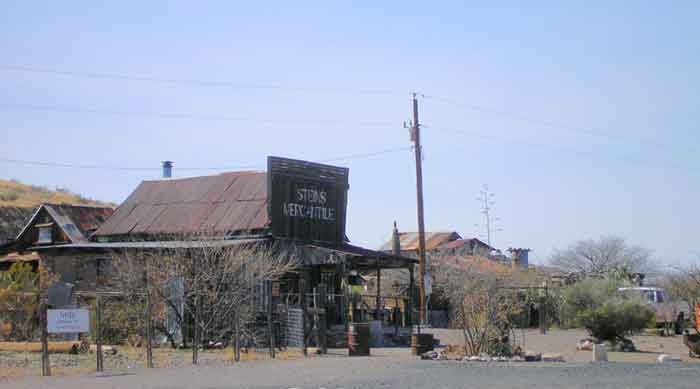
Steins, New Mexico Mercantile, by Kathy Alexander, February 2015.
In 1902, the area around the town of Steins had only 35 registered voters but still had a schoolhouse for the children. A couple of years later, the Southern Pacific Railroad built a new station East of the older one at Steins Pass, and the town of Steins grew fast around it, with the post office moving there in 1905.
By 1905, the settlement boasted about 100 people, a mercantile store, a restaurant, and a saloon. Acting as a headquarters for a few mining companies, the town grew to about 200, most of whom worked in the nearby mines or in the rock quarry.
At its high point in 1919, the surrounding area is estimated to have supported more than 1,000 residents. By this time, the town also had a boarding house, two bordellos, a dance hall, more stores, two more saloons, and a hotel. But for those early pioneers, life was tough in the desert region, as there was no water source, and it had to be brought in by train, selling for as much as $1.00 per barrel.
For Steins (pronounced ‘steens’ by some), prosperity would be short-lived. In 1925, the rock quarry closed, putting dozens of men out of work, and at the end of World War II, the Southern Pacific Railroad discontinued its stop in Steins, giving the town notice that it would no longer deliver water and the station would be closed.
Spelling certain death for the town, the railway offered residents free transportation wherever they wanted to go. Most inhabitants took the offer, leaving many possessions behind. In time, Steins was completely abandoned. The post office was discontinued in 1944. In 1964, a fire destroyed many of the historic deserted buildings.
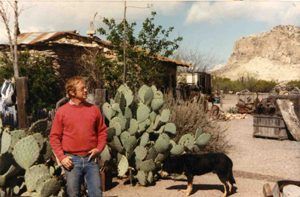
Warren Garrison after arriving to rebuild Steins, NM
Around 1976, a man named Warren Garrison says he took on the task to “rebuild” Steins after his parents purchased the land. About his experience in the 1970s, Garrison wrote:
‘I remember the very first morning I stayed there, a man came up and sat down in the window. “Good morning; how you doing?” and I was waking up. “So what’s going on? What are you doing here?” I said, “Well, I’ve always wanted to do something here, and I guess this is it.” He laughed, gave me $5, said he’d check on me again someday when he passed through, and left. That was the first bit of encouragement that I got from anyone. During that first night, a rattler had crawled into the room, and my little dog Spooky had barked and tipped me off; kinda scary, but I got up, and I do remember having a flashlight, so I got it and put it in a big barrel that was there at Steins’.
Garrison says that over the next 13 years, he worked many days at nearby Shakespeare for Manny and Janaloo Hough to earn money to support his renovation project, building a following for the Ghost Town along the way. He tells us that after a while, he had three to four hundred visitors a week coming in to experience the “Old West” realism he had created.
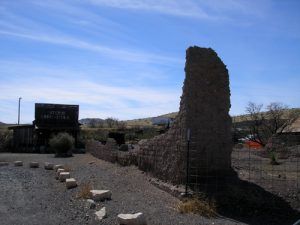
Steins, New Mexico by Kathy Alexander.
In 1988, Garrison decided to sell the place to Larry and Linda Link, and says the Links have since managed to write him out of Steins history. Indeed, while researching this article, some describe Garrison not by name but only as “a mysterious fellow who lived there alone.” Despite the feud between Garrison and the Links, Steins continued to host tourists until the Links retired in 2008, then continued tours by appointment for a few more years.
In June of 2011, Larry Link was murdered, a crime that, as of this writing, is still unsolved. Link was shot five times by an unknown assailant who left an untraceable gun behind. Police think it was a break-in gone wrong that potentially involved drug cartels, but Pamela Link, Larry’s daughter, told ABC Television affiliate KVIA in May of 2015 that she thinks it was someone local who knew him.
In June 2013, family members announced they would no longer open the ghost town to the public regularly. We noted in 2016 that a family member has tried to revive the tours and, though he doesn’t open it to the public regularly, takes appointments.
The community includes several adobe ruins and about ten restored buildings, including a tack shop, a community kitchen, and “Girdie’s Garter.” Nearby is an old cemetery dotted with a few worn and weathered tombstones.
Though many of its residents are gone, Southern Pacific locomotives still pass through daily, whistling as a reminder of a more prominent time.
Steins is 19 miles West of Lordsburg, New Mexico, just off I-10 at Exit #3, just East of the Arizona–New Mexico border.
©Kathy Alexander, Dave Alexander, with additional information/edits from Gerald T. Ahnert, Warren Garrison, updated October 2026.
Additional sources:
Ghost Towns and Mining Camps of New Mexico, James E. Sherman, Barbara Sherman, the University of Oklahoma Press, 1975
Also See:
Shakespeare, New Mexico – Born Again and Again