
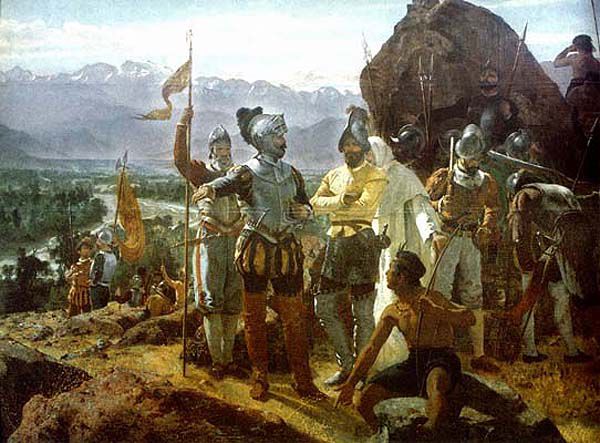
Spanish Conquistadors.
Since the first Spanish colony, San Juan de los Caballeros, was established at the San Juan Pueblo (now called Ohkay Owingeh) in 1598, New Mexico has been a Franciscan enclave dedicated to converting the region’s Native Americans to Christianity. Conquistador Juan de Oñate named the Pueblo San Juan de los Caballeros after his patron saint, John the Baptist.
Juan de Oñate and his men forced the Native Americans from their homes and soon established the capital of the new Spanish colony of New Mexico across the river at another pueblo called Yunque, naming it San Gabriel de Yunque. Oñate then became the governor of the new province. The Spaniards cut windows and doors into the blank adobe walls of the first-floor rooms and changed the Pueblo to fit their European standards. Almost immediately, soldiers began raiding nearby pueblos, taking anything of value.
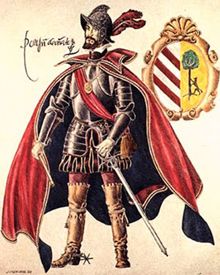
Juan de Oñate.
Oñate’s primary purpose in colonizing New Mexico was to discover gold and silver, but the missionaries who traveled with him were determined to Christianize the Native Americans. In the decades that followed, the Pueblo Indians suffered under an oppressive Spanish rule in which they were forced to labor, required to pay demanding taxes on goods, and their religious activities were suppressed.
The Acoma tribe was the first to rebel. In December 1598, a party of Spanish soldiers seeking food arrived at Acoma. Initially, they were welcomed and treated friendly until the soldiers turned aggressive and began to demand grain from the Acoma storehouses, which was needed for the tribe to survive the Winter. Provoking a furious reaction, the Acoma attacked the soldiers, killing 13 of them, including their commander, Juan de Zaldivar, who was a nephew of Juan de Oñate.
In response, Oñate resolved to make an example of Acoma and dispatched 70 of his best men, under the command of Vicente de Zaldivar, to attack the Acoma Pueblo. On January 21, 1599, the Spanish troops came into view of the Pueblo, and the tribe fanned out from their village to guard the mesa’s edge. As the Spaniards drew closer, the defenders unleashed a barrage of rocks and arrows. Despite the defensive barrage coming from atop the mesa, the soldiers fought their way to the top over the next three days. During the battle, the Spaniards brought a small cannon up the back of the mesa and began firing into the village. The battle then became a massacre, and when it was over, as many as 800 Acoma people died, and their Pueblo was in ruins. Oñate was later tried, convicted of cruelty to Indians and colonists, and was banished from New Mexico. However, he appealed the ruling and was later cleared of all charges. He lived out the rest of his life in Spain. A later governor, Pedro de Peralta, established Santa Fe in 1609 as the seat of government. Peralta built the Palace of the Governors in 1610.
The Acoma rebellion was not forgotten, and tensions increased between the Spanish and the Pueblo Indians as the Spanish continued to demand food, clothing, and labor. Additionally, the Spanish attempted to prohibit their traditional religion and disrupted their economy. The Franciscans also found the Pueblo people increasingly unwilling to consent to baptism, despite the number of missions they founded.
For the next several decades, most of the Puebloans lived in relative peace with the Spanish, primarily due to the Spanish’s protection against Navajo and Apache raiding parties. However, some repeatedly rebelled against the better-armed and better-organized Spaniards, but these uprisings were quickly suppressed.
In the 1670s, drought swept the region, causing famine among the pueblos and provoking increased attacks from neighboring nomadic tribes. Because of the number of attacks, Spanish soldiers could not always defend the pueblos. At the same time, European-introduced diseases ravaged the pueblos and significantly reduced their populations. Becoming increasingly dissatisfied with the Spanish, the Puebloans turned to their old religions, provoking a wave of repression from the Franciscan missionaries. While the missionaries had previously tended to ignore the occasional pueblo ceremonies as long as the people made some effort to attend Mass, the Puebloans’ renewed vigor towards their religions caused the Fray Alonso de Posada to forbid Kachina dances by the Pueblo Indians and ordered the missionaries to seize every mask, prayer stick, and effigy they could lay their hands on and burn them.
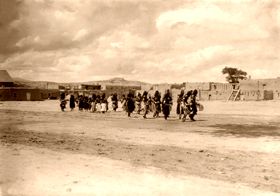
Tewa Dancers, Edward S. Curtis, 1905
Furthermore, the Indians were forbidden, on pain of death, to practice their native religions. When some Spanish officials tried to curb the Franciscans’ power, they were charged with heresy and tried before the Inquisition.
In 1675, the tension came to a head when Governor Juan Francisco Treviño ordered the arrest of 47 medicine men and accused them of practicing witchcraft. Four men were sentenced to be hanged – three of those sentences were carried out, while the fourth prisoner committed suicide. The remaining men were publicly whipped and sentenced to prison.
When this news reached the Pueblo leaders, they moved in force to Santa Fe, where the prisoners were held. Because many Spanish soldiers were away fighting the Apache, Governor Treviño released the prisoners. Among those released was a medicine man from the San Juan Pueblo (now known as Ohkay Owingeh) named Popé, who would soon become the leader of the Pueblo Rebellion. Popé then moved to Taos Pueblo and began plotting with men from other pueblos to drive out the Spaniards.
Before long, a well-coordinated effort of several pueblo villages was established in August 1680. Throughout the upper Rio Grande basin, North of El Paso to Taos, the Tewa, Tiwa, Hopi, Zuni, and other Keresan-speaking pueblos, and even the non-pueblo Apache, planned to rise against the Spanish simultaneously.
The attack was planned for August 11, 1680, but the Spaniards learned of the revolt after capturing two Tesuque Pueblo youths carrying messages to the pueblos. Popé then ordered the execution of the plot on August 10 before the uprising could be put down. The intent was to kill the missionaries, destroy the pueblo churches, and kill any settlers who refused to leave their lands.
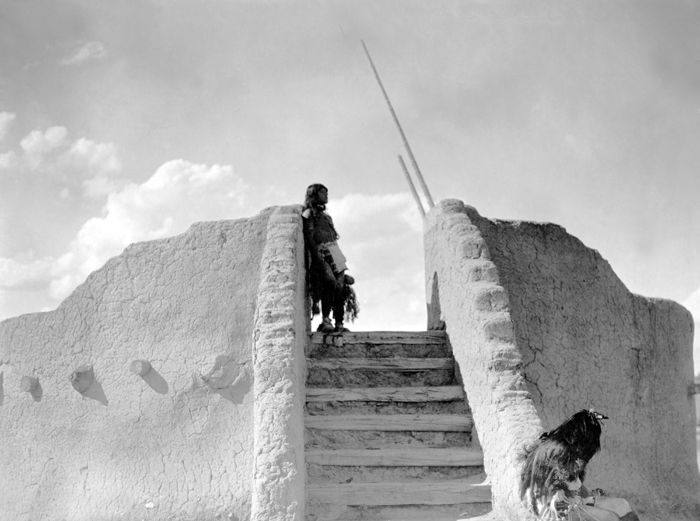
Tewa Indian guard at the top of the kiva stairs, San Ildefonso Pueblo, by Edward S. Curtis, 1905
On August 10, 1680, the attack was commenced by the Taos, Picuri, and Tewa Indians in their respective pueblos. The warriors killed 21 of the province’s 40 Franciscans and another 380 Spaniards, including men, women, and children. The Spaniards, who could escape, fled to Santa Fe and the Isleta Pueblo, one of the few pueblos that did not participate in the rebellion. Popé’s warriors, armed with Spanish weapons, then besieged Santa Fe, surrounding the city and cutting off its water supply. Barricaded in the Governor’s Palace, New Mexico Governor Antonio de Otermín soon called for a general retreat. On August 21, the remaining 3,000 Spanish settlers streamed out of the capital city and headed for El Paso, Texas. Believing themselves the only survivors, the refugees at the Isleta Pueblo also left for El Paso in September. In the meantime, the Pueblo people destroyed most of the homes and buildings of the Spanish.
The Pueblo Revolt effectively ended Spanish rule in New Mexico for the next 12 years. However, not everything was as the Puebloans had hoped. The expulsion of the Spanish did not bring peace and prosperity to the pueblos. Returning to their traditional religion did not bring rain to ease the drought. With the Spaniards gone, the Apache and Navajo stepped up their raids. Additionally, the Spaniards’ retreat left New Mexico under the pueblos’ control. However, the diverse pueblo tribes, separated by hundreds of miles and eight different languages, quarreled about who would occupy Santa Fe and rule over the country.
Popé, who had led the rebellion, set himself up as leader but was not as effective in that role. He attempted to destroy every trace of the Spanish presence in New Mexico. “The God of the Christians is dead,” he proclaimed. “He was made of rotten wood.” The pueblo villages were divided, and many resented Popé and considered him a tyrant. Many who had converted to Christianity opposed the destruction of Christian relics. Opposition to Spanish rule gave the pueblos an incentive to unite, but not the means to remain united once their common enemy was defeated. These power struggles, with raids from nomadic tribes, Spanish attempts to reconquer, and a seven-year drought, weakened the Pueblo resolve and set the stage for a Spanish reconquest.
A Spanish force of 300 men attempted to regain a foothold in New Mexico in 1681 but was repelled by Popé’s warrior army. Another Spanish effort in 1687 also failed. The following year, Popé died, with the pueblos divided and weak.
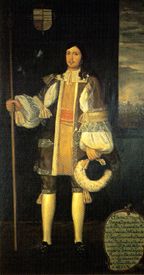
Governor Diego de Vargas.
In July 1692, Governor Diego de Vargas began a successful military and political reconquest with an army of 150 Spanish soldiers and pro-Spanish Pueblo warriors. Indian leaders gathered in Santa Fe to meet with Vargas and agreed to peace. On September 14, 1692, Vargas proclaimed a formal act of repossession. Vargas wisely promised pardon rather than punishment, and most pueblos gradually acceded to Spanish rule. Only the Hopi, living in distant Arizona, retained their independence.
Though the 1692 peace agreement was bloodless, Vargas maintained increasingly strict control over the Puebloans in the years that followed. During his absence from Santa Fe in 1693, the Puebloans retook the city. Vargas and his forces staged a quick and bloody recapture that concluded with 70 executions and 400 Puebloans sentenced to ten years’ servitude.
In 1696, warriors of 14 pueblos attempted a second organized revolt, killing five missionaries and 34 settlers. Vargas’ retribution was unmerciful, thorough, and prolonged. By the end of the century, the Spanish reconquest was essentially complete.
©Kathy Alexander/Legends of America, updated October 2026.
Also See:
Acoma Pueblo – Ancient Sky City
Ancient & Modern Pueblos – Oldest Cities in the U.S.
See Sources.