
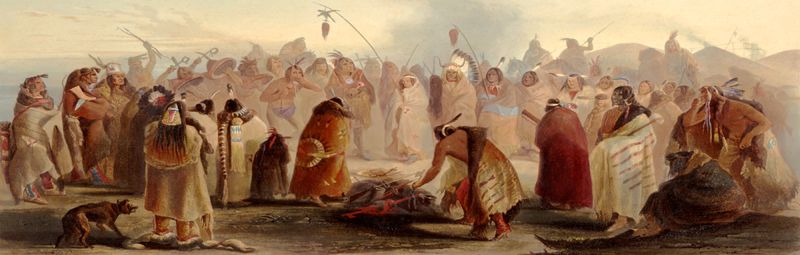
Hidatsa Dance by Karl Bodmer, about 1840.
The Hidatsa are a Siouan tribe known to whites since the first contact in the vicinity of the junction of the Knife and Missouri Rivers in North Dakota.
Although they have a long-standing connection with the Mandan and Arikara, their language is closely akin to that of the Crow, with whom they claim to have been united before the historic period. At this time, the two tribes separated over a dispute over the division of game. The Crow then drew off farther to the west.
The name Hidatsa has been said, with doubtful authority, to mean “willows” and is stated to have been originally the name only of a principal village of the tribe in their old home on Knife River. It probably came to be used as the tribe’s name after the smallpox epidemic of 1837 and the consolidation of survivors from the three villages.
By the Mandan, they are known as Minitarí, signifying “they crossed the water,” traditionally said to refer to their having crossed the Missouri River from the east.
The Sioux call them Hewaktokto, said to mean ”dwellers on a ridge,” but more probably signifying “spreading tipis,” or “tipis in a row,” the name by which they are known to the Cheyenne and Arapaho. The Crow called them Amashi, “earth lodges,” and at the turn of the century, they were officially known as Gros Ventre, a name also applied to the Atsina, a detached tribe of the Arapaho.
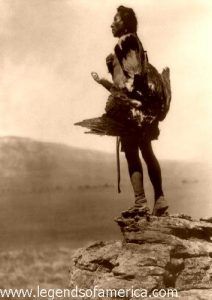
Eagle Catcher, Hidatsa.
According to their own tradition, the Hidatsa came from the neighborhood of a lake northeast of their later home, identified by some of their traditionalists as Mini-Wakan, or Devils Lake, in North Dakota. There, they had the circular earth-covered log house, which was also used by the Mandan, Arikara, and other tribes living close along the upper Missouri River, in addition to the skin tipi occupied when on the hunt. After repeated attacks by the Sioux, they moved southwest and allied themselves with the Mandan, who then lived on the west side of the Missouri River, near the mouth of the Heart River. The three tribes, Hidatsa, Mandan, and Arikara, lived in this vicinity about 1765. From the Mandan, the Hidatsa learned agriculture.
Sometime before 1796, these two tribes moved up the river to the vicinity of Knife River, where they were found by Lewis and Clark in 1804, the Hidatsa being then in three villages immediately on the Knife River, while the Mandan, in two villages, were a few miles lower down, on the Missouri River. The largest of the tribe’s three villages was called Hidatsa and was on the north bank of the Knife River. The other two, Amatiha and Amahami, or Mahaha, were on the south side. The last-named was occupied by the Amahami (Ahnahaway of Lewis and Clark), formerly a distinct but closely related tribe. As a consequence of the inroads of the Sioux, the Amahami had been so far reduced that they were compelled to unite with the Hidatsa and have long since been completely absorbed.
The three villages together had a population of about 600 warriors and about 2,100 members in total. Of these, the Amahami counted about 50 warriors. There was no change in the location of the villages until after the terrible smallpox epidemic of 1837, which so greatly reduced the Indian population of the upper Missouri River that the survivors of the three villages consolidated into one.
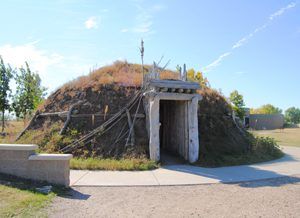
Hidatsa Lodge, Knife River, North Dakota, by Kathy Alexander.
In 1845, the Hidatsa and the remaining Mandan moved up the river and established themselves in a new village close to the trading post of Fort Berthold on the north bank of the Missouri River.
In 1862, the Arikara moved up to the same location, and the three tribes occupied a reservation on the northeast side of the Missouri River, including the village site. In 1905, the Hidatsa were officially reported to number only 471.
Early writers described the Hidatsa as somewhat superior intellectually and physically to their neighbors, although this was less evident in later days. In home life, religious beliefs and customs, house building, agriculture, the use of the skin boat, and general arts, they closely resembled the Mandan with whom they were associated.
Their great ceremony was the Sun Dance, called by them Da-hpi-ke, which was accompanied by various forms of torture. Their warriors were organized into several military societies, as is the case with the Plains tribes generally.
Today, the Hidatsa are a part of the Mandan, Hidatsa, and Arikara Nation, located in New Town, North Dakota.
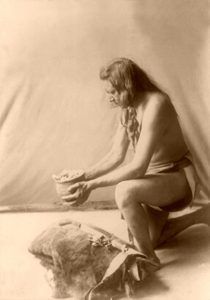
Hidatsa Medicine Man by Edward S. Curtis, 1908.
Contact Information:
Mandan, Hidatsa & Arikara Nation
404 Frontage Road
New Town, North Dakota 58763
701-627-4781
Compiled and edited by Kathy Alexander/Legends of America, updated April 2026.
Also See:
Native American Heroes and Leaders
Native American Photo Galleries
Native Americans – First Owners of America
Primary Source: Handbook of American Indians by Frederick Webb Hodge, 1906.