
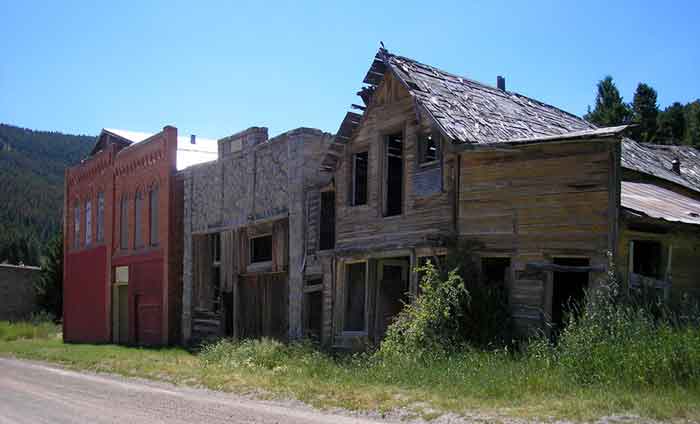
Marysville, Montana, 2008: from left to right, the Marysville Masonic Lodge, built in 1898; the J.A. Shaffer Mercantile, built in 1895; and the Lush Confectionary Store by Kathy Alexander.
Sitting just four miles below the Continental Divide and some 25 miles northwest of Helena, Montana, is the once-thriving mining camp of Marysville. The settlement started when Irishman Tommy Cruse discovered a rich vein of gold on Silver Creek in 1876. A placer miner who had been working downstream, Tommy continued upstream, hoping to find the mother lode, and lo and behold, he was the lucky man to find it.
Dead broke, Cruse had to borrow money to work his claim, but eventually developed the Drumlummon Mine. Almost immediately, he recovered more than $140,000 in ore from the mine.
Within a short time of Cruse’s find, word spread of the rich gold vein, and miners began to flood the area.
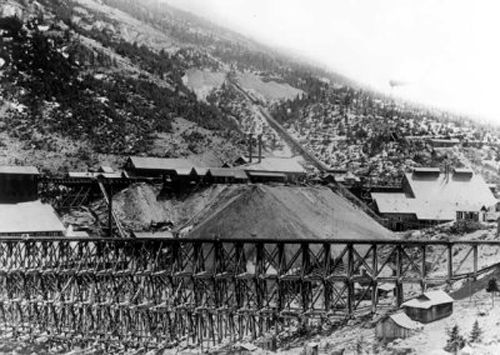
Historic Marysville Train Trestle and Mine.
Cruse named the new mining camp Marysville for its first female resident, Mary Ralston. The mine was named for the parish in Ireland where Cruse was born. In 1880, Cruse built a five-stamp mill near the Drumlummon Mine. The following year, the Marysville Post Office opened in February 1881, and by then the small settlement was flourishing with numerous businesses.
In 1884, Cruse sold the Drumlummon Mine to an English Corporation for one million dollars in cash and another ½ million in stock. He then moved to Helena, where he built a mansion, started a couple of banks, and at the age of 50, married a young woman. However, a year later, his new bride died in childbirth, and Cruse became restless. He soon returned to the Marysville area and bought the Bald Mountain Mine on Bald Butte above the town, which produced hundreds of thousands of dollars in gold, silver, copper, and lead ore over the years.
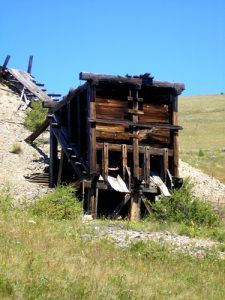
Old mining remnants and cabins dot the hillsides in and around Marysville, by Kathy Alexander.
Within two years of selling the Drumlummon Mine, the English company built 110 stamp mills to process the ore. During the 1880s and 1890s, Marysville boomed, with the Drumlummon Mine and 12 additional mines in the area. The town soon boasted some 60 businesses, including 27 saloons, seven hotels, three newspapers, grocery and drug stores, a bank, a dry-goods store, a bakery, three churches, two doctors, and numerous other businesses. At that time, the mining camp was served by two railroads, mining operations ran 24 hours a day, and the area supported as many as 4,000 people. A school was later built that accommodated over 250 children.
Marysville was also a very social community during its heyday, with numerous local activities, including ice cream socials, garden parties, concerts by the Marysville Brass Band, and drilling contests, in which the miners would compete to see who could work the drill into huge boulders of hard rock the fastest. Miners worldwide competed in these contests, vying for the World’s Drilling Record. One such event in the Marysville area was said to have drawn over a thousand spectators.
Unfortunately, at the turn of the century, the rich ores were becoming depleted; the mine was involved in a lawsuit with the nearby St. Louis Mining Company over boundary rights, production slowed, and people began to move from Marysville.
To make matters worse, the town suffered a devastating fire in 1909 that destroyed several buildings. However, the town persevered and rebuilt.
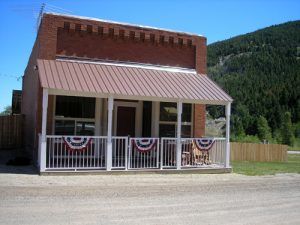
This building was constructed after the 1909 fire and originally served as the Nels Lund Saloon. During the 1940’s it operated as a grocery store by Kathy Alexander.
In the meantime, the lawsuit was finally settled, and the St. Louis Mining Company bought out the Drumlummon Mine in 1911. Though it continued to be worked until 1948, Marysville was dying.
By the 1950’s, many of the homes had been moved to other areas, while others stood silent and abandoned to the elements, and over the last half-century, nature has taken its toll.
Though the amount of ore taken from the Drumlummon and other area mines varies, estimates put the total at some $50 million.
Today, Marysville is a sidewalk of history, with numerous old buildings dotting the landscape and its historic (though unkempt) cemetery. The old graveyard has just a few visible headstones left, but it includes several graves from a mining disaster at the nearby Belmont Mine in 1891.
Several buildings remain in town, including the 1895 J.A. Shaffer Mercantile, the Masonic Lodge, Nels Lund Saloon, the 1886 Methodist Church, the schoolhouse, and many more. The hillsides are dotted with cabins and mining remains.
But changes have been coming to Marysville in the last several years. It has slowly progressed into a bedroom community of Helena and a summer destination for many who have rehabilitated existing buildings and built brand-new homes.
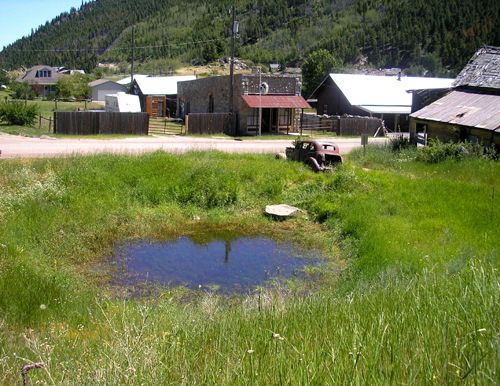
Marysville, Montana – Looking down on Main Street from a hill on the West. The pond is where the old railroad turntable was located. Photo by Kathy Alexander.
Marysville was due for more change: the high price of gold in the late 2000s led to the reopening of the Drumlummon Mine; however, in the summer of 2013, after the price dropped from its peak, the mine stopped operations.
Though Marysville has slowly moved into the 21st century, its old legends and tales persist. According to the lore of this old mining camp, numerous strange events occur in the area. Locals say that several unearthly spirits, including some dreadful tales, haunt Marysville and the surrounding area.
Near Marysville, an unexplainable hunter, who is riding a bicycle and appears severely mangled, has been seen pulling a dead wolf. Nearby, a headless woman has been spotted atop Bald Butte. Another not-so-welcome guest has been spied in American Gulch. This gentleman is said to be an old miner with a big mustache and a hook-right hand. Another probable miner, who also appears headless, has been seen near 1 Spring.
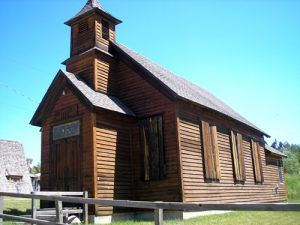
Built in 1886, the Methodist Church was utilized for services until 1939. Today it has been fully restored by its owner, Kathy Alexander.
Ghosts or no ghosts, the community of Marysville is a wonderful stop for ghost town enthusiasts.
To get to Marysville from Helena, travel North on I-15 for about 9 miles, then turn left (West) at exit 200 onto Lincoln road/CR-279/CR-453 for about 10 miles, then left again at Marysville Road for about six miles.
©Kathy Alexander/Legends of America, updated August 2026.
Be sure to read “Off the Grid – Our Friend Albert,” about Albert Hall, who lives nearby.
Also See:
Butte to Marysville (Legends’ old Travel Blog)
Ghost Towns & Mining Camps of Montana
See Sources.