
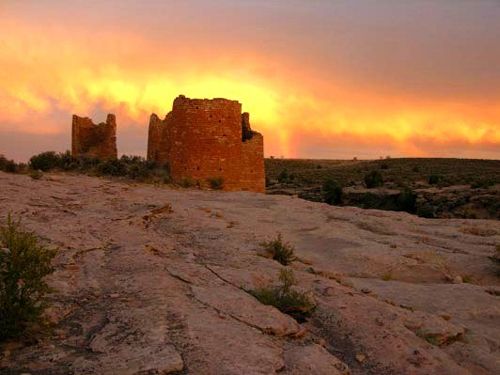
Hovenweep National Monument.
Protecting six prehistoric Pueblo villages in a 20-mile expanse of mesa tops along the Colorado–Utah border, Hovenweep National Monument is noted for its solitude and undeveloped, natural character. The name Hovenweep was bestowed on the region by explorer and photographer William Jackson in 1874. It is a Ute Indian word meaning “deserted valley,” referring to numerous small river valleys that feed into lower McElmo Creek and the San Juan River.
Proclaimed as a National Monument on March 2, 1923, by President Warren G. Harding, four Pueblo villages are located in Colorado, including Holly Canyon, Hackberry Canyon, Cutthroat Castle, and Goodman Point.
Two additional sets of ruins are in Utah: Cajon and Square Tower, where the monument headquarters are located. At the headquarters is a visitor center that provides interpretive programs, maps, guides, and a campground.
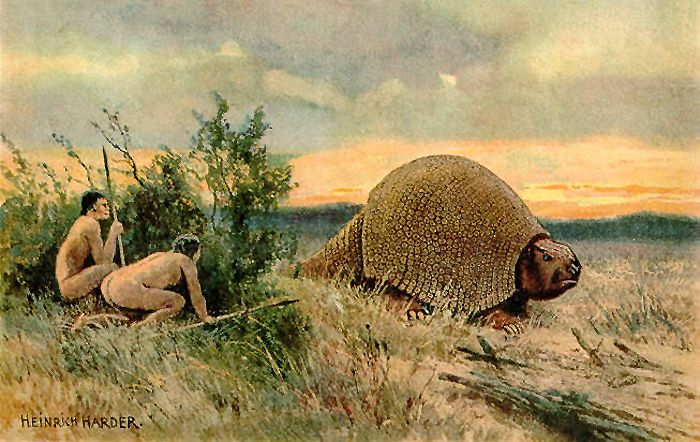
Paleo Indians by Heinrich Harder, 1919.
The area surrounding ancient ruins was first inhabited by nomadic Paleo-Indians as early as 14,000 years ago. Gathering food and hunting game, they roamed the area for centuries. Around 900 A.D., these early peoples began to settle more permanently, adopting an agricultural way of life. At that time, archaeologists believed the soil was rich on the mesa tops due to more moderate temperatures and higher rainfall than is observed today.
Around the same time, the ancestral Puebloans (Anasazi) began migrating from the Four Corners region to the Hovenweep region, bringing their advanced construction skills. These Ancient Puebloans built the first pueblos and masonry towers at Hovenweep between 1200 and 1300 A.D. As the population grew, the Paleo-Indians soon began building larger, fortress-like towers at the heads of box canyons.
Successful in dry farming, ancient peoples cultivated domesticated crops such as maize, beans, and squash in terraced fields. They also constructed catch basins to retain water and built check dams to retain soil that would otherwise erode. They diverted water to edible wild plants, including beeweed, ground cherry, sedges, milkweed, cattail, and wolfberry.
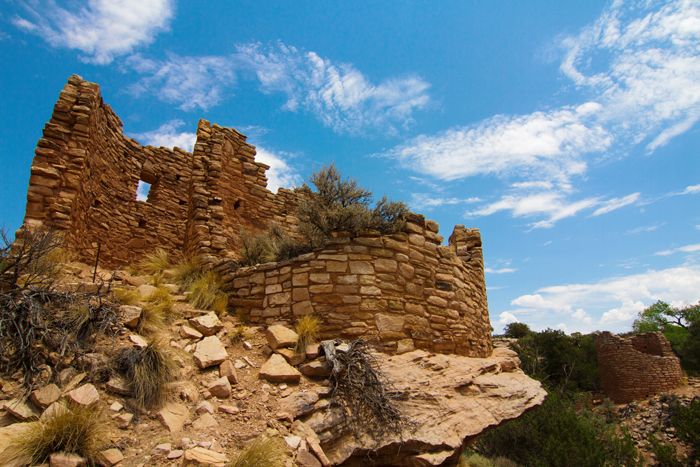
Cutthroat Castle at Hovenweep National Monument in Colorado by the National Park Service.
The population grew steadily; by the 1200s, the Hovenweep area was home to over 2,500 people. However, by the end of the thirteenth century, the people of Hovenweep and other nearby ancient cities, such as Mesa Verde and Kayenta, had been entirely abandoned. Several theories have been proposed to explain the Ancient Puebloans’ departure, including drought, overpopulation, disease, and warfare. Although the reason is unclear, ancestral Puebloans throughout the region migrated south to the Rio Grande Valley in New Mexico and the Little Colorado River Basin in Arizona. Today’s Pueblo, Zuni, and Hopi people are descendants of this culture.
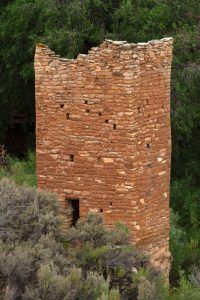
Hovenweep Square Tower, Utah, National Park Service.
The Hovenweep National Monument, encompassing some 785 acres, provides a historic view of dozens of ancient ruins, including square and circular towers, cliff dwellings, kivas, and pueblos. The masonry style and architecture at Hovenweep are skillful, with careful attention given to detail, indicating that the inhabitants of Hovenweep were closely associated with groups living at Mesa Verde and other nearby sites.
Many theories have attempted to explain the use of the structures at Hovenweep, most often the numerous towers. Although their exact purpose remains uncertain, archaeologists hypothesize that they may have served as celestial observatories, defensive structures, storage facilities, civic buildings, homes, or combinations of these. While most towers are often associated with kivas, their actual function remains unclear.
White settlers discovered the Hovenweep structures in 1854, more than 30 years before the more famous cliff dwellings at nearby Mesa Verde. The first sighting was recorded on an expedition of Mormon colonists led by W.D. Huntington.
During 1917-18, J. Walter Fewkes of the Smithsonian Institution included descriptions of the ruins in published archaeological survey reports and recommended their protection.
The six major Hovenweep site groups are located within a 20-mile drive of each other along the Utah-Colorado border. These units vary significantly in size, with the largest being the 400-acre Square Tower Group. This group, which includes the Ranger Station and the Cajon Ruins, is located in Utah. The Colorado sites are Holly Ruins, Hackberry Canyon, Cutthroat Castle, and Goodman Point.
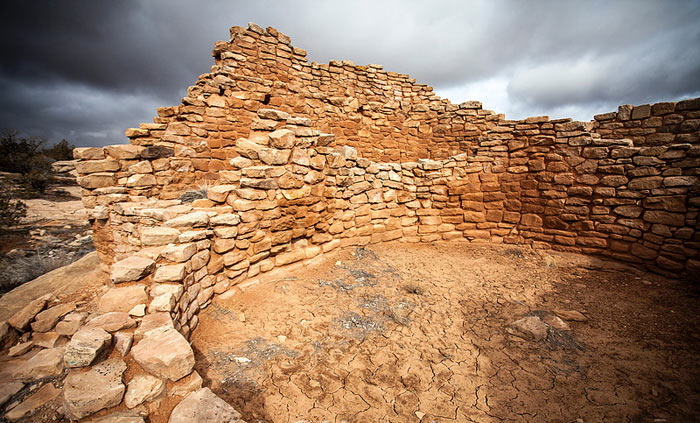
Horseshoe Ruin, Hovenweep. Photo by National Park Service.
Today, visitors to Hovenweep enjoy short hikes, natural quiet, and some of the finest examples of ancestral Puebloan architecture in the southwest. The trail system provides access to all cultural site units. All units are open to the public; however, most are located in remote areas and can be difficult to access. The Square Tower Group is the primary contact facility with a visitor center, campground, and interpretive trail.
More Information:
Hovenweep National Monument
McElmo Route
Cortez, Colorado 81321
970-562-4282
©Kathy Alexander/Legends of America, updated December 2025.
Also See:
Ancient & Modern Pueblos – Oldest Cities in the U.S.
National Parks, Monuments & Historic Sites
Native Americans – First Owners of America
See Sources.