
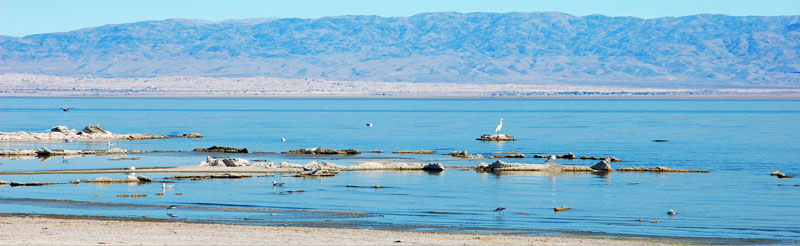
The West Side of the Salton Sea by Kathy Alexander.
The Salton Sea, the largest lake in the state, is situated in the Sonoran Desert in southeastern California. The Salton Basin has held various bodies of water over the last three million years as the Colorado River changed course and spilled over, filling it with freshwater lakes that eventually evaporated. Then, the process would start all over again.
One of these long-ago lakes in known history was Lake Cahuilla, which formed around 700 A.D. and was utilized extensively by the Cahuilla and the Kumeyaay Indians for freshwater fishing, bird hunting, and marsh plants. The ancient lake gradually occupied the basin until about three centuries ago.
By the time European explorers came to the area in the 16th century, the Salton Basin was completely dry, though just half a century earlier it had been about 26 times larger than the current Salton Sea.
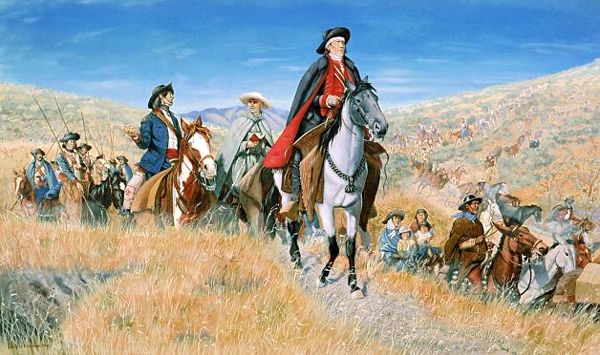
De Anza Expedition.
Over the decades, the lake continued to rise and fall until the last large infilling occurred in the early 1700s. However, when Don Juan Bautista de Anza led the first large European party through what is now known as the Imperial Valley, the Salton Basin was a salt-encrusted mudflat. In the 1800s, the Colorado River flooded the basin several times, creating several lakes that came and went.
Salt mining began in the area as early as 1815, and when the railroad came through the basin, large-scale salt mining started in 1884. The dry lakebed began to be called the Salton Sink or the Salton Basin.
In the late 19th century, the California Development Company and its ambitious president, Charles R. Rockwood, determined to make the Imperial Valley an agricultural oasis in the desert. A series of canals was constructed in 1900 to allow for irrigation. For a few years, the river flowed peacefully, regulated by a wooden headgate, and watered the fields of fruits and vegetables. However, the flowing waters contained large amounts of silt, which soon blocked the headgate. To correct this problem, the California Development Company cut a new channel a few miles South of the Mexican border. Unregulated by U.S. authorities, the new channel crossed an unstable river delta. When the Colorado River began to peak due to heavy rainfall and snowmelt in the summer of 1905, the dike broke, and the Salton Basin began to fill at an alarming rate.
For two years, the Colorado River flooded the Salton Sink, destroying the town of Salton and the Southern Pacific Railroad siding. Having substantial business interests in the region, the railroad spent about $3,000,000 to stop the river’s flow into the Salton Sink, finally succeeding in 1907. However, a “new” lake, called the Salton Sea, was created.
The large sea, surrounded by desert terrain, was a natural site for fishermen. Still, without an outlet, the sea became increasingly saline as freshwater was pumped out of the lake for irrigation. When the water returned via runoff, it carried dissolved salts from the soil, pesticides, and fertilizer residues. As salinity increased, the freshwater fish died. Over the years, officials began experimenting with bringing in various species of saltwater fish, including salmon, halibut, bonefish, clams, oysters, and more. Unfortunately, these fish also died due to the high saline level.
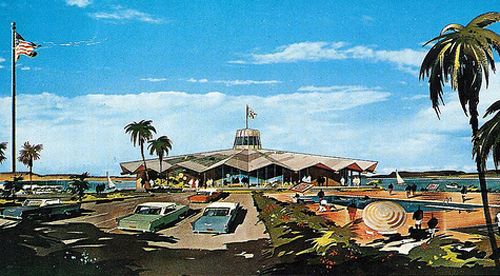
Salton Bay Yacht Club.
However, in the early 1950s, certain species survived, including gulf croaker, sargo, orange corvine, and tilapia. As the fish began to thrive, it fueled a recreation boom in the 1950s, and the inland desert sea became an inviting sport-fishing and vacation destination. Its coastline developed numerous resorts and marinas catering to water skiers, boaters, and fishermen in no time. Billed as “Palm Springs-by-the-Sea,” restaurants, shops, and nightclubs also sprang up along the shores. The lake enjoyed immense popularity, especially among the rich and famous, as movie stars and recording artists flocked to the area. From Dean Martin to Jerry Lewis, Frank Sinatra, and the Beach Boys, the lake became a speedboat playground.
However, the Salton Sea’s bright lights quickly faded in the 1970s as its water level rose due to several years of heavy rains and increased agricultural drainage. Shorefront homes, businesses, resorts, and marinas flooded several times until the water stabilized in 1980 after a series of conservation measures to reduce field runoff. However, for the many resort areas, it was too late. The salt and fertilizers in the runoff had accumulated to toxic levels, triggering a cycle of decay. As algae fed on the toxins, it created massive amounts of rotten-smelling matter floating on the lake’s surface, suffocating many fish.
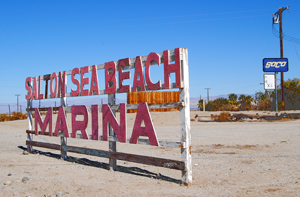
Salton Sea Beach & Marina sign by Kathy Alexander.
Within just a few years, the resorts had closed, the marinas were abandoned, and those who could afford to have moved, leaving in their wake abandoned businesses and homes and scattered junk.
Today, the Salton Sea continues to be maintained by the Alamo, Whitewater, and New Rivers, as well as agricultural runoff from irrigated farmland. It is the largest lake in California, covering an average surface area of about 375 square miles.
But the lake is still in trouble. The salt in the Salton Sea is higher than that of the Pacific Ocean, and numerous restoration plans have been developed. The latest of these proposes reducing the lake’s size to make it more manageable, but it will cost billions of dollars and take more than two decades to complete.
The lake is dotted with “signs” of more prosperous times, and the area is much like a “ghost lake,” surrounded by small “ghost towns,” “ghost resorts,” and “ghost trailer parks.”
Towns:
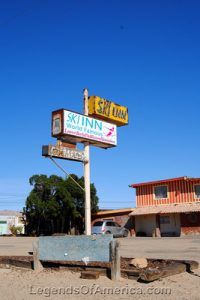
Ski Inn, Bombay Beach, California, by Kathy Alexander.
Bombay Beach – Located on the East shore of the Salton Sea, Bombay Beach was developed by R.E. Gilliagan in October 1929 as a private community that quickly grew with weekend visitors and retirees. By the 1960s, the town sported numerous businesses and homes. However, the next decade would take its toll on the community as tropical storms and flooding destroyed parts of the town. Though this permanently affected Bombay’s development, the small town still supports 350 people and a few open businesses in a sunken trailer park and abandoned buildings. A dike now protects the small community’s Western portion, just South of the Salton Sea State Park. It is one of the lowest-elevation communities in the U.S., sitting about 225 feet below sea level.
Desert Shores – This small community still supports more than 1000 people and has grown over the last several years. However, signs of its resort community heydays can still be seen in a few abandoned businesses and fading billboards. One of the many communities that developed during the sea’s heydays in the 1950s, the city was bustling in the 1960s with the Desert Shores Yacht Club, Marina Mobile Estates, a five-fingered marina, a fishing barge just offshore, and numerous businesses. However, in the 1970s, the town was battered by tropical storms, and the rising sea level flooded many shoreline resorts and homes. Desert Shores is located just North of Salton Sea Beach on the West side of the sea East of S.H. 86.
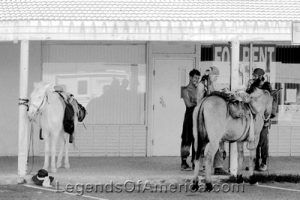
Niland, California Horses, by Kathy Alexander.
Niland – Another small town on the lake, Niland was once known as the “Tomato Capital of the World.” Though not the agricultural center that it once was, it still sports an annual Tomato Festival, which has been held for over 60 years. Like neighboring towns, it also developed into a fishing and hunting paradise during the Salton Sea’s heydays in the 1950s and 60s. It is still home to about 1,000 people, many of whom work at the nearby Calipatria Prison. Salvation Mountain is another quirky addition just outside town, a colorful artificial religious folk-art mountain that draws numerous visitors annually.
North Shore – Ray Ryan and Trav Rogers developed North Shore in 1958 as yet another resort on the Salton Sea coastline. In 1960, they began selling lots and building the area’s crown jewels: the North Shore Beach, Yacht Club, and North Shore Motel.
The $2 million Marine Paradise opened in 1962 to much fanfare and was described as one of Southern California’s largest marinas. Catering to the rich and famous, the resort soon claimed visitors such as Jerry Lewis, the Marx Brothers, and the Beach Boys, who were frequent visitors or kept boats at the marina.
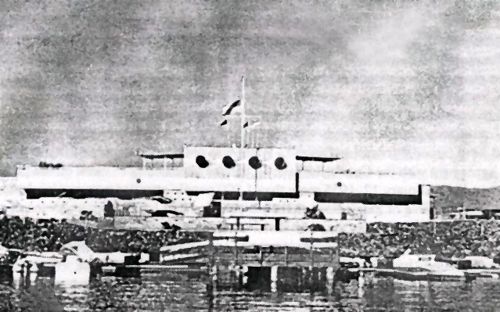
North Shore Beach, Salton Sea, California.
The marina was a hotspot, mainly when it featured speedboat races, parties, and dances that drew hundreds of visitors. However, like most resorts on the Salton Sea, the resort faced problems due to fluctuating water levels and flooding in the 1970s. However, the yacht club hung on until 1981, when it suffered a severe flood that destroyed the jetty and marina, making it impossible for boats to dock there. The famous club was later closed and used as a rehab center, then a nursing home. However, the once-glamorous resort is entirely abandoned today. People live in homes that dot the hills above the water, but North Shore’s heydays are long gone. However, North Shore is still notable as the home of the Salton Sea National Wildlife Refuge and one of California’s greatest bird-watching areas. Established in 1930, the refuge covers several thousand acres. North Shore is accessible via State Route 111, and the wildlife refuge and campground are just a short distance South of the town.
Salton City – The most ambitious Salton Sea development, Salton City, was established in the late 1950s by M. Penn Phillips and the Holly Corporation, shortly after Phillips had successfully developed the high-desert community of Hesperia. The development plan called for 25,000 lots, 250 miles of paved roads, swimming pools, churches, parks, a golf course, and a $500,000 luxury yacht club and hotel. Opening in 1958, the development was an immediate success, with busloads of people brought in to view it. By 1964, some $20 million had been spent developing the community, and about 15,000 lots had been sold. A yacht club was soon built, and motels, restaurants, a championship golf course, an airport, and other amenities followed. Its brochures touted the “Miracle Salton City by the Desert Sea” as Southern California’s most famous sea resort. For a time, sailing regattas, powerboat races, Hawaiian luaus, fishing tournaments, and derbies attracted thousands, including the rich and famous, such as Frank Sinatra, Dwight Eisenhower, and Desi Arnaz.

Lots for sale at Salton Sea, California, Kathy Alexander.
However, though numerous lots were sold, few homes were built, as most people seemingly purchased the lots for investment purposes. And when the lake began to flood and the saline levels started killing off the fish, Salton City’s plans were doomed. Today, the yacht club is closed, many businesses stand abandoned, and empty streets lined with dying palm trees feature hundreds of lots for sale but no homes. Though it’s nowhere near its intended vision, the small town still boasts a population of about 1,000 and several open businesses. “New” California developers and home builders also work hard to attract new residents. Salton City is located on State Highway 86 on the West side of the Salton Sea.
In addition to the many ghostly relics in the area, the Salton Sea State Recreation Area still offers active fishing. The area also offers camping, picnicking, and boating. Additionally, the Salton Sea National Wildlife Refuge is a birdwatcher’s paradise, with more than 375 bird species, many of which are endangered. The Salton Sea is located about 30 miles South of Indio, California, on Highway 111.
Contact Information:
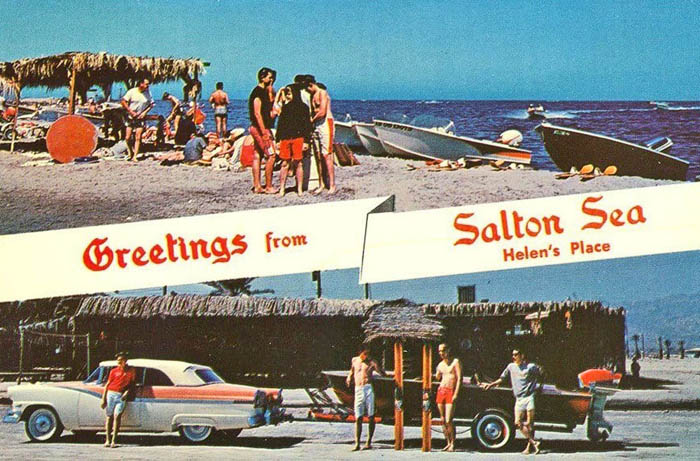
The Salton Sea 1950s Postcard.
Salton Sea State Recreation Area
100-225 State Park Road
North Shore, California 92254
760-393-3052
©Kathy Alexander/Legends of America, updated August 2025.
Also See:
Salvation Mountain – A Tribute to God
See Sources.