
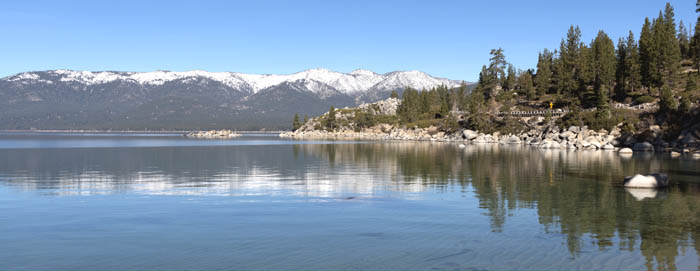
Lake Tahoe, California, by Carol Highsmith.
Located along the border of California and Nevada, Lake Tahoe has a rich and diverse cultural heritage spanning thousands of years. The Lake Tahoe Basin was formed by vertical motion faulting, creating the Carson Range on the east and the Sierra Nevada Mountains on the west some 2-3 million years ago. Snow, rain, and streams filled the southern and lowest part of the basin, forming the ancestral Lake Tahoe. Modern Lake Tahoe was shaped and landscaped by the scouring glaciers during the Ice Age, a million or more years ago.
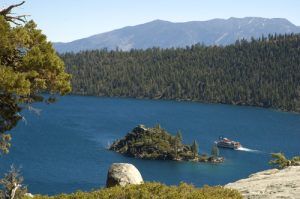
Lake Tahoe by Debbie Warner.
Much remains to be learned about the first peoples who utilized the Lake Tahoe Basin as many as 8,000 to 10,000 years ago. However, in later years, the archaeological record becomes clearer. At the time of first European contact, the Washoe Tribe and their ancestors had called the resource-rich Lake Tahoe and the surrounding land of approximately 10,000 square miles home for at least 2,000 years. Washoe’s existence at the lake centers around fishing camps and milling sites in lush meadows within view of the lake and along permanent streams.
Linguists think the Washoe origins are earlier than any other Sierran or Great Basin Indian cultures. The Washoe language is unique and unrelated to those spoken by any neighboring tribes. Washoe tradition holds that their homeland has always included Lake Tahoe, without reference to migrations from other worlds, as is common in other cultures. The Washoe were the first to name Lake Tahoe simply “the Lake.” Da ow ga, the Washoe word for “lake,” is considered the source for “Tahoe.”
Scores of prehistoric and ethnographic Washoe sites have been identified around the lake’s shores and in higher-elevation use areas. Todsome 1500 enrolled members of the Washoe Tribe of Nevada and California live in “Colonies,” tribal lands scattered in the Reno, Carson Valley, and Gardnerville areas of Nevada and Woodfords, California. An active tribal government continues to lobby for a land base in the Lake Tahoe basin. It works with federal and state agencies and private landowners to protect locations important to Washoe Heritage.
There are several sites in the Lake Tahoe vicinity where visitors can learn more about the Washoe tribe.
- Lam Watah Washoe Heritage Site – This small archaeological site managed by the U.S. Forest Service includes many boulders with depressions where women prepared food for their families during the summer and processed dried food for the winter. It is set in a meadow along a one-mile hike to Nevada Beach. The trailhead is located on the corner of U.S. Highway 50 and Kahle Drive, just north of the casino area in Stateline, Nevada. There is another Washoe Indian Pounding Rock located in the middle of South Shore near Trout Creek.
- Baldwin Museum – The Washoe exhibit, created by the tribe, is housed in the Baldwin Estate portion of the Tallac Historic Site, a National Register District managed by the U.S. Forest Service. It is located approximately four miles west of the junction of California State Highway 89 and U.S. Highway 50 along the south shore of Lake Tahoe.
- GateKeepers Museum – This museum features a magnificent collection of baskets from many California Indian groups, including Washoe basketry. It is located at 130 West Lake Boulevard in Tahoe City, on the north shore, south of the bridge at the Truckee River.
- Carson Valley Museum and Cultural Center – This museum includes a permanent Washoe exhibit designed and installed by the tribe. This exhibit features dramatic murals by different artists depicting four aspects of Washoe’s heritage. The museum is in the old Douglas County high school, 1477 Highway 395 in Gardnerville.
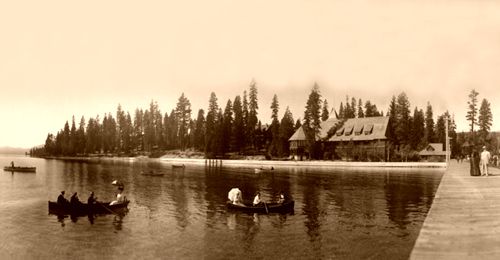
Lake Tahoe, California, 1908, George R. Lawrence.
In 1844, pioneers began settling throughout the Tahoe Basin and establishing claims on the land. In 1849, during the California Gold Rush, more settlers came along, opened roadhouses, and staked out ranches and farms. The first major disruption to the Washoe way of life at the lake came in 1859, when a large silver lode was discovered in Virginia City, Nevada. Before long, the Lake Tahoe Basin rapidly became the victim of massive-scale resource extraction. The forests of the entire basin were virtually clear-cut between 1860 and 1890 to fuel mining operations, shore up the mine tunnels, and build the rapidly growing Virginia City. Once the land had been stripped of its natural forestation, entrepreneurs snapped up the land cheaply and began building hotels and mansions for the wealthy.
In the early 1900s, serious efforts were made to designate Lake Tahoe as a National Park. These efforts failed because the area had been ravaged and lacked the “untouched” qualities necessary for National Park status.
With the advent of the automobile and improved roadways, Tahoe lost its exclusivity as the influx of the general population increased. After World War II, campgrounds and inexpensive hotels sprouted up and were very popular during the post-war growth period.
About one-third of the Tahoe Basin is in Nevada, and two-thirds is in California. Most terrain is mountainous, limiting development to relatively flat-lying areas along tributary streams. Major recreational activities within the basin include casino gaming in Nevada, alpine and cross-country skiing, golfing, water sports, hiking, fishing, camping, and bicycling.
Lake Tahoe is the second-deepest lake in the United States and the tenth-deepest in the world, with a maximum depth of 1,645 feet.
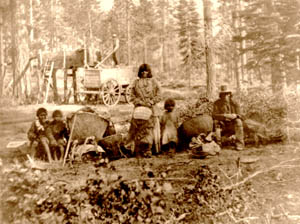
Washoe Indians at Lake Tahoe by Lawrence & Houseworth, 1866.
©Compiled and edited by Kathy Alexander/Legends of America, updated March 2026.
Also See:
Sources: