
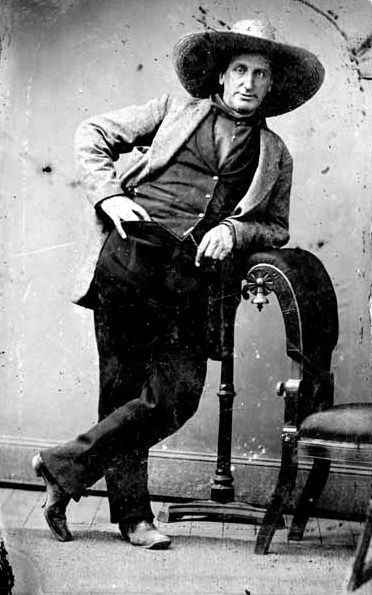
Jack Langrishe.
A native of New York, Jack (John) S. Langrishe, an actor, impresario, and production manager, operated various theatres for some 17 years before arriving in Deadwood, South Dakota, in 1876.
From 1859 through the early 1860s, the Langrishe-Allen St. Joseph Theatre Company played to Missouri and Kansas audiences in St. Joseph, Missouri, and Topeka and Junction City, Kansas. Enacting productions such as Ten Nights in a Bar Room, Toodles, Lady of Lyons, Hamlet, Ingomar the Barbarian, Uncle Tom’s Cabin, and Othello, the troupe fine-tuned these and other plays before appearing in Deadwood.
Langrishe and his wife, Jenette, an actress and impresario, moved West in the early 1860s. They operated the Colorado Denver Theatre, along with partner Mike J. Dougherty, from 1862 to 1876.
The original two-story theatre opened in November 1861 on the northeast corner of 16th and Lawrence Streets as the Platte Valley Theater. After its success, Langrishe and Dougherty bought the building in August 1862, made immediate improvements, and reopened it as the Denver Theater.
The theatre, which seated about 1000 people, was a huge success. Ever the opportunist, Langrishe ensured the “business” made money even when there were no performances. The performances took place on the second story, while the first floor was reserved for a saloon and gambling hall. Here, the frontiersmen enjoyed various games, including Faro, poker, roulette, monte, and chuck-a-luck, 24 hours a day, seven days a week.
In the late 1860s, Langrishe was ready to move on again, and the theatre was leased. The theatre was renamed the Denver Opera House, but only for a couple of weeks before the name reverted to the Denver Theatre. Unfortunately, a fire destroyed the building in March 1877.
Meanwhile, Langrishe and his troupe performed in many of the West’s mining towns. In 1870, they built the Langrishe Opera House in Helena, Montana, which operated until 1874, when fire consumed it.
They returned briefly to Denver before traveling again to Deadwood in July 1876. He was well-seasoned and wasted no time establishing a theatre in the thriving boomtown. Upon arrival, the Langrishe troupe performed briefly at the Bella Union before building their own theater. Late in 1876, the Deadwood Theatre, often called the McDaniels Theatre for the builder or the Langrishe Theatre, was completed. It was here that the trial of Jack McCall, Wild Bill Hickok’s killer, was first held.
Exchanging stage performances for gold dust, the nightly performances played to a packed house, delighting Deadwood audiences with the latest Broadway hits, many of which were running concurrently in New York and London. At other times, when no performance was being staged, the new theatre building was often used for trials, receptions for distinguished visitors, funeral services, and dances. Though other “entertainment” existed in Deadwood when the Langrishe Troupe arrived, Langrishe’s theater was the only one in which any respectable lady would set foot.
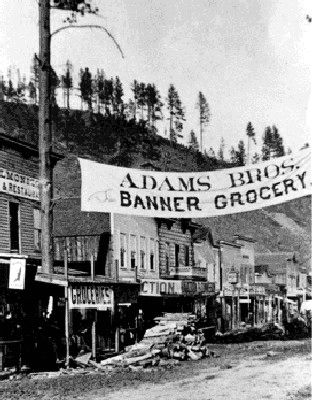
Bella Union Theater, Deadwood, South Dakota.
The theatre was so successful that by 1878, Jack Langrishe moved it to a larger building on Sherman Street in South Deadwood. Its most famous star was Fanny Price, but the theatre also featured other well-known names, such as Charlotte Cushman, Jim and Belle Gilbert, Augusta Chambers, Viola Porter, and more.
However, like many mining towns, the success did not last, as in early 1879 many miners began moving from Deadwood to the next big mining strike in Leadville, Colorado. The Langrishe Theatre’s last production in Deadwood was Our American Cousin on August 14, 1879. After the miners, the Langrishe Company moved to Leadville, where they performed the first show at the brand-new Tabor Opera House on November 20, 1879, and continued performances through the end of the year.
Meanwhile, the devastating Deadwood fire on September 26, 1879, destroyed the Langrishe Theatre in Deadwood.
Later, Langrishe returned West, where he was elected justice in Coeur d’Alene, Idaho, in 1886 and managed the Wardner News in 1891.
Jack Langrishe died in Wardner, Idaho, on December 12, 1895.
©Kathy Alexander/Legends of America, updated September 2026.
Also See:
 Calamity Jane – Rowdy Woman of the West
Al Swearengen & the Notorious Gem Theater
Calamity Jane – Rowdy Woman of the West
HBO’s Deadwood – Facts & Fiction
Wild Bill Hickok & The Dead Man’s Hand
See Sources.